
An evergreen reference answering common questions about the meaning, observance and traditions of Diwali, including worship, diyas, Amavasya, Yama Deep Daan, oil bathing, rangoli, family customs and related practices.
Diwali, a.k.a Deepavali is a major Indian festival spread over five days that is very significant in Hinduism known as the “Festival of Lights,” it symbolizes the victory of good over evil, and lamps (diyas) are lit as a sign of celebration and hope for human kind. Many have requested us to compile a FAQ article like the one on Pitar Paksha. We hope that this article will answer many of your questions. These are some of the questions that many have emailed me.
What Is the Meaning of Diwali
Diwali, a.k.a Deepavali is a major Indian festival spread over five days that is very significant in Hinduism known as the “Festival of Lights,” it symbolizes the victory of good over evil, and lamps (diyas) are lit as a sign of celebration and hope for humankind. “Regardless of the explanations one prefers, what the festival of lights really stands for today is a reaffirmation of hope, a renewed commitment to friendship and goodwill, and a religiously sanctioned celebration of the simple — and some not so simple — joys of life.”
How Does One Observe or Celebrate Diwali
After you have taken an oil bath early in the morning and wearing clean clothes proceed to your prayer place and offer incense, lamp and flowers (all seven times in a clockwise around the picture of Shree SitaRaam. After that all the food that has been prepared should be offered first to Shree SitaRaam. Leave the unoffered food before Their Lordships to bless and after about ten minutes remove from the prayer place and then that prashad (blessed food) is for all to eat. As this is a day of celebrations, many will have very elaborate breakfasts and lunches and meet family and friends. Many distribute sweets and cakes and the like to their friends and family.
In the evening, lamps are again lit and Mother Lakshmi is worshipped and offered special dishes. On Diwali Amavasya, many Hindu’s will offer food and tarpana (offerings of water and sesame seeds) to their ancestors. This information is procured from the Garuda Purana. Like Christmas in the West, Diwali is very much a time for buying and exchanging gifts.
How Long Does Diwali Last
Deepavali is traditionally celebrated over a period of five days. One should know that one is free to observe Diwali on any of the five days depending on which of the significance one attaches to it, or one may observe all five days.
Why Is Amavasya During Deepavali Considered Auspicious
Generally Amavasya is considered inauspicious, but the Amavasya that occurs in the Dipavali period is extremely beneficial and prosperity bestowing. During Deepavali the worship of Mother Lakshmi is highly recommended. The subtle effects of the Lakshmi puja positively affects both the husband and wife. When the husband and wife remember and worship Lakshmi devi with spiritual emotion, a spiral of spiritual emotion and positive vibrations are generated in both of them. A flow of positive energy is attracted in the image of Lakshmi Devi and its spiral is thus generated. Through the spiral the flows of positive Energy are emitted in the environment.
These flows of positive Energy are emitted towards the worshipper also and its spiral is generated in him/her. Particles of positive Energy is then spread in the body of the worshipper and the immediate environment. A flow of Bliss is attracted at the venue of worship. Through this flow a spiral of Bliss is created and the positive vibrations of Bliss spread in the environment.
Why Is Diwali Called the Festival of Lights
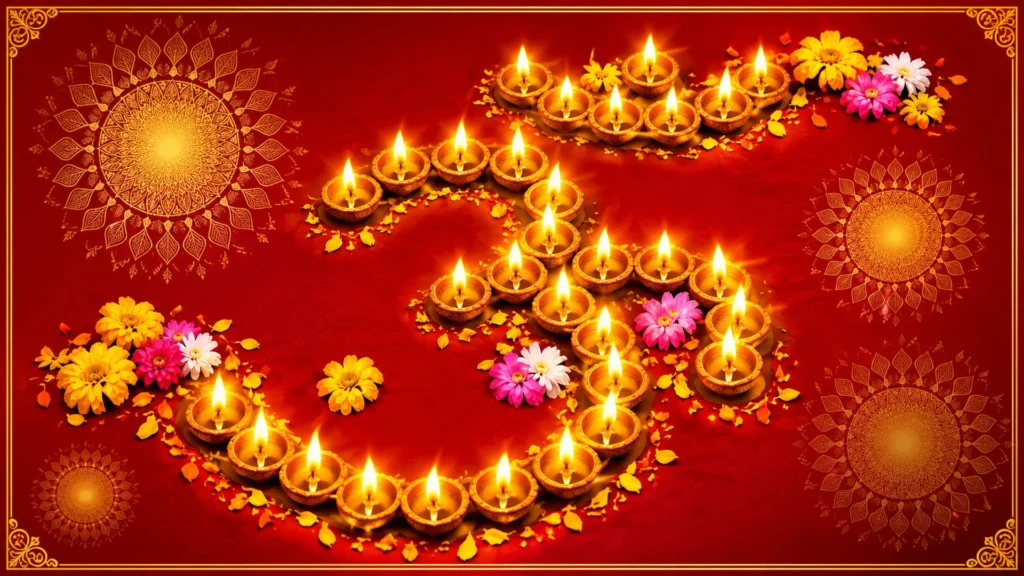
The Deepavali lights represent the time when Shree Raam returned from the forest after His exile, and all in Ayodhya lit lamps to welcome their most beloved Lord back home after fourteen years. Many do believe that when the lamps are lit this helps Mother Lakshmi find her way into people’s homes. Celebrations focus on lights and lamps, particularly traditional dipa or deeya (earthen lamp).
Can Meat Be Eaten During Diwali
No, not at all. This shouldn’t be an issue as humans are meant to be vegetarian.
Is This a Good Time for New Ventures
Yes there are no scripture injunctions saying that new ventures cannot be started in this period. However new ventures should always commence when the moon is waxing.
Why Is Yama Deep Daan Lit Before Diwali
Dhanteras is also known as Yama deepdaan and lamps are kept burning through the night in reverential adoration to Lord Yamaraj (the Lord Of Death) and prayers offered to him to keep away death and despair. A very interesting Katha/story about this day is attached to the sixteen year old son of King Hima. As per his janmakundali (birth horoscope) he was doomed to die by a snakebite on the fourth day of his marriage. On that fateful fourth day of his marriage his young wife did not allow him to sleep. She laid all the ornaments and lots of gold and silver coins in a big heap at the entrance of her husband’s palatial room and lighted infinite numbers of lamps all over the place.
After all these, she went on telling stories and singing songs so that her husband is not able to sleep. When Shree Yamaraj, arrived there appearing in form of a Serpent his eyes got blinded by the dazzle of those brilliant lights and he could not enter the Prince’s chamber. So he climbed on top of the heap of the ornaments and coins and sat there whole night listening to the melodious songs. In the morning he quietly went away. Thus the young wife saved her husband from the clutches of death. Since then this day of Dhanteras came to be known as the day of “Yama deepadaan” and lamps are kept burning throughout the night in remembering Lord Yamaraj, the presiding deity of Death.
Thirteen lamps made of wheat flour or clay lamps and lit with oil are placed outside the house, facing southwards (the direction of Lord Yamaraja’s abode), in the evening. A lamp is never kept facing southwards except on this day. Then, reciting the following mantra one should offer obeisance: “I offer these thirteen lamps to the son (Lord Yama) of the Sun deity (Surya), so that He liberates me from the clutches of death and bestows His blessings upon me.”
Can Diwali Be Celebrated After a Death in the Family
Many are under the belief that because the deceased is still travelling for a year that out of respect they don’t perform any prayers. This can’t be further from the truth. After 12th /13th days puja you can perform prayers. Life carries on and prayers should not stop after a person expires. Actually the more prayers you perform the better it is for the deceased. But let’s just rewind a bit and see what our shastras (Garuda Purana) say. In the previous ages the Sapindidaan Puja was performed one year after death of a person. Now the thing with the sapindi puja is that until this prayer is performed you cannot do practically anything. You are stuck basically at home.
You cannot go to prayers, weddings, you yourself cannot perform any prayers at home etc. but in this age of Kali the Sapindi Puja is performed on the 12 th 13th day. Thus after this prayers is performed, normal pujas are resumed. So you can read from the above that maybe this is where the whole story that you cannot do anything for year stems from. Sometimes I do feel that this is an excuse not to perform any prayers for a year. If this is the case then they must not have any salt food for the year, they must not consume nonsattwic foods for the year and not do anything in that one year. Now this changes everything doesn’t it.
Try to tell a Hindu stay away from nonsattwic foods for a year and that will cause a raucous. So Diwali should be celebrated even if there is a death in the family.
Which Other Religions Observe Diwali
Just Hinduism, Sikhism, and Jainism that I am aware of but I am sure that other religions have an offshoot version of this celebration.
How Does One Light the First Diya
Light the first lamp one at your prayer place and pray to Mother Lakshmi and then from this one light the other lamps.
Who Is Worshipped During Diwali
This is a time when Shree SitaRaam returned from exile. Thus many worship Shree Sita Raam but you can worship any form that you consider attracted to. But also many perform Lakshmi Puja and Kali Puja on this day. Do note when I say Kali puja this does not mean sacrificing of a goat or rooster, but rather Halwa Puri offerings are offered to Mother Kali. Since the 14th and 15th is Amavasya, many will offer food and tarpana (offerings of water and sesame seeds) to their ancestors just as one does in Pitar Paksha. This is from the Garuda Purana.
What Is the Purpose of the Diwali Oil Bath
Oil baths stems from the Ayurvedic Shastras hence beneficial in so many positive ways. Abhyanga is the Sanskrit Ayurvedic term for an oil massage which is an integral part of the daily routine recommended by this healing system for overall health and wellbeing. An oil bath will leave you feeling profoundly relaxed – mentally and physically. Oil applied to the skin is warming, moistening, nourishing, and soothing – everything that Vatta in one’s body needs to be balanced. Sesame oil is the most penetrating and nourishing of all the oils which makes it ideal for pacifying dry Vatta in/on one’s body. Sesame Oil is warming as well, another characteristic that pacifies Vatta.
While Vatta is cold and dry, Kapha is cold and wet, so for Kapha a warm, spicy oil that stimulates lymphatic drainage like mustard oil is often used. If mustard is unavailable, one can use a spicy olive oil or a lighter oil like sunflower. Pitta on the other hand is fiery and hot, so coconut oil and even diluted neem oil are used in oil bath for Pitta dominant types.
Match the Oil to your Dosha: • Vata: Sesame, Almond, Olive (but not a spicy variety) – dry skin, drier in cold weather, dry type psoriasis or eczema and painful joints. • Pitta: Coconut, Neem – red, hot skin, easily irritated skin, oily skin, headaches from hot sun. • Kapha: Mustard, Olive (prefers a spicy variety), Sunflower – cool, moist skin, large boned, slow, easy going and gains weight easily. The article advises using a combination of Til (Sesame), Coconut and Mustard oils. So it’s not uncommon that the tradition of taking a oil bath during Naraka Chaturdashi and Diwali mornings is still continued to be observe up to today. This ritual is known as Tel Snaana (oil bath).
Symbolically oil baths on Narak Chaturdashi and Deepavali suggest new beginning – removing the negativities viz the ego, anger, fights, pride and jealousy of the previous year and a fresh new beginning. So this is a physical cleansing of the body and a spiritual cleansing of the mind with new hope ritual. Lord Krishna after killing the mighty demon Narakasura took an oil bath to get rid of the blood spattered on His body. The ritual of cleansing of the body also is symbolic of removing all dirt, evil and inauspicious things before the arrival of Srimati Lakshmidevi on the following day of Diwali. The oil bath thus has a symbolic meaning – a new beginning after washing away all dirt.
Traditions mentions that those who perform the oil bath on Naraka Chaturdashi and Diwali will be blessed with prosperity, progeny and wealth. Celebrations begin before dawn with the ritualistic oil bath. While taking an oil bath seems to be a Diwali tradition, it’s by no means restricted to just this festival. In most Indian homes, the oil bath is a weekly affair. How to Take an Oil Bath: Ensure that the bathroom is as dry as possible. Ensure that body is dry. Now apply the 3 kinds of oils (which you have selected from the list above) on your scalp and the length of the hair (if you have hair). Now apply the mixed oils all over your body.
Massage the oils gently until it is absorbed thoroughly. Wait for 5 minutes. Now you may also apply a thin layer of the besan paste (gram flour) all over your body. Stand still while it dries and thereafter wash off the rest of the oil and besan using just warm/hot water. Do not use soap or body wash. The benefits of taking oil bath: It clears oily substances from the skin of total body and facilitate the same to transfer heat from its inside to outside. By giving healthy cold to our body we can have good appetite and feeling of taste. Healthy cold prevailing in our body prevents many diseases like jaundice, cancer and other viral diseases.
We can get healthy, deep sleep and good concentration in our daily activities. Side effects of severe diet control can be cleared by this good healthy habit. Skin and hair health can be maintained as it removes surface tension on the body. It is very economical and also required once in a week.
Was Shree Raam Exiled for Fourteen Years
Yes this is correct. This is confirmed in the Ramayan. For the full katha do read the Ramayan. To download the Valmiki Ramayan please visit this website… http://www.valmikiramayan.net/
May Havan Be Performed During Diwali
Yes this is most auspicious but also offering food and water to one’s ancestors is most auspicious as confirmed by the Garuda Purana.
What Is the Procedure Regarding Measles and Diwali
www.dipika.org.za compiled a very detailed 12 pages article on “Measles Its Significance in Hinduism” kindly CtrlClick (HERE) to follow this article link on DIPIKA. So yes one can celebrate Diwali but unfortunately going out gifting parceled gifts and the like should be avoided as much as possible as one may have a part of the measles virus on oneself and thus the infection may spread. Frying, et al is definitely NONO. Kindly revert to this article to find out why.
How Many Days Are Observed and What Prayer Is Performed
This information is all attached on this article on Measles. Do remember that having measles is not some kind of death kneel rather it’s a virus that should be prevented more than feared. I pray that what we have mentioned addressed this matter adequately.
Why Are Sweets Cakes and Goodies Shared
This is performed to encourage love, harmony, peacefulness and brother/sisterhood amongst people. Our beautiful culture always encourages us give gifts and the like and keeping up with this tradition we send sweets and the like to our beloved ones.
May the First Diya Be Refilled During the Night
Yes this can be done.
What Is the Meaning of Rangoli
Rangoli is one of the most popular art forms in India. It’s a form of sandpainting decoration that uses finely ground white powder and colours, and is used commonly outside homes in India. Rangoli can be wall art as well as floor art. The term rangoli is derived from words rang (colour) and aavalli (‘coloured creepers’ or ‘row of colours’).
Why Are New Clothes Worn on Diwali
There are lots different traditions and people all have their unique way to celebrate Diwali. Many wear new clothes to signify a new beginning.
What Is the Significance of Fireworks
Fireworks represent the happiness of good defeating evil. It is said that when Lord Rama returned to Ayodhya after 14 years of exile, the people were overjoyed to see Him along with Sita Devi and Lord Lakshman. Since it was a no moon night, people lit up candles and diyas along Lord Rama’s path. Once he reached his abode, there was also dazzling display of lights which lit up the night sky and left everyone mesmerized. Everybody sang, and danced in celebration and welcomed their king with open arms and hearts. Since then, each year that day came to be celebrated as Diwali, and the Diwali lights became its most conspicuous feature.
What Is the Significance of Diwali Kajol for the Eyes
This is a practice that’s performed due to tradition. Traditionally it’s used on the eye and as a dot on the forehead by unmarried girls to keep at bay the “evil eye” but medically kaajal is good for the eye. It’s applied at the margin of eyelids, which stimulates the excretion of the tear and helps in lubricating and opening of duct of lid glands. Kaajal is also used for the attractive appearance of the eye. Kaajal should be use at that place where dusty atmosphere is present.