

An explanatory article on Alakshmi Devi, the elder sister and shadow aspect of Lakshmi Devi, exploring scriptural symbolism, household conduct, Diwali traditions, Sharad Purnima offerings, and the Alakshmi Nissaran practice for removing poverty and misfortune.
In the Durga Paath (a.k.a Chandi Paath/Durga Saptashati) chapter 12 verse 40 states “In times of prosperity Devi Durga is indeed Lakshmi devi, who bestows prosperity in the homes of men, and in times of misfortune she herself becomes the goddess of misfortune (Alakshmi) and brings about ruin” Goddess Alakshmi is the Goddess of misfortune, barrenness and strife. Alakshmi is all that does not stand for Lakshmi devi. You don’t want this goddess visiting you, but you don’t get to make that call either. She comes as a package with Mother Lakshmi, the Vedic Goddess of Wealth and Prosperity. Alakshmi devi is the elder sister of Lakshmi devi and is the Vedic devi of misfortune.
She is also the second wife of Kali, the male demon from the Kalki Purana and the Mahabharata. Do note Kali is not to be confused with Mother Kaali.
The Worship and Acknowledgement of Alakshmi Devi
No-one worships a negative aspect. But one should always acknowledge Alakshmi Devi as she accompanies Lakshmi Devi everywhere. So, one worships Lakshmi Devi for adequate blessing and also to keep away Alakshmi Devi. Praying for greed and abundance is inviting Alakshmi Devi to the doorsteps because wealth has hidden within it the invisible seeds of destroying Lakshmi Devi’s blessings. In Hindu homes, Lakshmi Devi is invited inside by various Lakshmi Devi pujas by having sweet prasada in the prayer room. Whereas lemons and red chilly is kept outside. It is hoped that Alakshmi Devi would feed on that and not enter.
Once a while, both the front door and back doors are kept open so that while Lakshmi Devi is welcomed and stays in for the sweet prasada, Alakshmi Devi is seen off through the back to taste the sour prasada kept outside. These are rituals but one is to use buddhi (intelligence) to know the difference between Lakshmi Devi and Alakshmi Devi.
Mother Saraswati and Alakshmi Devi
So one is to practice cleanliness, discipline, selflessness, and hard work so that Alakshmi Devi does not stay with one for an extended period of time. So one especially needs to worship Mother Saraswati to procure her blessings of jnana, sound knowledge and sound judgment to realize the difference between need and greed. Lakshmi Devi resides with a person as long as that person is worthy of her. Aslo a point of note is that Mother Saraswati herself wards off Alakshmi Devi from other self, Lakshmi Devi. This is in keeping with the concept that wisdom helps to bring restrain and balance in a person. Vedic philosophy is a maze of symbolism and the energy is inward bound.
It makes one think and attain a state of perfection through the evolution of the intellect through higher intelligence.
But one may inquire that the natural order of things would have it that Lakshmi Devi herself is not beyond the holds of Alakshmi Devi. Lakshmi Devi even disappeared from Lord Indra’s abode. The Durvasa Muni had been observing Lord Indra’s indulging in worldly pleasures. He was totally drunk for days on end, immersed in the arms of women with whom he was very generous with. He was given to adultery and forgiven but the next event was just to follow without any remorse. His amusements were of worldly nature. His indulgence with courtesans’ was beyond redemption and he not only ignored the Muni’s arrival but his celestial duties.
This was very unbecoming of a Lord of the Heavens. Therefore Durvasa Muni cursed him. “You do not respect the wealth and power bestowed upon you. May you be deprived of it all. May Lakshmi Devi abandon you.” With such powerful utterance, Lakshmi Devi dissolved herself in the ocean of milk. The three lokas were shattered by the absence of Lakshmi Devi. “Instantly, a pall of gloom descended upon the three worlds: cows stopped giving milk, plants did not bear
flower or fruit.
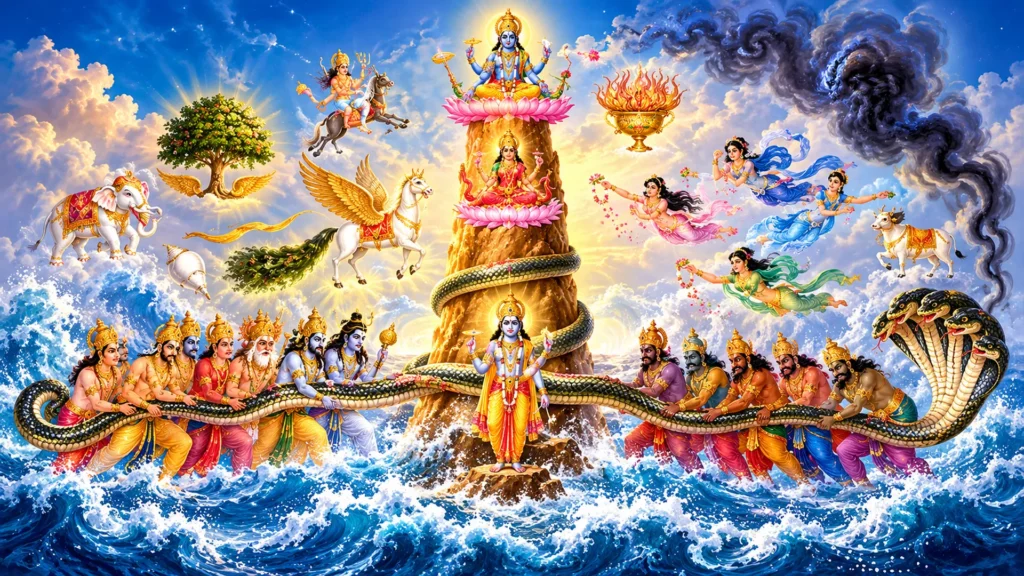
The sun did not shine, gems did not sparkle. There was death and alakshmi throughout the universe.”Lord Vishnu, the Preserver had to act to bring normalcy. Mother Lakshmi was finally churned out of the ocean. The Samudra manthan was an enterprise of cosmic proportions. Both Devas and asuras participated to become a single force and counterforce to churn for thousands of years. Mount Meru served as spindle. Ananta-sesha was the churning rope and the turtle Akupura was the steady base. There is no result without effort, before Mother Lakshmi could be churned out. But with Lakshmi Devi, her shadow Alakshmi also came in the form of halahala poison.
Lord Shiva comes to counter that and swallows the poison and thus takes the name Nilakanta being, blue-throat caused by the poison.
Alakshmi Nissaran Removal of Poverty
Importance of Alakshmi Nissaran
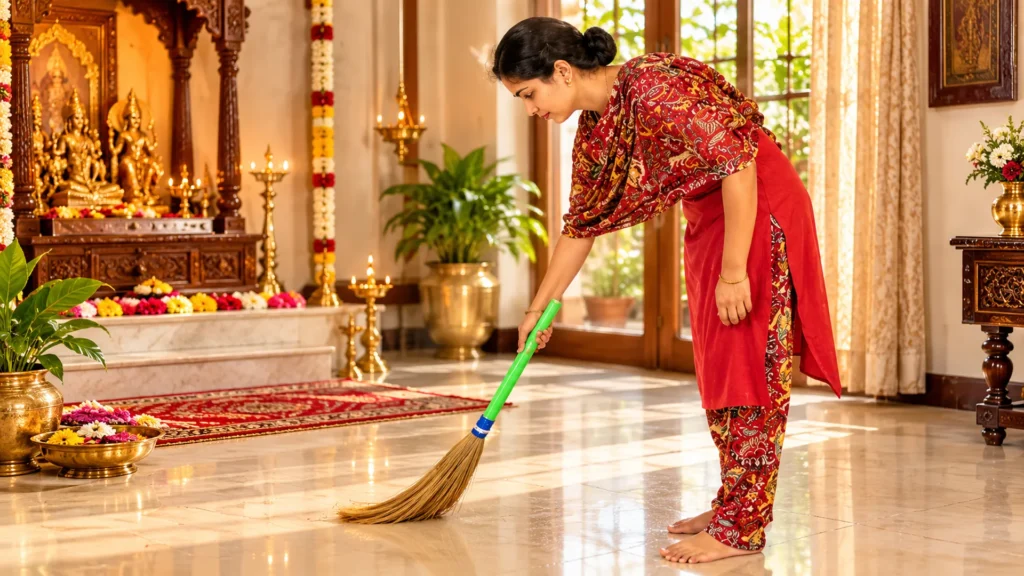
Development of virtues gains importance only if in the process defects are overcome. When one performs pujas and remedies to acquire Lakshmi (wealth),it also has to be complemented with removal of alakshmi (poverty). Hence, a new broom is purchased on this day. It is called ‘Lakshmi’.
Alakshmi Nissaran Practice
‘At midnight one should sweep the house with that broom, collect the dust in a dust pan and throw it out’. This is called ‘alakshmi nissaran’. Sweeping the house and throwing the dust out at night is forbidden on other nights. It is done only on this particular night. Sweeping
here is sometimes accompanied by beating of the winnow and a dimdi (an earthen vessel covered with a hide) to drive away alakshmi.
[IMAGE PLACEHOLDER: a woman sweeping the floor with a new broom, illustrating the Alakshmi Nissaran household-cleansing practice]
Diwali and Light
The concept of Lakshmi is very easy to understand if we are receptive and open minded. The same is very difficult to discern when we become slaves to ego and power. In Vedic philosophy, dharma is upheld as the prime responsibility that a person is entrusted with. Sunlight, lamp or light is representative of ‘dharma’. Thus the tradition of lighting and decorating and cleaning of houses during Diwali festival arose along with the worship of Lakshmi Devi. Lakshmi Devi is fickle (canchala – from the Bhagavat Gita) and she will leave us the moment she will discover dirt and filth in our surroundings and in our heart , and Alakshmi will take her place instead.
Diwali literally means a series of lamps or Deepam. By lighting lamps, devotees embrace dharma and demonstrate their devotion. Lakshmi Devi is said to visit and bestow her gifts to a household that is resplendent in lights. On the same day, gifts are exchanged between people which is symbolic of movement of wealth.
Alakshmi in the Atharva Veda
In the ATHARVA VEDA it mentions that Alakshmi is not to be reviled or abused. One is to respect her also. Afterall she teaches us many lessons. She has a duty to enforce. She may even be a necessary evil. The Atharva Veda refers to two both Lakshmis. It also provides spells and incantations to drive away the former. “Go away, go away Papi Lakshmi Go and attach yourself to my enemies. Oh! Savitar, Use your golden hands and pluck away this unenjoyable goddess who clings like a parasite to a tree”
Alakshmi Devi is described as being “cow-repelling, antelope-footed, and bull-toothed.” Or she “has a dry shriveled up body, sunken cheeks, thick lips, and beady eyes and that she rides a donkey.” She sometimes takes the form of an owl that is portrayed accompanying Lakshmi devi. The owl is the representation of “arrogance and stupidity that often accompanies fortune brought by Lakshmi devi and heralds misfortune.” It is for this reason that Lakshmi devi’s devotees are wary of the owl. There are many kathas surrounding her origins. One katha mentions her sister was born from the radiance of Prajapati’s face, while Alakshmi was born from his back. Another mentions her sister was born from the churned ocean of milk, while she
rose from the Kalakuta poison dripping from Vasuki Naaga’s mouth. Still others simply mention both were born from the ocean of milk, but Alakshmi is always the oldest of the two.
According to one source, “It was said that when she entered a household, Alakshmi brought jealousy and malice in her trail. Brothers fell out with each other, families and their male lineages (kula) faced ruin and destruction.”
According to one katha, Alakshmi was upset because her younger sister was wife to Lord Vishnu and was living in the Vaikuntha paradise, while she had neither husband nor abode. Lakshmi then decreed “Mrityu, god of death, decay, and degeneration will be Alakshmi’s husband and she will dwell wherever there is dirt, ugliness, sloth, gluttony, envy, rage, hypocrisy, greed and lust.”
Sharad Purnima Offerings
On Sharad Purnima, the following denotes it beautifully. “Lakshmi devi, the goddess of wealth moves around in the night sky, asking `Ko jaagarti’ searching for people below who are awake. In Sanskrit, `Ko jaagarti’ means, ‘Who is awake?’ And to those who are awake she gives wealth.”. “Currently, this full moon comes during Sharad ritu (season) of the year and hence it is called Sharad Purnima or Sharad Poonam. Many Hindu’s prepare an offering of kheer (sweet rice) which will then be placed on a thari and left outside for it to absorb the Moon rays. With that you can also on another thari place a slice of lime and or imli.
One also makes an offering of Kheer inside one’s home by the Lakshmi lamp to Lakshmi devi and her husband Lord Narayana (Vishnu). Thereafter one eats this as Prashadam. Leave the other kheer for a few hours for the moonlight rays to bless and empower that kheer. Later you can eat this outside kheer as blessings from Mother Alakshmi. Every Purnima is Lakshmi-Narayana day, as Lord Vishnu is the presiding Deity of Purnima (Full Moon).
Lakshmi Devi has a sister called Alakshmi, the Goddess of Misfortune. She is offered sour things, like lemons, outside the house so she doesn’t come in.
Alakshmi and Nirriti
In the Brihat Parashara Hora Shashtra on Nakshatra constellations states that the deity of the 19th lunar mansion of Mula is Nirriti, the goddess of destruction who has the power to “ruin, destroy or break things apart (barhana shakti).” Alakshmi is another name for Nirriti. Nritti is the Goddess of Destruction having the ‘barhana shakti; or the power to ruin, destroy or break up things. As Alakshmi was born Mother Goddess Devi is to have said “Lakshmi will dwell where there is nobility and righteousness, cleanliness and beauty, virtue and compassion. Alakshmi will dwell elsewhere, attracted by sloth, envy, greed, lust and pride.”
Lakshmi Devi the Owl and Alakshmi
Lakshmi Devi sits on a lotus; hence She has been given the epithet Padma-aasana, but She rides on an owl as Her “Vaahana” of choice. The owl is known as Uluka. It is also a lesser known or unlikeliest vahana for the beautiful Goddess Lakshmi. But Vedic symbolisms carry spiritual message. It is a bird that sleeps during the day. The daytime partial blindness is indicative of a sadhaka’s assumed blindness and tendency to seek secular instead of spiritual wealth. Symbolically, Goddess Lakshmi thus seeks one to open the eyes to the light of wisdom residing within us. Owls are solitary creatures, who sleep all day and prowl at night.
Because of their nocturnal activity and screeching call, they have been associated with bad luck and death, leading to the conclusion that she is Alakshmi, Lakshmi’s elder twin, the goddess of strife and misfortune. Thus uluka sitting at Lakshmi’s feet, symbolizes Alakshmi, the Goddess of Strife and her inauspicious nature. Lakshmi’s owl symbolizes patience, intelligence and wisdom. It has the ability to foretell events. Uluka becomes Lakshmi’s vahana when she blesses with
wealth and prosperity. But when Lakshmi’s wealth is used by humans for adharmic activities, then one is said to be blinded and the vahana is all but a bird of ill omen representing darkness, disgrace, inauspiciousness and misfortune. Thus Alakshmi’s owl represents ignorance, arrogance and the coming of misfortune. a symbol of universal wisdom that warns about arrogance and indiscipline. Hindus believe that owls are the messengers. It announces an impending death or disaster. Thus the owl also calls for some respect as that is equivalent to respecting the Goddess of Strife as without due attention, she can also create complete havoc and destruction.
While the owl is the bird of wisdom, it is the negative aspects of the owl that follows Alakshmi.
The Spiritual Meaning of Alakshmi
In spiritual terms Alakshmi is a shadow of Lakshmi. It is inexorable that where there is Lakshmi there would Alakshmi also so they co-exist. But Alakshmi is not restless; once she finds a seat she occupies it to multiply her negative energy constantly until it engulfs the person or the household. It is therefore wise to avoid her presence rather than trying to get rid of her ‘durbhagya’ or bad luck, inauspiciousness and extreme ugliness of both external and internal nature.
According to the Linga Puraana, Sati, who is no other than Mother Parvati, divided herself into two parts – the bright half and the dark half. Sri, Swaahaa, Mahaavidyaa, Medhaa, Sarasvati and Savitri came out of the bright half, and the dark half produced Swadha, Durga, Rudraani, Mahakaali and Kaalkarni.
The Owl as a Symbol of Spiritual Wisdom
People are not all wakeful to the same thing. When the owl is compared to the sthitha prajna, the enlightened person described in Bhagavat Gita 2.69, the symbol means that Lakshmi is the mistress of spiritual wisdom. The disciplined yogi is awake at night. Lord Krishna states “What is night for all beings is the time of awakening for the self-controlled; and the time of awakening for all beings is night for the introspective sage.”
Wealth and the Seed of Strife
Lakshmi devi always comes with her sister in tow. Failure to acknowledge Alakshmi is dangerous for she represents all the negative energies that accompany any wealth. Everyone knows that money breeds strife and jealousy. Alakshmi embodies that dark aspect of wealth. She is the one who makes rich brothers quarrel. She is the one who divides the household. She is the one who does not allow peace to enter the house of gold.
Awareness and Household Symbolism
The only way to make Alakshmi weak is to constantly be aware of her; acknowledge her as much as her sister. Typically in rituals, sweets, kept inside the house, are offered to Lakshmi while lemons and chillies, kept outside the house, are meant for Alakshmi. Lakshmi davi, mentions our scriptures, never goes anywhere without her sister. In other words, wealth never goes anywhere without the seed of strife.
The Trader and the Two Sisters
The katha mentions that Lakshmi and Alakshmi once paid a visit to a trader and asked her who of the two is more beautiful. The trader was frightened of making either one unhappy so he came up with a clever answer that would please both. “Lakshmi is beautiful when she walks towards me. Alakshmi is beautiful when she walks away from me.” Pleased with this response, fortune moved towards the trader while strife moved away.
Modern Reflections on Strife
Today, we seem to be inviting strife into our house. News reports celebrate strife. Television shows are based on strife. Everyone is fighting. Young people are fighting on reality shows and the audience loves it. Judges are fighting, singers are fighting and we are beaming these thoughts into our living rooms during family time, while eating dinner. War is presented as
entertainment. Stories of rape and abuse and murder are generating vicarious thrills. And all this is happening at a time when India is reaping the benefits of liberalization. Guess, in our pursuit of Lakshmi, we have forgotten to tell Alakshmi, with utmost love and respect, “Stay out!”
Additional Reading
Although the information provided below kind of seems unrelated to this article I personally would like to perceive that these two links would change your life for the better. It should make you a more positive minded individual.
Why Talking About Our Problems Is Our Greatest Addiction http://raiseyourvibrationtoday.com/2015/02/08/talking-problems-greatest-addiction/
3 Reasons Why You Keep Manifesting the Same Problems http://thespiritscience.net/2015/10/08/3-reasons-why-you-keep-manifesting-the-same- problems/