

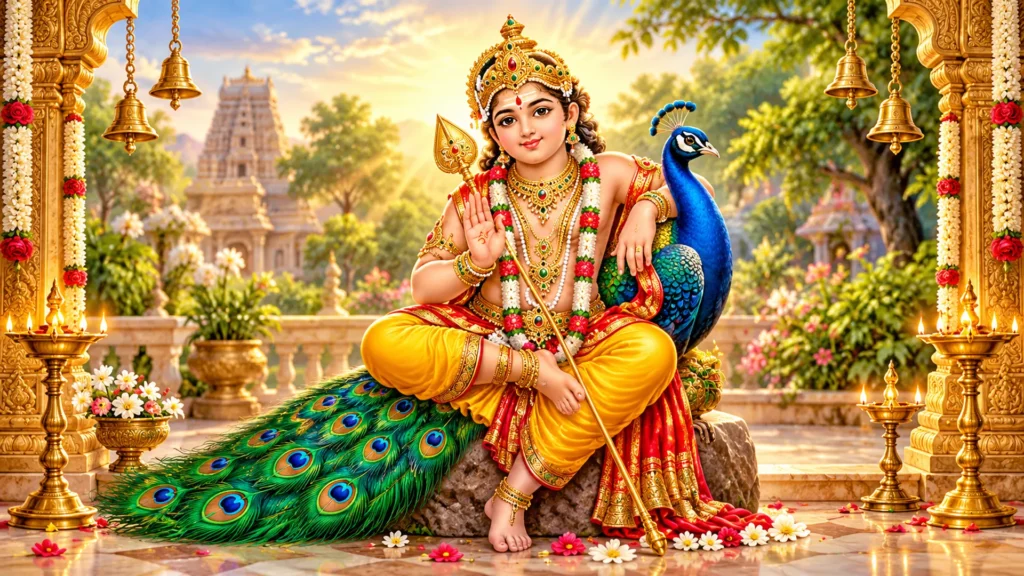
Skanda Shashti honours Lord Muruga, also known as Skanda, Kanda and Subramanya. The observance culminates in Soorasamharam, commemorating the Lord’s victory over Soorapadman and the triumph of good over evil.
Skanda Shashti also known as Kanda Shashti, the sixth Vedic day in the bright (shukla paksha) half of the Tamil month of Aippasi (Mid October Mid November), is the most important festival dedicated to Lord Muruga is celebrated with an extra measure of grandeur in temples dedicated to Lord Subramanya (a.k.a Muruga/Skanda). Skanda Shashti is observed mainly by Hindus from South India (Tamil speaking Hindus). The day of Skanda Shashti is decided based on lunar month and it falls during sixth day of the bright half of Kartik Maas (The Holy month of Kartik).
Although all Shashti(s) during the year (and there is one every month) are dedicated to Lord Muruga but the Shukla Paksha Shashti during lunar month Kartik (which is during Solar month Aippasi or Karthikai) is the most significant of all. During Kanda Shashti, devotees observe six (lunar) days of fasting which commences from the first Vedic day or Pratipat (Pirathamai) of Kartik lunar month and ends on the sixth Vedic day (or Shashti) which is known as Soorasamharam day. Soorasamharam is the final and the most important day of the six days festivities.
Shastras states that Lord Muruga defeated the powerful demon Surapadman on this very same vedic day and the festival of Soorasamharam is observed every year to mark the victory of good over evil.
The Devas took refuge at the feet of Lord Shiva but Lord Shiva was in deep meditation. On the advice of Lord Brahma, all the devas took the help of Kamadeva to incite sexual desire in Lord Shiva. Kamadeva succeeded in his mission but the angry Lord Shiva reduced Kamadeva into ashes. The semen that was emanated from Lord Shiva got divided into six parts and was deposited in the Ganga River. Mother Ganga then deposited the six parts in a forest and it assumed the form of six children. The children were looked after by the six Karthikai stars.
Later, Mother Parvati combined the six babies into one. Therefore Lord Muruga is depicted differently sometimes with one face and two arms, sometimes with six faces and twelve arms and in some places with single face and four arms.
The demons continued their rampage and Soorapadman held many beings, sages and devas as captives. Lord Subramanya soon adorned the role of general of Devas and
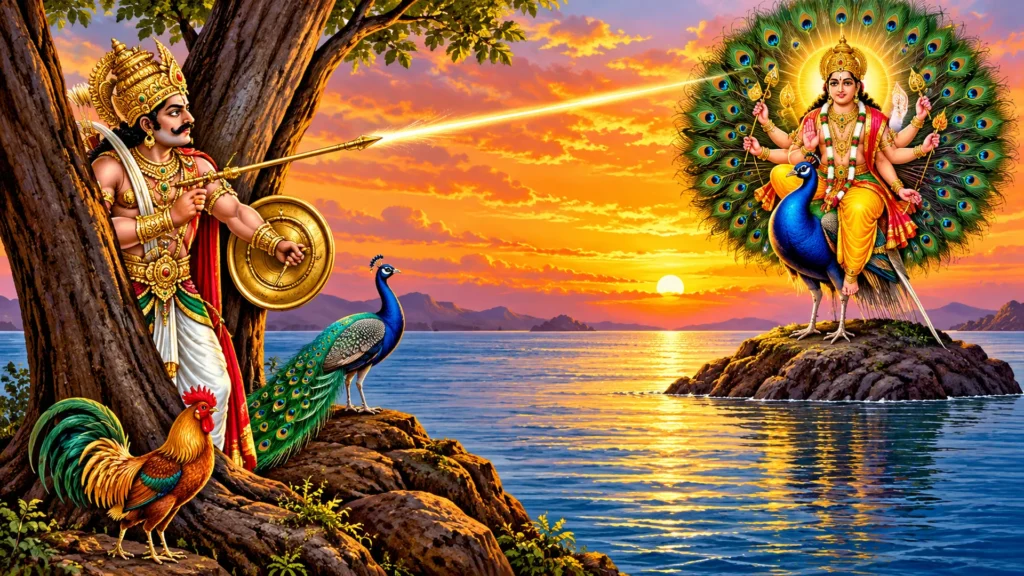
decided to annihilate the demons. He soon defeated the demons. In the final battle, Lord Muruga killed Soorapadman with his ‘Vel’ (spear) and this act of the Lord is known as Soorasamharam. The main Skanda Shashti day is celebrated on the sixth lunar day.
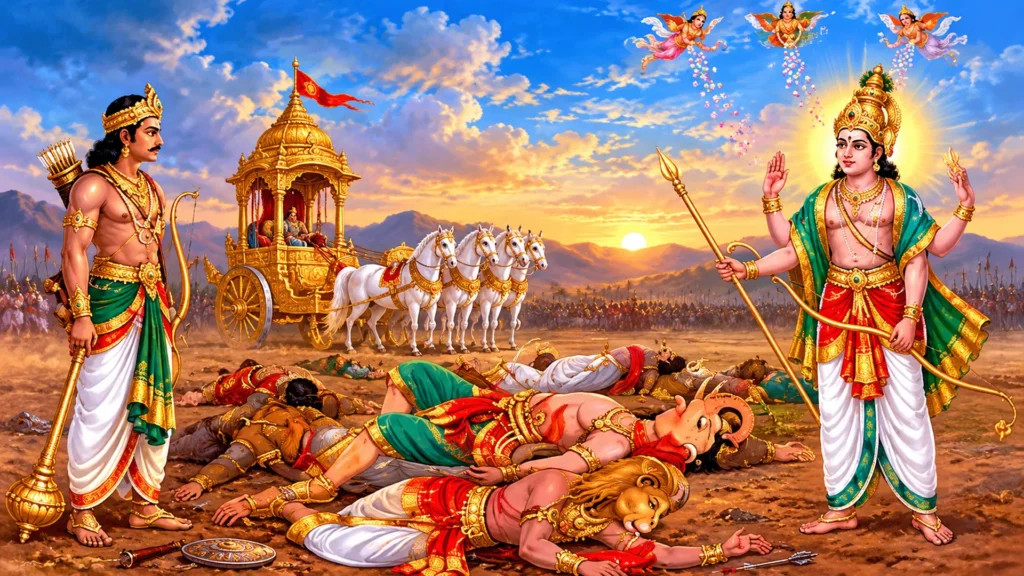
Soorasapadma being defeated by Lord Skandadeva.
Corresponding to the six days of the war over the evil forces, devotees undertake fasts, prayers and devotional singing to Lord Muruga. Many devotees stay in temples during these six days.
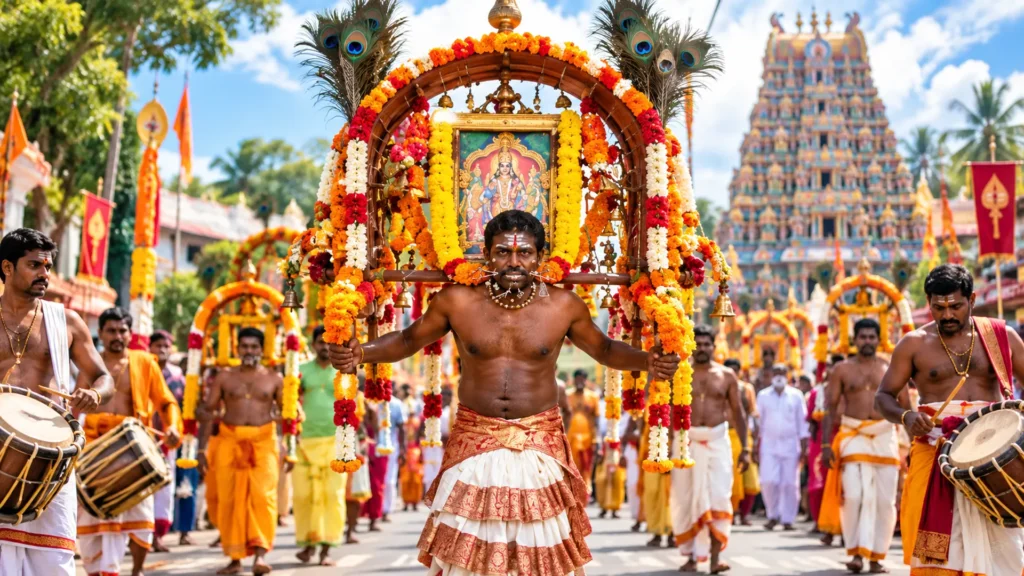
Offering of Kavady on Skanda Shashti is a form of popular worship. Perhaps the most potent propitiatory rite that a devotee of Lord Muruga undertakes to perform is what is known as the Kavady. The benefits that the devotee gains from offering a Kavady to the Lord are a million fold greater than the little pain that he inflicts upon himself. Generally, people take a vow to offer the Lord a Kavady for the sake of tiding over a great calamity.
Though this might, on the face of it, appear a little mercenary, a moment’s reflection will reveal that it contains in it the seed of love. After the ceremony he gets so God intoxicated that his inner spiritual being gets awakened. This is also a method that ultimately leads to the supreme state of devotion. The Kavady bearer enjoys a high state of religious fervor. He dances in ecstasy. His very appearance is awe inspiring; there is divine radiance on his face. Devotees often experience the state of feeling union with the Lord.
The Different Names of Lord Muruga
Shanmugan: He descended to destroy adharma. Kartikeyan: the Karttika maidens nursed him Guhan: He resides in the cavern of one’s heart Saravanabhavan: He belonged to Lake Saravanai where he was born Arumugan: He who has six faces. Murugan: The beautiful one Karttikeya: meaning ‘son of Krittika’ Kumara: meaning ‘child or son’ Skanda: meaning ‘that which is spilled or oozed, namely seed’ in Sanskrit Senthil: the red or formidable one
The six-syllabled mantra chanted for Lord Muruga: OM SARAVANABAVA NAMAH/POTRI (please note in north India namah (I offer my obeisance’s) is used and in South India Potri is used. Both have the same meaning.
Why Devotees Chant Saravanabava
SA – CONFERS THE PROSPERITY OF SHAKTI
RA – GIVES THE WEALTH OF KNOWLEDGE
VA – BESTOWS HAPPINESS OF ENJOYMENT
NA – PROTECT FROM ALL FORCES OF EVIL
BA – CONFERS MORALITY
VA – CONFERS THE LIFE OF BLESSEDNESS
HARAGAROGARA Hail, Hail, Hail Oh Lord
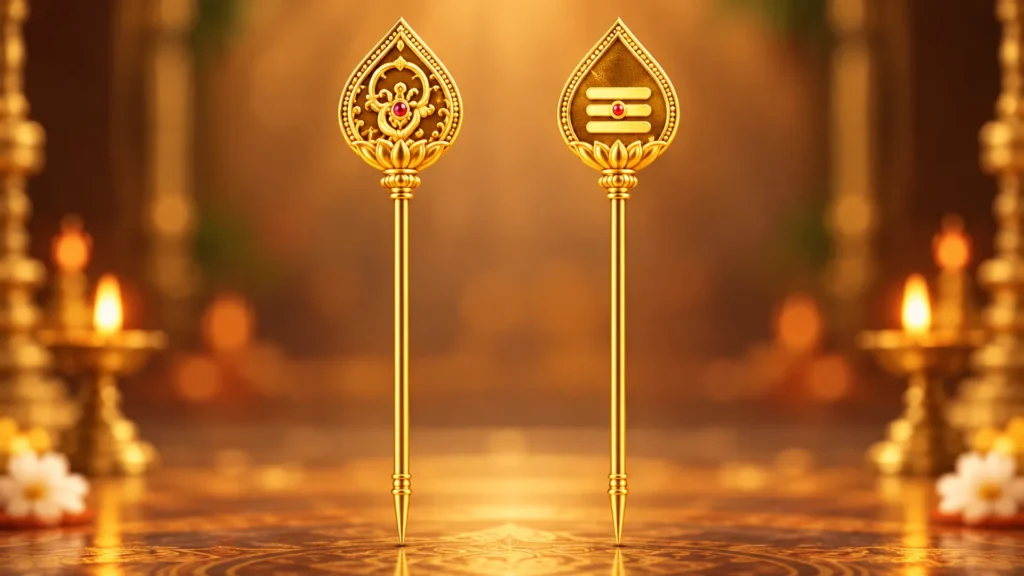
Lord Muruga’s Vel (Spear)
How to Perform a Simple Skanda Shashti Puja at Home
You can do this Puja on all six (lunar) days of the Skanda Shashti Vrata or on Soorasamharam day. The devotee should have a bath and wear clean clothes before proceeding to the puja place. Have all the requirements for the Puja and the havan arranged on a tray. Before beginning any puja try to create a calm and pleasant atmosphere. Try to keep all the puja items near you.
Sit facing East or North.
This prayer process is very simple and cost effective.
If you cannot pronounce the Sanskrit mantras then read the English translations I have translated.
Lord Ganesha Prayer Procedure
At the prayer place, place a Lord Ganesh murti or photo.
Firstly offer an agarbatti, lamp (with either ghee or oil with a wick or a small piece of camphor), a flower (or all three on a tray) to Shree Ganesh (turn seven times clockwise around the murti or photo).
Then offer Lord Ganesh Naivedhyam (either sweet rice, Soji, sugar candy or fruits, etc).
Finally pray to Shree Ganesh, praying to him to remove all obstacles in the path of your prayer that follows.
Lord Skanda Prayer Procedure
At the prayer place, place a Lord Skanda murti or photo.
Now chant the following:
1) Hold your palms in the Namaste 🙏🏼 position and chant: Om swagatam su swagatam – Om Skanda deva-ye namah (Swagatam means “O Lord Skanda I welcome you”.)
2) Offer one or three incense sticks (dhoopam) by turning it seven times clockwise around Lord Skanda’s deity/photo. Om tato dhoopam aghraa-payaami – Om Skanda deva-ye namah O Lord Skanda I offer you this incense, kindly accept my offering.
3) Then offer a clay or brass lamp (deepam) with either ghee or oil with a wick or a small piece of camphor by turning it seven times clockwise around the deity/photo. Om prat-yaksha deepam darshayaami – Om Skanda deva-ye namah O Lord Skanda I offer you this lamp offering, kindly accept my offering.
4) Then offer flower (pushpam) or flower petals by turning it seven times clockwise around Lord Skanda’s deity/photo. Om idam pushpam – Om Skanda deva-ye namah O Lord Skanda I offer you this flower, kindly accept my offering.
5) Then offer cut fruit or sweet meats or sweet rice (Naivedyam). It should be in a small bowl with a teaspoon. Turn the bowl seven times clockwise around the deity/photo and bring the bowl near the lips of Lord Skanda suggesting he partakes in the food offering. Then leave this in front of the deity/photo. This is later consumed by the family as the Prashad. Om naivedyam samar-payaami – Om Skanda deva-ye namah O Lord Skanda I offer you this food offering, kindly accept my offering.
6) Then in a cup (lota/chumbhu) which has Milk with sugar turn the lota seven times clockwise around the deity/photo and bring the lota near the lips of the Lord suggesting he drink the Milk offering. O Lord Skanda I offer you this Milk drink, kindly accept my offering.
7) Offer prayers for forgiveness Om yaani kaani cha papani janmaantara kritaani cha taani sarvaani nashyanti pradakshina pade pade // “O Compassionate Lord Skanda! Victory to You! Please do forgive all the errors committed by me with the hands, legs, speech, body, through actions, through the ears, eyes, mind or by not doing ordained actions or by doing prohibited actions”.
Then offer your personal prayers to Lord Skanda. Ask Lord Skanda for whatever you desire (within reason) and the Lord being so merciful will grant what you desire. But be careful what you desire for. Bow down and leave the prayer place. The food offerings are eaten as prashadam and the Milk drunk by the family members.
1. Optional: Suggested Lord Skanda mantra you may chant 108 times: OM SHARAVANABAVA NAMAH
Tirukalyanam of Lord Muruga
concludes the Skanda Shashti festival which is held the day after Soorasamharam. After the sixth day Skanda Shashti fasting and Soorasamharam, Tirukalyanam is held on the seventh day. It is observed on the seventh day, after Soorasamharam. It is a major event in major Lord Muruga temples.
On the Tirukalyanam day, Lord Muruga marries Mother Valli. This divine marriage is celebrated with all traditional rituals by Lord Muruga devotees. Special arrangements are made on the Tirukalyanam day. The previous day is the Surasamharam and this holy event too attracts thousands of devotees.
Now you can chant Skanda Shashti Kavacham, Subramanya Bhujangam or read Skanda Purana or any katha related to Lord Muruga. If you have prepared any food (navediyam) you can offer it to Lord Muruga now. At the end of the Puja you can thank Lord Ganesha and Lord Muruga for helping in successfully conducting your pooja.
Temples Dedicated to Lord Muruga in Bharata Bhumi India
The following six abodes, which are known as Arupadaiveedu, are the most important shrines for Lord Muruga devotees in Tamil Nadu, South India.
1. Palani Murugan Temple (100 km south east of Coimbatore) You may Ctrl-click (HERE) to a quick link to learn more about this temple in India.
2. Swamimalai Murugan Temple (Near Kumbakonam) You may Ctrl-click (HERE) to a quick link to learn more about this temple in India.
3. Thiruthani Murugan Temple (84 km from Chennai) You may Ctrl-click (HERE) to a quick link to learn more about this temple in India.
4. Pazhamudircholai Murugan Temple (10 km north of Madurai) You may Ctrl-click (HERE) to a quick link to learn more about this temple in India.
5. Sri Subrahmanya Swami Devasthanam, Tiruchendur (40 km south of Thoothukudi) You may Ctrl-click (HERE) to a quick link to learn more about this temple in India.
6. Thirupparamkunram Murugan Temple (10 km south of Madurai) You may Ctrl-click (HERE) to a quick link to learn more about this temple in India. Please remember that prayers to Lord Muruga are not only for the Tamil-speaking people but also for all Hindu’s. PLEASE let’s not segregate rather congregate.