

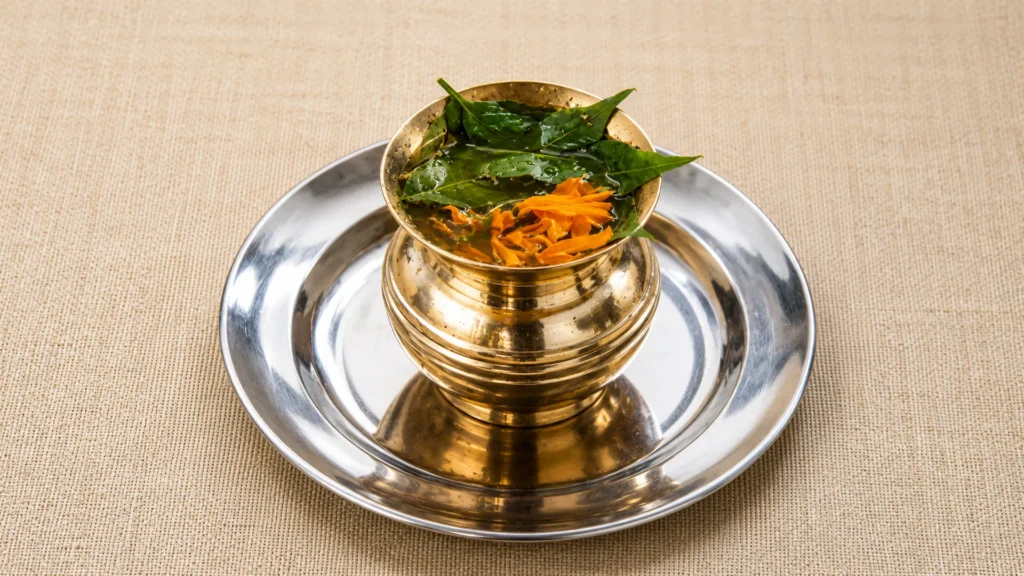
Jai Mata Di. All glories to our most amazing and wonderful Mothers. In any puja to Devi, particularly in Her Divine forms as Mothers Durga/Bandi/Kali, Dhaar is offered. Unfortunately there is no direct English translation of Dhaar from Sanskrit. The nearest being “The Divine Wine”. Now I said wine, but it does not refer to the famous wines we produce here in South Africa, rather this beverage – the “wine” – is especially Devi’s favourite. Many have been offering Devi Dhaar but have never had an idea as to why. So, below we are furnishing you with shastric proof of Dhaar and its importance in Devi puja.
What Dhaar consists of
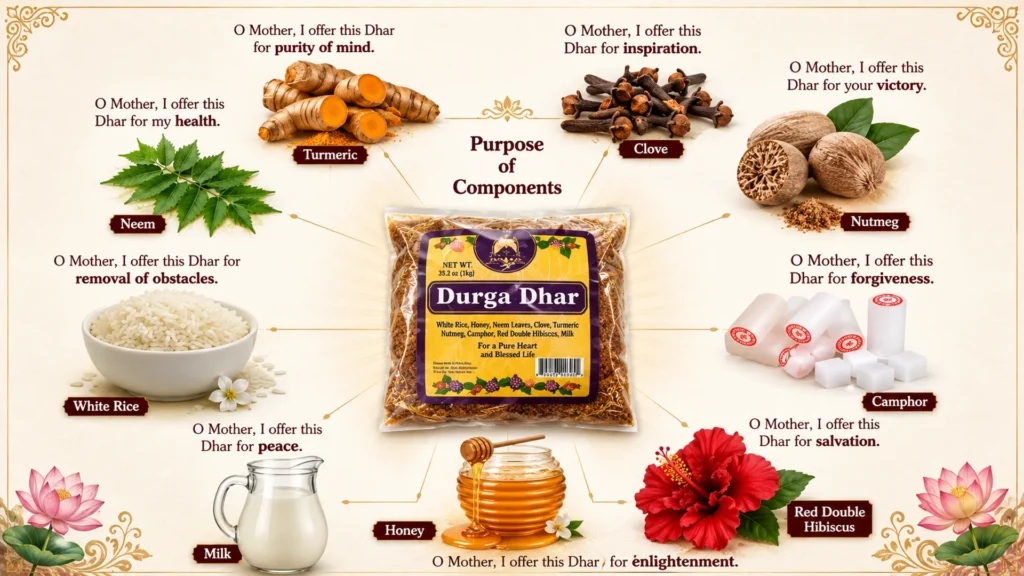
Turmeric sticks, cloves, nutmeg (Jaiphal/Jaifar), almonds, elachie, flower petals (Hibiscus), sugar candy, camphor, turf, cow’s milk, honey, akshat (white unbroken rice) and syringaberry leaves.
These are the basic ingredients but some choose to add or leave some ingredients. You can use jaifar (nutmeg) as long as you are offering the Jaifar as a fruit and not substituting it for something else. A little of each of the above ingredients are ground on a Seel (large flat stone) with a lorha (grinding stone) and then the mixture is added into a bucket of water. Add some milk and fresh flower petals as well. Mix and stir this mixture well in the water.
*** Do not talk while preparing the mixture, as one’s saliva may enter the mixture thus rendering the mixture soiled. Do wear a mask.
*** Dhaar is offered on all 8-10 days in Navaratri and I personally advise people to offer Dhaar on available/convenient Fridays during the year. When one offers the Dhaar, one should pray to all the Devi’s (There are approximately 16.5 billion Devi’s). All mothers are expansions or expansions of expansions of Srimati Radharani… We have been told over the years that only married ladies must offer Dhaar and this is incorrect and should be disregarded. Do note anyone can offer Dhaar i.e. young children, widows, men etc.
It’s best to offer Dhaar in the morning (after one has a bath) as you are clean, fresh and in a much more positive vibration than in the evening. You can offer Dhaar at any time of the day but my humble advice is to offer Dhaar in the morning… you offer your Dhaar in a designated place (Thaan) near your Jhanda place facing East. You can also purchase the ground, ready-made Dhaar, but I am a huge exponent of making one’s own Dhaar. It’s the effort and fun in making Mata’s favourite drink.
Additional information on Jaifar
During a Mata Puja many Hindus cut a Jaifar (a.k.a. Jaiphal/Nutmeg). “Jai” means victory and “Phal” means fruit. The Jaifar is not used as an offering of life rather as a fruit. The aromatic nutmeg is protected by an outer shell. In this way we are praying to Mata saying “O Mata may our lives become “victorious” and sacred, may you O Mata protect our bliss and may we always have success and victory in our endeavours”. “Jai Mata Di”.
One may chant the following mantra from the “Shree Artha Argala Stotram” when offering Dhaar but if it’s rather difficult to pronounce then recite the English meaning…
Om Jayanti Mangala Kaali Bhadra Kaali Kaapaalini
Durga Shamma Shivaah Dhaatri Swaahaa Swaadhaa Namostute
(Oh! Conqueror of all, Remover of darkness, Auspicious one, beyond time, the bearer of Skulls of Impure thoughts, Reliever of difficulties, loving forgiveness, supporter of the Universe. You are the one who truly receives the sacrificial offerings and the offerings to the Pitrs (Ancestors). To you I bow most merciful Devi.)
A question will be asked by some aspirants – “how many lotas of Dhaar should one offer?” I would humbly suggest one lota of Dhaar and from that one lota offer 9 times on your Thaan. Yes you can offer 9 Lotas of Dhaar, but if you offering the Dhaar to a plant you are going to drown that poor plant… So common sense should always prevail.
Please perform Mata’s prayers simply – don’t complicate things. The Mother is not interested in elaborate rituals as all Mata wants is your devotion and of course Her favourite Dhaar :), hence I stress make the Dhaar yourself.
References of Dhaar From the Durga Paath
Devi is often depicted carrying a wine-cup enjoying Her divine wine, as noted in Devi Mahatyama (a.k.a Durga Saptashati, Chandi Homa or Durga Paath) below:
In CHAPTER 2 of the Durga Path “Slaughter of the armies of Mahishasura”
“I resort to Mahalakshmi, the destroyer of Mahishasura, who is seated on the lotus, is of the complexion of coral and who holds in her (eighteen) hands rosary, axe, mace, arrow, thunderbolt, lotus, bow, pitcher, rod, sakti, sword, shield, conch, bell, wine-cup, trident, noose and the discus Sudarshana.”
Shloka 34. ”Enraged, Chandika, the Mother of the worlds, quaffed a divine drink again and again, and laughed, her eyes became red.”
Shlokas 30-33. “The lord of wealth (Kubera) gave Devi a drinking cup, ever full of wine. Sesha, the lord of all serpents, who supports this earth, gave Devi a serpent-necklace bedecked with best jewels. Honoured likewise by other devas also with ornaments and weapons, Devi gave out a loud roar with a decrying laugh again and again. By her unending, exceedingly great, terrible roar the entire sky was filled, and there was great reverberation. All worlds shook, the seas trembled.”
Shloka 36. “And Devi, with showers of arrows, pulverized those mountains hurled at her, and spoke to him in flurried words, the colour of her face accentuated with the intoxication of the divine drink.”
CHAPTER 3 of the Durga Paath “The Slaying of Mahishasura”
Shlokas 37-38. “’Roar, roar, O fool, for a moment while I drink this wine. When you will be slain by me, the devas will soon roar in this very place.’”
F.Y.I… On the first day of Navaratri you can (it’s optional) place an Anar (Pomegranate) by Ma Durga’s picture/Murti. This is Mata’s most favourite fruit. And now the western world is coming to grips with the most wonderful miraculous benefits of Pomegranate. In the 11th chapter Durga Paath verses 44-45, Devi Durga said “When I shall devour the fierce and great Asuras (demons) descended from Vipracitti, my teeth shall become red like the flower of an Anar. Therefore when devas in heaven and men on earth praise me, they shall always talk of me as the “Red-toothed” one.” After the 9th day you can then distribute this as Mata’s Maha-Prashad to one’s family members and friends.
Halwa-Puri offerings w.r.t. Mother Durga
Many aspirants inquire – “are Halwa Puri, camphor, cloves and the like mentioned in our shastras?” Most certainly they are and we have kindly furnished the shastric proof below.
Srimad Devi Bhagavatam – The 11th Book chapter 18 called “The greatness of Devi Puja”. Narada Muni spoke:- “O Bhagavan! I’m now very eager to hear the special Puja of Shree Devi.” Lord Narayana (a.k.a Lords Vishnu/Krishna/Raam) said:- “O Devarsi! I shall now specially speak to you on how the Mother Bhagavati (another name for Mother Durga) is worshipped. Offer Devi Dhoopa (incense/agarbatti) made of black Aguru (aloe wood/eagle wood), camphor, sandalpaste, red sandalpaste, Sihlaka (oriental sweet gum/liquid amber) and Guggula (gugul/googul), saturated with ghee in such a way so as the whole room of Shree Bhagavati scents with pure fragrant smell. (Do Note if you don’t have the above-mentioned items use what you do have like camphor, sandalpaste and gugul which is readily available at local puja shops). The Devi Bhagavati becomes very pleased. The devotee, who offers daily the light of camphor to the Devi, goes to the Surya Loka (The Sun Realm). The devotee should offer heaps of food consisting of *** six Raasas (Tastes viz. pungent, bitter, spicy, sweet, salty, and astringent), the plates and dishes for chewing, sucking, licking and drinking, that is, all kinds of food solid, and liquid and mountain-like high. Always offer food on flat plates and cups and various delicious, sweet, juicy, nice, heavenly fruits (like pomegranate or apple, grape, orange or coconut juices to name but a few), nicely arranged on trays, cups and saucers. When Shree Mahadevi Bhuvaneshvari becomes pleased, the whole universe becomes pleased. Offer Devi a jar (lota/chumbhu) of drinking Ganga (Ganges) water, cool and nice, scented with camphor to Devi; then offer betels (leaf and nut) with camphor, cardamom (elachie), cloves, and various delicious scents. These all are to be offered with great devotion so that Devi will be pleased. Next, have music with lovely flutes and (percussion instruments like) mridangas, murajas, dhahkas and dundubhis to please Devi. (Hence after a Devi Puja the family has Patchara/Nagara/River-side music where the instruments {like the Nagara drum – two drums with two sticks} above are played and a person sings songs glorifying the Mother in her many forms while a person, generally a male dressed as a female, dances to this music). The Vedic mantras are to be recited, the Puranas are to be read and the hymns to be chanted. Devi is pleased with anybody who remembers Her even once! What wonder then that She will be pleased with all these offerings! The Mother is naturally merciful to her child. When She is loved with devotion, She becomes very merciful. There is nothing strange here!”
Srimad Devi Bhagavatam 8th book chapter 24 “On the worship of the Devi”
Lord Narayana (a.k.a Lord’s Vishnu/Krishna/Raam) said:- “O Devarsi Narada the worshipper is to offer cake flour (from which Puri is made) to the Devi. The worshipper is to offer plantains (bananas) to the Devi. The Lord said it’s a rule to give an offering of Payasam (Sweet Rice – a food prepared of rice, milk, and gur {sugar}) known as Devi Payasa. Lord Narayana said The Mother becomes very much pleased when one offers the following food items to Her:- Gur (a form of sugar), honey, ghee, milk, curd, Takra (butter-milk), apupa (barley cake), fresh butter, Karkati (cucumber), Kushmanda (a medical plant where the fruit is used – Botanical name: Benincasa hispida), Modaka (is a sweet dumpling stuffed with a filling of coconut and jaggery), Panasa (jack-fruit), plantain (is a member of the banana family/bananas), Jambu Fruit (rose-apple), mango, sesamum (Til seeds), oranges, Anar (pomegranate), Badari (a variety of dates – red dates – Jujube), Dhatri fruit (Amla/Amalaki), Payasa (kheer/sweet rice), Prithuka (Hindi {Poha} – Flattened/beaten rice preparation), gram (different types of pulses esp Channa {chickpea} Dal), coconut, Jambira (lemon/lime citrus fruits), Kaseru (a.k.a Singhada and water chestnut is used as a vegetable, fruit, nuts and flour), and Surana (sweet potato or Yam).”
For further information, at the end of the 11th chapter of the Durga Paath, Ma Durga expands Herself as Shakambhari Devi, the Mother that provides nourishments and food to humankind.
*** Camphor and cloves are mentioned above, hence we use these items in Devi pujas. It’s very important that utmost cleanliness is observed. In this period abstinence from meat and alcohol/smoking cigarettes is observed. When cooking one should not wear shoes, etc, and not speak as saliva can enter into the food thus contaminating the food offerings. This puja can be performed in or outside your home. It doesn’t matter. In a clean bucket add warm water, Dhaar mixture, ground syringaberry leaves (if you don’t have syringaberry leaves, it’s ok (it’s optional)), milk and flower petals. Make sure you have 9 lotas/Chumbu of the Dhaar mixture in the bucket.
The six Rasas (tastes) are as follows
- Lavana (salty) – Betel nut, Puri (salt),
- Madhura (sweet) – Halwa/sweet rice, Betel nut, cardamom, Mithai (sweetmeats), Puri (sugar), fruits (apples, purple/red grapes, pear)
- Amla (sour) – fruits (purple/red grapes, orange), betel nut
- Katu (bitter) – Betel nut.
- Tikta (pungent) – Betel leaf, Betel nut, cloves, cardamom,
- Kashaya (astringent) – channa Dal, Betel nut, cloves, Puri (wheat flour), fruits (apple, purple/red grapes, pear)
Astringent foods are not always easy to digest or can take longer to digest for some. For that reason, it also classifies all high-protein foods, including non-veg and nuts, as astringent. Such foods may not be as readily digested as carbohydrate-rich foods, and consuming them can help you feel full and stay full for longer periods of time. All legumes, including peanuts, beans, peas, pears, apples, Anar, dried fruits and lentils have astringent qualities. Grains such as buckwheat, quinoa and rye are also astringent.
The flat black/brown betel nut (Areca) possesses as many as 13 qualities found in the regions of the heavens. It has all 6 rasas (tastes viz. pungent, bitter, spicy, sweet, salty, and astringent). Chewing this nut stimulates the flow of saliva to aid one’s digestion. The flat betel nut also has been used to stimulate the appetite, expel wind, remove worms from one’s stomach, remove phlegm, subdue bad odours, induce purification, and kindle passion.
Cardamom (Elachie) has a sweet, spicy flavour with a pungent aroma. Cardamom is very good for digestion & it can reduce flatulence. Additionally, it is also beneficial for heartburn. For some, cardamom stimulates the appetite. It can help with stomach ulcers and nasal conditions by soothing the mucous membranes. Cardamom tea is a good way to consume this spice to counter indigestion.
On a banana leaf (which should be on a tray) place 9 sets of Puris; on top of the Puris place a betel leaf, 1/4 tsp (teaspoon) Halwa, 1/4 tsp sweet rice, 3 kinds of cut fruits (purple/red grapes, apple, pear), 3 kinds of mithai (sweets), 3 grains channa dal, 1 elachie, 1 clove, 1 flat (black/brown) betel nut, Sindhoor (red) dot, 1 tikli, 2 red bangles (preferably glass and not plastic bangles but according to one’s financial situation). Please set the above in the order I have stated.
Do note that the betel leaves’ points/tips (DO NOT BREAK OFF THE TIPS) must be facing you as you are setting the Puris with its offerings on the rectangular tray. On a brick place 9 pieces of camphor and place cloves on it.
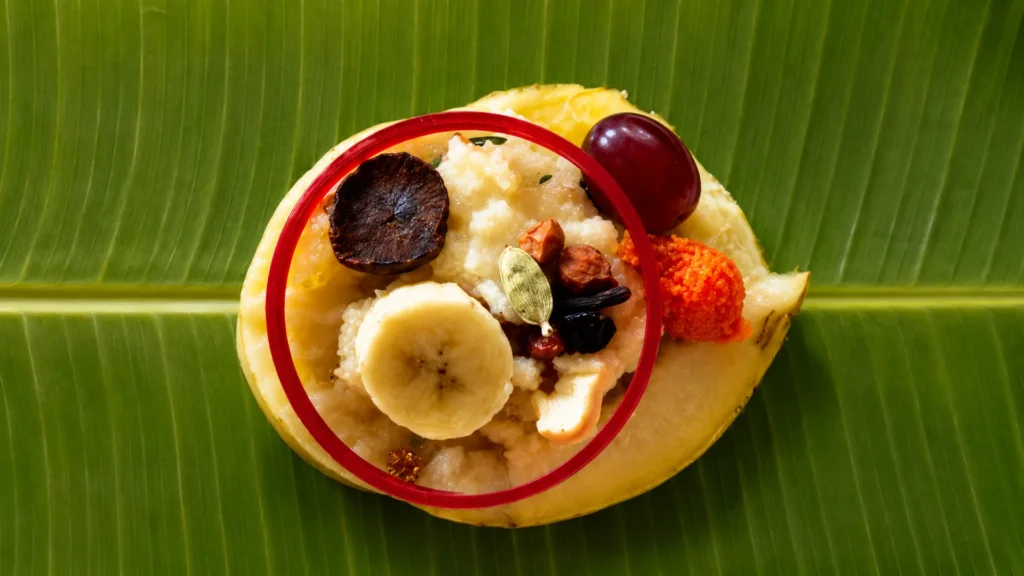
Lord Narayan mentions that the offerings on the Puri should be mountain-like high.
Do note: Soak the channa dal overnight and next morning wash the channa dal once more and then boil it until it’s soft, then add a pinch of salt for taste… Many will ask – “why are we adding salt to the channa dal?”, please read more on this below, after the Puri recipe.
Do soak the cloves for a day in rose water and then wash the cloves in water a few days before and then dry the cloves in the hot sun. The reason for this is that the cloves were plucked and cleaned by workers that maybe weren’t clean at that time, hence the vibrations were low; washing the cloves in rose water removes those low vibrations and thus they are now fit to be offered to Devi.
Now many will ask “What if I don’t get a beera – is my puja answered or not”? Please understand that this is not a bargaining prayer; whether you get a beera or not is inconsequential. Ask Mata and leave it to Her.
After that, take the lota of Dhaar and turn nine times in a clockwise direction around the lit camphor and then drop 9 little drops of Dhaar in front of the brick. The rest you offer in your Thaan (an already specified place in your yard where you offer your Dhaar).
Additional Information on ritual placement
Question: Why is a banana leaf used as a base for the Halwa Puri to be place on?
Answer: Our awesome Pitrs (Ancestors) commonly used banana leaves to eat food instead of plates. There are lots of benefits eating on a banana leaf. Placing the hot Halwa Puri and its “mountain-like high offerings” on the banana leaf awakens the digestive acids to digest the offerings that Mother Durga is going to consume. Also the hot Puri – when placed on the banana leaf causes the leaf to become sweltered, thus absorbing the chlorophyll in that leaf. Not only that, a flavour is produced at that time, that which awakens the six tastes of that person. So when one consumes food on a banana leaf, diseases like Diabetes, Blood Pressure, Cholesterol, Cancer, Ulcer, Heart diseases, Piles, etc get alleviated. Amazing, isn’t it? 🙂
Question: Why is a betel leaf and flat black/brown betel nut used in Devi Puja?
Answer: The Betel leaf and betel nut as explained above by the Supreme Lord Narayan is a must offering in Devi puja. The betel leaf and nut are a powerful media of transmitting the frequencies of a particular Deity and in this case Mother Durga. On a platter of puja materials the betel leaf and nut are kept on the Puri as advised above. The tip of the leaf should be towards the worshipper. The particles present in the leaf and the water particles present in the betel nut attract the subtle frequencies of Mother Durga towards the worshipper. The reason why the tip faces the worshipper is that as the puja is being performed Mother Durga targets Her worshipper with a single point (like a laser) of blessings and sends that blessings towards Her worshipper.
Question: Why is Sindhoor or kumkum used in Devi Puja?
Answer: The divine energy present in the Sindhoor or Kumkum is activated and emitted when offered to Mother Durga. This energy then moves in a circular clockwise direction (like a chakra). Simultaneously the Chaitanya (the living force/energy) present in the Sindhoor/kumkum is also emitted, this has a very special spiritual significance because of its property of constant emission of divine energy and divine consciousness. Because of its red colour, it has more capacity to attract the Devi Durga principle. The divine energy present in the Sindhoor/kumkum purifies the vital air, body and mental body of the worshipper.
If you don’t know how to prepare Suji Ka Halwa (Semolina Pudding) below is the recipe.