

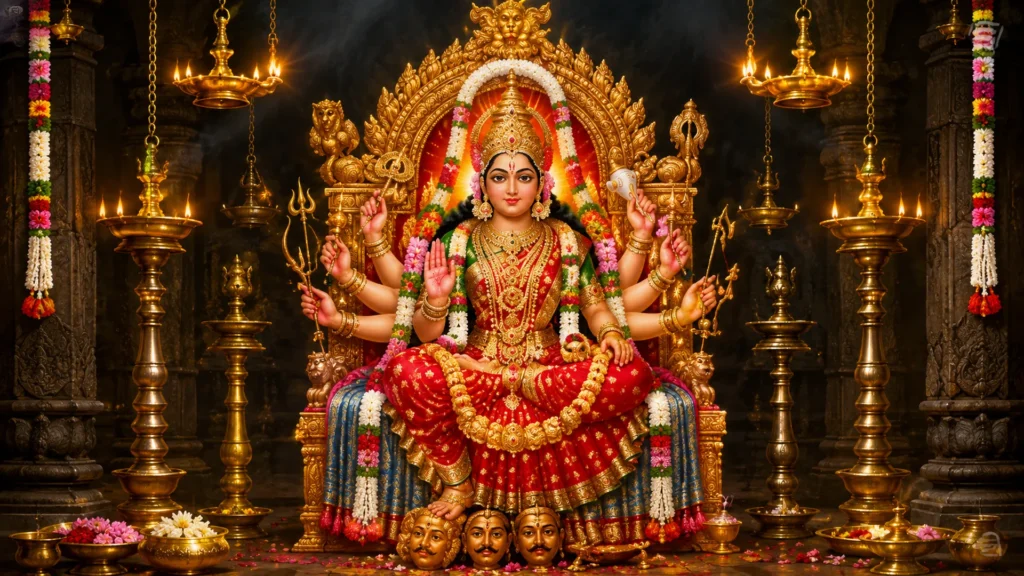
The Month of Marieammen Prayers
The prayer to Mother Marieammen is primarily observed by people of South Indian origin (Tamils, Telugu, Malayalam and so forth) BUT this month of prayer to Mother Marieammen should be observed by all Hindus. This article is sent out to make people of all cultures and faiths aware about Mother Marieammen. Jai Marieammen – all glories to you.
Since untold centuries, even long before villages sprang up, the people of South India have been worshiping the Goddess in Her fierce, Ma Kali like form of MARIEAMMEN. Mother Marieammen embodies the sacred energies and evolutionary forces of Mother Earth. She is related to the Kundalini fire rising up from the Muladhara Chakra. However, She is infinitely more than just that. Great saints worshiped Her as an integral aspect of ADI PARA SHAKTI, the Mother of the entire cosmic manifestation. For Her truly surrendered devotees, She shatters all their attachments and preconceived notions of reality. If Mother Kali is looked upon as the awakening force of death, Mother Marieammen is related to diseases and fevers, especially to the lethal affliction of feverish clinging to the illusions of an ego-oriented way of life.
The concept of Mother Worship has existed since time immemorial. Mother Shakti (her original name is Mother SATI), the Divine Mother, is portrayed as cosmic energy in its dynamic form. Being the Mother of the Universe She is ever ready to heed to the call of her devotees. At such an instance did the force manifest as MUTHU MARI AMMEN. MUTHU – Pearl, MARI – Rain, AMMEN – Mother, thus being titled as the mother of rain. One of the grandest festivals of the South Africa community, the Marieammen prayer, is observed every year during the Aadi Madham.
This year it falls between 17th July – 16th August
In a time of great drought, a time when people were plagued with measles, chicken pox, small pox, mumps, and so forth, they sought help from the Divine Mother. This Mother ever willing to help her children, manifested in the form of a woman garbed in a yellow sari, descended on the state of Samayapuram in the district of Thiruvekardu, South India. Here she fed the ill with porridge and nursed them with a mixture of Syringaberry leaves and turmeric paste. She continued healing the sick and when her work was done she retired to her abode.
Mother Marieammen is all-powerful and her vehicle is the lion, which we know as her Vaghanam. The lion is all-powerful and changes instantly according to his duty and purpose. Mother is also in control of the soil of the earth, hence her appearance as the Puttru (Puthu). Her presence can be strongly felt not only during the month of Aadi Madham, but throughout the year. The people who Mother Marieammen had cured sought her and wanted to know the identity of this mysterious MARI AATHAL. They found her seated under a Syringa tree. They asked her to reveal her identity and wanted to know how she could be thanked for saving the lives of so many. She disclosed herself as the Mother of the Universe and asked only that every year in the time that she appeared, her devotees gather in great numbers, and worship the Lord and she promised to be their guiding and protecting force. She then disappeared leaving torrents of rain to bathe the earth and aid the growth of all floras. She then became known as Samayapuram Mariaathal and her scripture is the Marieammen Thalatu. It is therefore; in this great month of Aadi that Mother Marieammen is venerated as the protector and curer of all miseries. The Gargam symbolizing her crown is carried honouring her as the Queen of the Universe. This prayer is now the thanksgiving prayer to Mother Marieammen.
How to perform one’s Marieammen prayers
Due to the above article on Mother Marieammen many people of Hindi background have requested me to compile information (which is given below) how to perform this very special prayer to our very merciful Mother Marieammen. I am really glad that people of different backgrounds are now praying to our merciful Mother. Please note that the advice given below is subject to change as many perform Ma’s prayers in many different ways and according to their heart’s desire. All Ma wants is your love that’s all and not showing off to others what a nice prayer you did for her. Keep it simple.
Now the two most popular ways to pray to Mother Marieammen is to firstly perform a havan and then offer to Ma her special food preparations. You can perform Ma’s prayers at any time of the Aadi Month (17th July – 16th August) and many perform Ma’s prayers on a Saturday due to time, place and circumstance constraints. But my humble suggestion is to perform Ma’s prayers on Fridays in the Aadi month.
It’s best to visit your local Marieammen temple to perform Ma’s prayers but if this is not possible then it can be performed in your house (if you live in a flat) or outside your house. After having a bath and wearing clean clothes you must arrange for a clean place to perform the havan and then to offer Ma the delicious food preparations that you have so lovingly cooked for her.
Below is a simple prayer format to perform to Marieammen.
This prayer process is very simple and cost effective.
If you cannot pronounce the Sanskrit mantras then read the English translations I have translated.
Lord Ganesh Prayer Procedure
At the prayer place, place a Lord Ganesh murti or photo. Firstly offer an agarbatti, lamp (with either ghee or oil with a wick or a small piece of camphor), a flower (or all three on a tray) to Shree Ganesh (turn seven times clockwise around the murti or photo).
Then offer Lord Ganesh Naivedhyam (either sweet rice, Soji, sugar candy or fruits, etc).
Finally pray to Shree Ganesh, praying to him to remove all obstacles in the path of your prayer that follows.
Marieammen Prayer Procedure
At the prayer place, place a Marieammen murti or photo.
Now chant the following:
- Hold your palms in the Namaste position and chant:
Om swagatam su swagatam – Om Marieammen-yai namah
(Swagatam means “O Marieammen I welcome you”.) - Offer one or three incense sticks (dhoopam) by turning it seven times clockwise around Marieammen’s deity/photo.
Om tato dhoopam aghraa-payaami – Om Marieammen-yai namah
O Marieammen I offer you this incense, kindly accept my offering. - Then offer a clay or brass lamp (deepam) with either ghee or oil with a wick or a small piece of camphor by turning it seven times clockwise around the deity/photo.
Om prat-yaksha deepam darshayaami – Om Marieammen-yai namah
O Marieammen I offer you this lamp offering, kindly accept my offering. - Then offer flower (pushpam) or flower petals by turning it seven times clockwise around Marieammen’s deity/photo.
Om idam pushpam – Om Marieammen-yai namah
O Marieammen I offer you this flower, kindly accept my offering. - Then offer cut fruit or sweet meats or sweet rice (Naivedyam). It should be in a small bowl with a teaspoon. Turn the bowl seven times clockwise around the deity/photo and bring the bowl near the lips of Marieammen suggesting she partakes in the food offering. Then leave this in front of the deity/photo. This is later consumed by the family as the Devi’s Prashad.
Om naivedyam samar-payaami – Om Marieammen-yai namah
O Marieammen I offer you this food offering, kindly accept my offering. - Then in a cup (lota/chumbhu) which has milk with sugar and turn the lota seven times clockwise around the deity/photo and bring the lota near the lips of Devi suggesting she drink the offering.
O Marieammen I offer you this milk offering, kindly accept my offering. - Offer prayers for forgiveness
Om yaani kaani cha papani janmaantara kritaani cha
taani sarvaani nashyanti pradakshina pade pade //
“O Compassionate Mother! Victory to You! Please do forgive all the errors committed by me with the hands, legs, speech, body, through actions, through the ears, eyes, mind or by not doing ordained actions or by doing prohibited actions”.
Then offer your personal prayers to Marieammen. Ask Marieammen for whatever you desire (within reason) and Devi being so merciful will grant what you desire. But be careful what you desire for. Bow down and leave the prayer place. The Dhaar is offered in your Devi thaan. The food offerings are eaten as prashadam.
You may chant the Marieamma Gayatri Mantra namely:
“Om Maha marie char vidmahe
ugra marie chadi mahi tanno marie prachodayat”
11, 21 or 108 times
You may chant or play the Marieammen’s Thalattu – The Lullaby to Mother Mari.
Now you can start with the havan
In a medium size bowl add about 100 g of sesame (Til) seeds; add 50g of vegetable or butter ghee, havan samaghree, and white rice. Mix all these ingredients together. Place wood in the havan kund (which should already have a little sand in it. The reason for this is so that the ghee does not leak out.) Take a little Ganga water and sip it three times chanting “Om Vishnu”. Now invite Lord Ganesh. You should already have a small picture or murti of Lord Ganesh. Chant “Om Ganapataye namah avaahaayaami sthaapayaami.” Offer/turn 3 times in a clockwise direction around the picture/murti of Shree Ganeshji firstly incense, then a lamp, flower petals and finally a sweet.
Thereafter invite Lord Vishnu and the devis and devas to the havan by saying “O Lord Vishnu, Sarva Devi’s and Devas and Mother Marieammen I ________ (your name) invite you all to this auspicious havan.”
Place camphor on the wood and light it.
Now start the offerings by the chanting the following mantras as follow:-
Offer the samaghree and chant swaahaa
Om Ganapataye swaahaa or (Potri – as used in South India) x 1
Om Sarasvatyai swaahaa x 1
Om agnaye swaahaa x 1
Om somaya swaahaa x 1
Om praja-pata-ye swaahaa x 1
Om indraya swaahaa x 1
Om bhuh swaahaa x 1
Om bhoovah swaahaa x 1
Om svah swaahaa x 1
Om bhoor bhuvah svah swaahaa x 1
Om Sooryaaya swaahaa x 1
Om Somaaya swaahaa x 1
Om Angaarkaaya swaahaa x 1
Om Budhaaya swaahaa x 1
Om Brihaspataye swaahaa x 1
Om Shukraaya swaahaa x 1
Om Shanaish-charaaya swaahaa x 1
Om Raahave swaahaa x 1
Om Ketave swaahaa x 1
Om Maha marie char vidmahe ugra marie chadi mahi tanno marie prachodayat swaahaa x 108
Om trayam bakkam yajaa-mahe sugan-dhim pushti-vardhanam urvaa-rooka-miva bandha-naam mrityor mooksheeya maamritaat swaahaa x 3
Om Shreem Mahaa-lakshmi-yai swaahaa x 1
Om Vishnave swaahaa X 1
Once this is complete ask Lord Vishnu, Mother Marieammen and all the Devis and Devas for forgiveness for any mistakes that were committed during the prayers and havan and chant the Maha Mantra “Hare Krishna Hare Krishna Krishna Krishna Krishna Hare Hare Hare Rama Hare Rama Rama Rama Hare Hare” 11 times to allay for any mistakes committed during the havan.
Requirements for the Havan:
One packet havan wood; 50g ghee; 100g til; havan kund, 100g white rice, 2 blocks of camphor.
After the havan is completed you can now offer all the food that you have cooked to Marieammen. In this holy month many Hindus of South Indian descent prepare offering foods like pumpkin, herbs etc for the Mother (Mata/Ammen). Ammen’s devotees know her just as Ammen/Marieammen, but her other name is Mother/Ammen Shakambhari devi. Of course many Hindus will say hmmm, I never heard of this Mother/ Mata before. Mother Shakambhari is an incarnation of Devi Durga, the consort of Lord Shiva. In times of famine, the Mother Durga comes down and gives vegan food to the hungry. (“Shaaka” comes from Sanskrit word meaning vegetables and vegan food; and “Ambari” means “one who wears or bears”). Actually the name Shakambhari comes from “shakam” joined with the root “bhri” (“shaka” = vegetables or food and root “bhri” = to nourish).
Mother Shakambhari (VIEW HER PHOTO BELOW) is mentioned in the 11th chapter of the Durga Path verses 46 – 49, as well as in Chapter 28 of the 7th book of the Devi Bhagavatam Purana. To put things into perspective view the picture below. Notice the pumpkin in Mata’s uppermost right hand, a variety of herbs, spanspek in the top left hand, corn, pineapple, sugarcane, bananas, snake gourd (chichinda), grapes, lime, green bananas, carrots, butternut, squash, bindi, mangoes, tomatoes, potatoes, brinjal, roots, etc. These are the most offered foods to Ma. Of course some will offer more and some less.
But these are the suggested foods that you can cook for our beloved Ma = Sour Porridge (see below on how to make sour porridge), mixed vegetable curry, pumpkin curry, and drumstick herbs curry. Of course you will also cook rice, roti or purees to go with the curries. In a corner place a picture of Ma and on the floor place syringaberry leaves and sprinkle a little hurdi (turmeric/manja) on the syringaberry leaves. Now place all the pots of food that you have cooked. The lids should be removed. Now pray to Mother Marieammen to please bless the food that you have cooked and ask Ma to guide and protect your family and yourself. After praying to Ma bow on the ground seeking Ma’s blessings. Leave the food for about 10 minutes. After about 10 minutes you can take out the food.
Before the prashad (blessed food from Ma) is consumed by the family members firstly take out a little of each of the prashad and place on a banana leaf and keep under a syringaberry tree. If you don’t have a syringaberry tree then you can keep it under any tree in your yard. The reason for doing this is that when one is married one promises to take care of the living entities and by offering the offered prashad to the different living entities the Supreme Lord and Mother Marieammen becomes very happy and pleased.
How to make sour porridge
A few days before your actual prayers to Ma obtain a 5L bucket and wash the outside and inside of the bucket with turmeric powder mixed with water. Dot the outside of the bucket with kumgum powder. Now add water in the bucket. Depending how many people you want to feed add mielie meal in the bucket. Cover the bucket with the lid and on the top of the lid place a few syringaberry leaves. Place the bucket near your Lakshmi/Prayer place. If you so desire you can now in front of the bucket light 7 small pieces of camphor and offer a lamp (diya) to Mother Marieammen seeking her Divine blessings to perform Her prayers. On the day of your prayers to Ma in a pot add water and as its half way boiled add the soaked mielie meal. Add salt for taste. It cooks rather quickly. Many have different ways to prepare sour porridge so this is our humble offering to those who don’t know how to prepare it. If you still confused ask a Tamil/Telugu person to help you.
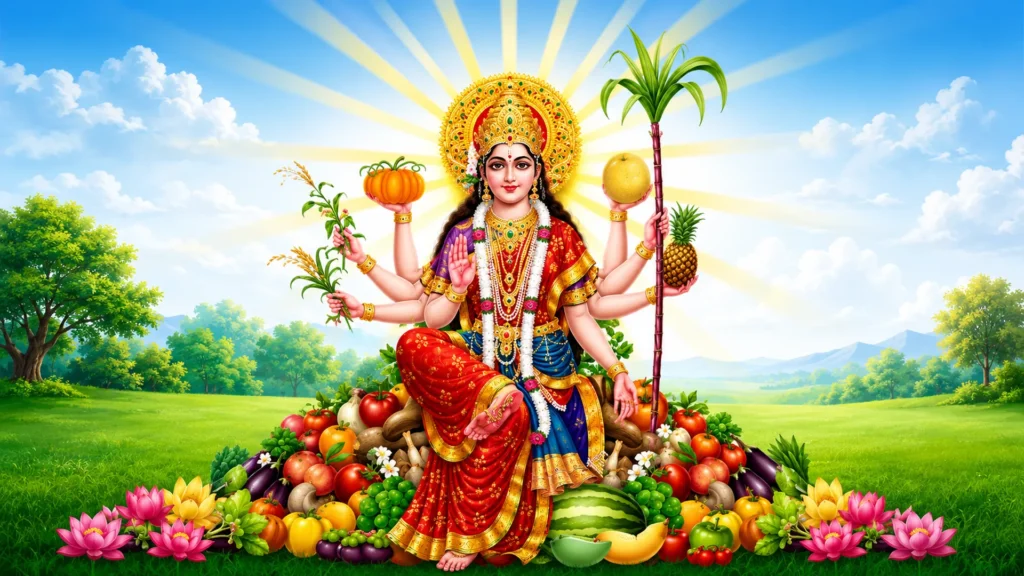
Mother Shakambhari also known as Marieammen
From the late Mala Lutchman’s “Tamil festivals”
Over the years many of those of South Indian origin following the worship of local Deities as it was handed down by the previous generations. Some of the rituals which had some meanings in earlier days, are now lost in antiquity and some devotees follow these rituals with blind faith only because it was handed down by their ancestors. Many due to fear do not question these Neanderthal minded rituals and if some did question them they would not find the appropriate answers. However it is heartening to note that the present generation are questioning the various rituals surrounding the worship and choosing to respectfully disregard them. At the same time it should be noted that some of the rituals are significant and meaningful.
What follows is an example of a ritual followed with blind faith. During a Marieammen prayer in the South African context, at the conclusion of the prayer that is observed in the morning, three elderly women are first served in the morning, with the fermented porridge together with the curries before it is distributed to others. These women received the porridge and curries with cupped hands. In the earlier days in South India at the Marieammen prayers people from low castes were given the porridge did not want their utensils and ladies to be “polluted” by coming in contact with the lower castes. Hence the low castes women were expected to receive their food in cupped hands. In South Africa, there are no caste considerations during this prayer, yet this is practice of the three women receiving the food in cupped hands is a definite feature of the prayer and has been copied and carried down without reasoning. Further to prevent the pollution of the ladies used by the high castes to serve those belonging to the low castes the coconut shell was used to serve the first helping of the porridge. This practice is also maintained here in South Africa. The caste system is almost non existent here in South Africa yet we follow this practice assuming it to be an integral part of the rituals.
Let us examine the observance of the worship of Marieammen, Maduraiveeran and Kaateri in the South African context. The Observance of the Marieammen prayer is a South African context.
At a temple three, five, seven or nine days prior to the day of the main prayer, in a container that is decorated with Turmeric, vermillion (Kugumum) and syringaberry leaves, maize meal is mixed with water and salt and is allowed to ferment. On this day milk and fruits are offered to Devi. For the remaining days up to the day of the main prayer special precautions are taken to ensure that this vessel containing the fermenting maize meal is unpolluted as this forms the main item of offering to Devi. The Marieammen festival usually commences on the first day of the month of Aadi and starts with the tying of the kaapu (a.k.a Tabeej, amulet, talisman) and the hoisting of the temple flag. The tying of the kaapu is seen as the protection against evil spirits that may want to invade the precincts of the temple. It also protects those involved in the festival by acting as a deterrent against evil forces. It also keeps in check the Shakti (Spiritual energy) invoked in particular persons during the festival and contains this shakti within the circle of the devotees and the temple. The hoisting of the flag is an indication that the festival has now begun and that people should observe the rules and regulations that the festival commands. The observance of the worship at the temple by the community collectively also gives those who cannot observe the worship for the current year for some reason or other (viz. lack of funds, etc) an opportunity to participate in the worship. The image of the Deity is washed with plain water, rose water mixed with turmeric powder, honey, milk, curd (yogurt), and sweet oil. This ceremonial washing is called an Abishegam. After this ceremonial washing the image is dried properly and clothed with a saree and adorned with jewelry and turmeric, kungumum, and sandalwood. These ingredients are very auspicious and dear to Devi. The image is then carried on a palanquin throughout the streets for worship by those who cannot come to the temple (the sick, elderly, the physically challenged, etc). Devotees offer coconut fruits, etc along the way. The offerings are made to the image and returned to the devotees with some sacred ashes (vibhuthi). Some devotees offer Devi turmeric water at the foot of the palanquin. This supposedly has a cooling effect on Devi. The image is then returned to the sanctum sanctorum of the temple. This pattern is followed every Friday, Saturday or Sunday during the auspicious month of Aadi. In the South African context the first Sunday of the Month of Aadi, is set aside for the worship of Marieammen at the temples throughout the country. Sunday is chosen merely out of convenience as Tuesdays and Fridays are considered auspicious days for Marieammen worship. This prayer is popularly known as “porridge prayers” among the south Indian community as the offering of the fermented porridge is the main part of the ritual. In India “ragi” (finger millet) is used to prepare the porridge but in South Africa due to the abundance and easy availability of maize, maize meal is used to prepare the porridge. On the actual day of the main worship the image of the deity is once again given a ceremonial bath and adorned with a beautiful saree, purchased especially for this occasion, jewelry and flowers. Kungumum, turmeric and sandalwood is also used generously to adorn the Murti of Marieammen. Specially prepared food items are offered to Devi. Few temples offer devi blood sacrifices offerings and non vegetarian offerings.
Other offerings to Devi
The offerings of coconut is symbolic in that the white kernel which is pure and untouched symbolizes the devotee’s pure faith. Turmeric water is poured at the feet of the Mother to cool the Goddess as turmeric is considered to have cooling properties. Syringaberry leaves are used liberally in the prayer and are cooling and contain germicidal properties. Syringa leaves which are rich in medical value is said to be particularly efficacious against measles and smallpox. Oil from the syringa plant (malia azaduachta) possesses varying degrees of anti-inflammatory properties. Maavilakku (a lamp made out of rice flour) is offered to Marieammen. It is a mixture of rice flour, honey, butter and milk. The maavilakku is unbaked, once again reiterating the quality of coolness. The mixture is then molded into the shape of a small lamp by making a depression in the middle into which oil, butter or ghee is poured. A wick is placed in the oil, butter or ghee and the lamp is then lit. Puranic kathas narrates that Lord Vishnu appeased the anger of His sister Durga Devi, who in her fury wanted to throw pox pearls onto the people in this world, by offering Devi this lamp. At the famous Samayapuram Marieammen temple in the district of Thiruchy in South India, a very special ritual concerning the maavilakku finds importance. The devotees who suffered from disease of the eyes, mouth, ears, stomach, hands, legs, etc. make a vow to offer a maavilakku to Marieammen should they be cured. Once cured the devotees fulfill their vow by offering a maavilakku to the Deity. The cured person lies on his/her back in front of the sanctum sanctorum and a maavilakku placed on a plantain (banana) leaf is placed on the affected part of the person’s body. The maavilakku is lit and after a while it is offered as prashad (blessed offerings) to everyone present.
MISCELLANEOUS INFO ON AADI MADHAM:
Aadi Pirappu – Aadi Pandigai – The first day of Aadi is observed as Aadi Pirappu. It means beginning of the month. The day begins with the making of huge kolams (Rangoli designs) in front of the home. The kolam is drawn on all days of the month. The kolams are bordered with red color – Kaavi. Doorways are decorated with mango leaves. The day begins with pujas and visit to temple. There will be a feast on the day with special delicacies include payasam(sweet rice), vadai, boli etc.
On the first day of Aadi, married women change the yellow thread in their Mangalsutra or thali. Dakshinayana Punyakalam (the night of the Deities), begins on the first day of the month Aadi.
MAY THE DIVINE MOTHER FOREVER BE YOUR GUIDING FORCE
All glories, all glories, all glories to Mother Marieammen.
Jai Marieammen
Article Dates
- 17th of July – 16th of August 2026: Aadi Madham period and month of Marieammen Prayers.
- Saturdays (during Aadi month): Days many perform Ma’s prayers due to constraints.
- Fridays (during Aadi month): Suggested days to perform Ma’s prayers.
- Three, five, seven, or nine days prior to main prayer: Period for starting fermentation of maize meal at temples.
- First day of the month of Aadi: Commencement of the Marieammen festival, tying of the kaapu, and hoisting of the flag.
- First Sunday of the Month of Aadi: Set aside for Marieammen worship at temples in South Africa.
- Tuesdays and Fridays: Considered auspicious days for Marieammen worship.
- Aadi Pirappu / Aadi Pandigai (First day of Aadi): Beginning of the month marked with kolams and feast.