

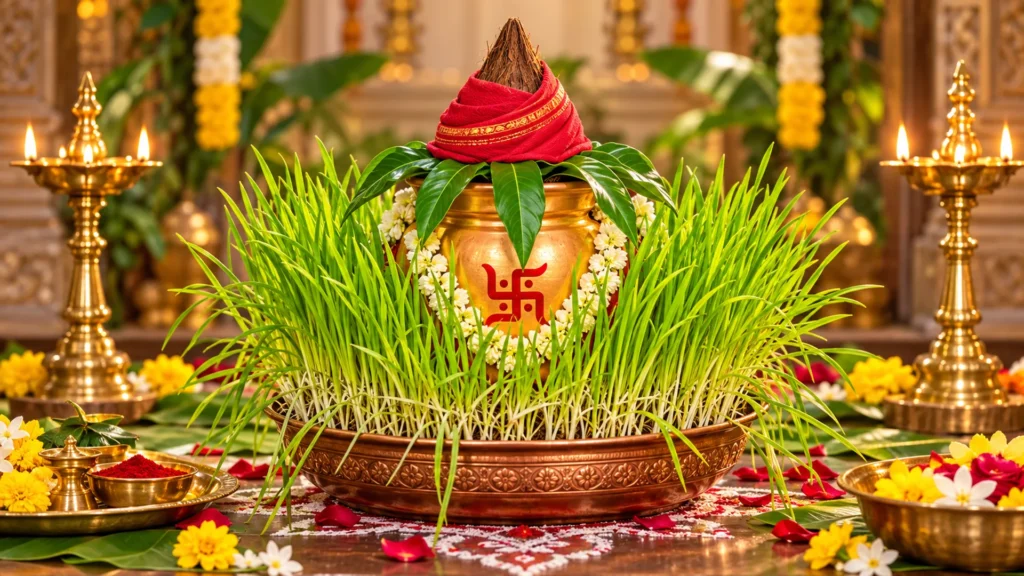
Ghatasthapana is one of the significant rituals during Navaratri. It marks the beginning of nine days of festivity. Our Vedic scriptures have well-defined rules and guidelines for performing Ghatasthapana during a certain period of time at the beginning of Navaratri. Ghatasthapana is an invocation of Goddess Shakti and commencing it wrong time, as our scriptures forewarn, might bring the wrath of the Goddess Shakti. Ghatasthapana is prohibited during Amavasya (new moon) and night time.
The most auspicious (Shubh) time to perform Ghatasthapana prayers is the first one- third of the day while Pratipada (the first Vedic day of the bright moon) is prevailing. If due to some reasons this time is not available then Ghatasthapana can be done during Abhijit Muhurta (refer below). The most important factor to consider is that Ghatasthapana is done before midday while Pratipada is prevailing.
Ghatasthapana prayer items
1. Wide and open Clay Pot to sow Sapta Dhanya (The seven types of grains are namely: Jau {Barley}, Brown Til, Rice {white unbroken rice) Green Moong Bean Dal, Chana Dal {Chickpea}, Gehun {Wheat} and Kangani {Foxtail Millet})
If you can’t procure the Millet then substitute with Red Lentils (Masoor Dal) or Black Gram (Urad dal) or Yellow Pigeon Peas (Toor Dal), or Horse Gram (Kulthi dal).
Srimad Devi Bhagavatam 8th book chapter 24 “On the worship of the Devi” Devi loves Til and Gram (pulses).
2. Clean Soil to sow Sapta Dhanya
3. Sapta Dhanya seeds of seven different grains
4. Navadaan (Nine types of grains)
5. Jau {Barley}, soaked overnight to be sowed on the first day in a small tray of sand.
6. Small clay or brass pot (Kalash)
7. Ganga Jal to fill the Kalash (pot)
8. Sacred thread (Moli / Mauli / Kalava)
9. Scent (Red perfume)
10. Supari (round betel nut)
11. A small packet (50g) of cloves with the “heads”
12. Hurdi (turmeric) powder
13. Coins to put into the Kalash
14. Five Mango leaves (it should not be torn or holes or damaged)
15. A clay (or saucer) lid to cover the Kalash
16. Raw rice or unbroken rice known as Akshat to put in the lid. I like adding a little red sindoor or hurdi with this rice.
17. A Coconut (cleaned with the turf still left). Wash and lightly smear with Hurdi (turmeric) paste. Let it dry.
18. Red Cloth to wrap the coconut.
19. Flowers and Garland preferably marigold.
20. Durva grass (common grass, the one you use for Ganesha puja)
21. Durbha grass (Kusha Grass)
22. Another small tray with clean sand to sow barley (Jau)
23. Small Ganesha photo or murti
24. Incense (preferably Rose or Jasmine as these are Devi’s favourites).
25. Clay lamp or Doobhakalsam
26. Clay lamp with cow ghee and a wick
27. Camphor + matches
28. Dhaar + a lota/cup/chumbu
29. Food offerings like Payasam (sweet rice) or other sweets. Fruits.
30. Liquid offerings like Dhaar mixture in a lota and/or a lota of milk with honey and/or a lota of water.
31. Jug of water, add a few drops of Ganga Jal.
32. Red string or Moli / Mauli / Kalava to be kept for blessing for the 9 “Vedic” days.
33. A Lakshmi red bag set (which consists of a mirror, comb, hurdi stick, various powders etc).
Kalash Preparation
The Kalash is prepared before invoking the Goddess and other Deities into it.
Step 1
On a large tray, place a yellow or red cloth or a fancy cloth. Place some Navadaan and white unbroken rice (not parboiled rice) or paddy rice in the centre of this tray on the cloth. Make sure it is designed in a circle shape. Now place the wide clay pot (the one which would be used to keep the Kalash) to sow the Sapta Dhanya grains on this Navadaan and white unbroken rice. Spread the first layer of the soil into the pot and then spread the grain and seeds. Now add the second layer of the soil and more grains. In the second layer, the grains should be spread near the periphery of the pot. Now spread the third & final layer of the soil into the pot.
Step 2
Now tie the sacred thread on the neck of the Kalash and fill it up with Ganga water up to the neck. Add the Supari, nine cloves, ½ tsp turmeric powder, red scent, Durva grass, Akshat and coins into the water. Keep five mango leaves at the edge of the Kalash (view the photo provided above) before covering it with a lid. On the lid have white rice grains (mix a little red sindoor or hurdi powder with this rice) to create stability for the coconut, otherwise, the coconut will fall to the side.
Step 3
Now take the cleaned coconut and wrap it with the red cloth. Fasten the coconut and red cloth with the sacred thread. Now keep the coconut on top of the Kalash prepared in step 2. Finally, install the Kalash in the centre of the grain pot prepared in Step 1. Now we have Kalash ready to invoke Durga Devi into it.
*** Optional and additional items to add on the Kalash and coconut if you so desire.
Make a knotted Kusha grass like the photo below and place it on the top of the Coconut.
A Lime garland. Lime (Nimbu) Lamp. Lime water (Nimbu Paanee). One Lime. A koki pen.
In the Devi Bhagavatam 11th Book chapter 18, mentions that Devi loves the smell of Sihlaka (Lobhaan/Samrani) and Guggula (Googul).
THE FULL PRAYERS TO LORD GANESHA AND DEVI DURGA
Lord Ganesh has been in the inner Earth since his immersing into the waters on Ganesh Visarjan powering up this Earth planet with positive energy hence he has been rather busy lately.
He appears once again once the sun rises on the first day of Navaratri in your locality.
This is the reason you find yourself rather pumped up with positive energy in the morning on the first day of Navaratri – all due to the grace of our Lord Ganesh – Mother Durga’s amazingly powerful child.
If you are observing this auspicious Maha Navaratri all the best and may the Mothers bless you with strength, good health and protection.
May the powerful force of the Mothers be with you.
This following prayer process is very simple and cost-effective.
If you cannot pronounce the Sanskrit mantras then read the English translations I have translated.
*** Before you commence I suggest sprinkling the place and yourself with Ganga Jal.
*** Next burn some Sihlaka (Lobhaan/Samrani) and Guggula (Googul). Devi loves the smell and it purifies the place from any lingering negative and stagnant energies.
Lord Ganesh Prayer Procedure
At the prayer place, place a Lord Ganesh murti or photo. Firstly offer an agarbatti, lamp (with either ghee or oil with a wick or a small piece of camphor) and a flower (or all three on a tray) to Shree Ganesh (turn seven times clockwise around the murti or photo). You may offer Lord Ganesh a sweet item and then Durva grass. Thereafter pray to Shree Ganesh, praying to him to remove all obstacles in the path of your prayer to his Mother.
Mother Durga Prayer Procedure
Now you invoke Durga Devi and request Devi to accept your prayers and to oblige you by kindly residing in the Kalash for the nine auspicious “Vedic” days.
Proceed with the prayers:
1. Hold your palms in the Namaste position and chant: Om swagatam su swagatam – Om Durga-yai namah (Swagatam means “O Mother Durga I welcome you”.) Light the clay lamp with cow’s ghee and a wick. Or should you desire to light a Lime (nimbu) lamp. You may light a Nimbu lamp daily or a few times during the nine days.
2. Offer one or three incense sticks (dhoopam) by turning them seven times clockwise around Mother Durga’s Kalash. Om tato dhoopam aghraa-payaami – Om Durga-yai namah O Mother Durga I offer you this incense, kindly accept my offering.
3. Then offer a clay or brass lamp (deepam) with either ghee or oil with a wick or a small piece of camphor by turning it seven times clockwise around the Kalash.
Om prat-yaksha deepam darshayaami – Om Durga-yai namah O Mother Durga I offer you this lamp offering, kindly accept my offering.
4. Then offer flower (pushpam) or flower petals by turning it seven times clockwise around Mother Durga’s Kalash. Om idam pushpam – Om Durga-yai namah O Mother Durga I offer you this flower, kindly accept my offering. Now garland Devi with the flower garland and if you desire also garland Devi with a lime garland.
5. Then offer cut fruit or sweetmeats or sweet rice (Naivedyam). It should be in a small bowl with a teaspoon. Turn the bowl seven times clockwise around the Kalash and bring the bowl near the lips of Mother Durga suggesting she partakes in the food offering. Then leave this in front of the Kalash. This is later consumed by the family as the Devi’s Prashad. Om naivedyam samar-payaami – Om Durga-yai namah O Mother Durga I offer you this food offering, kindly accept my offering. * Other foods that Devi loves are provided below.
6. A camphor tablet with 3 or 5 cloves. Place on a tile and light this. Pray to Devi. If you don’t get a popped clove (Beera), do not stress. That’s life, move on.
7. Then in a cup (lota/chumbhu) which has * Dhaar, turn this lota seven times clockwise around the Kalash and bring the lota Dhaar near the lips of Devi suggesting she drink the Dhaar offering. Drop three little drops of the dhaar on the tile in front of the just-lit camphor.
O Mother Durga I offer you your favourite drink Dhaar, kindly accept my offering.
* (What is DHAAR? I have included further information below)
Should you desire you may offer Devi Nimbu Paanee (Lime water) with sugar added.
Optional: Only on the first day, offer the little red Lakshmi bag (which consists of a mirror, comb, hurdi stick and various powders). Turn this around Devi and leave by Her side. Just like a cultured lady carries a little bag/purse of personal items (namely her face powder, mirror, comb etc), Devi is also offered this as well.
8. Offer prayers for forgiveness Om yaani kaani cha papani janmaantara kritaani cha taani sarvaani nashyanti pradakshina pade pade // “O Compassionate Mother Durga! Victory to You O Devi! Please do forgive me for all the errors committed by myself with my hands, legs, speech, body, through actions, through my ears, eyes, mind or by not doing ordained actions or by doing prohibited actions”.
In a small separate tray sow only Jau (barley) grains in the sand. This is lightly watered daily when offering prayers to Devi. The barley should be soaked in water from the previous night.
Thereafter offer your personal prayers to Mother Durga.
Optional 1: on the first day, you may offer the Mother a lime or lemon. You may write your name or initials on the lime or lemon with a Koki pen. Hold the lime or lemon and pray for what you desire like good health or a better job etc. Turn this lime 3 times around Her, and then this lime is kept for 9 days by the Kalash. On the 10th day, it is discarded in the garden or in a river. But be careful what you desire.
Optional 2: on the first day, I suggest you write all the things you desire from Devi on an A4 paper (but please don’t be unrealistic or ask for trivial things). Fold this page a few times and put into an envelope and then place it in between your palms and pray to Devi praying that what you wrote on the page comes true and you will observe this period of Navaratri with full conviction and purpose. Now leave this envelope with a R20 inside by
the Kalash. Use this money (R20) when you are buying items for the prayer a few days later. Daily pray to Devi to fulfil your desires on what you wrote on that page.
Bow down and leave the prayer place.
The Dhaar is offered in your Devi thaan and NOT a Tulsi plant.
The food offerings are eaten as prashadam.
1. Optional: Suggested Mother Durga mantra you may chant 11, 21 or 108 times: Om Dum Durga-yai namah “Salutations to the Devi who bestows compassion, fearlessness and patience”.
2. Optional: You may sing or hear the Durga Chalisa. Durga Chalisa click ( HERE ).
The brief outlay on the items on the tray
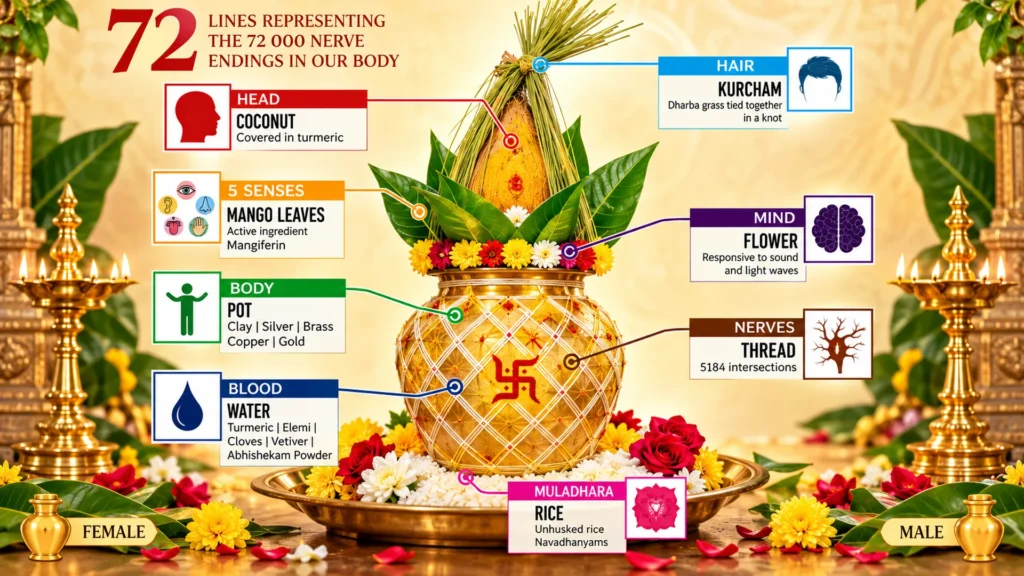
The coconut represents the head of Devi. Turmeric is lightly smeared on the coconut.
The clay pot represents Devi’s body. You may mark or design the clay pot with an Om or swastika sign with Sindhoor or Kungoo as the picture above shows.
The Five mango leaves represent Devi’s five senses.
The Darbha (Kusha) grass represents Devi’s hair (Koorcham) which is tied in a knot and placed on the top of the coconut.
The marigold flowers and garland represent Devi’s mind which is responsive to sound and light waves.
In the Kalash turmeric powder, cloves and Ganga Jal are added. This represents Devi’s blood.
The Sacred thread (Moli / Mauli / Kalava) represents the 72 nerves in Devi’s body.
The Navadaan and unhusked grains under the clay pot represent Devi’s Muladhara chakra. The Muladhara chakra is the root/base chakra in a human’s body. The Muladhara Chakra is associated primarily with survival. Living in South Africa is all about surviving the day.
Devi’s favourite foods are as follows: Lord Narayana said one should offer Devi the following items: Payasam (Sweet Rice, a.k.a Devi Payasa), Gur (jaggery), (Panchamrit which consists of honey, ghee, milk, yoghurt, sugar/gur), Takra (buttermilk), fresh butter, Karkati (cucumber), Kushmanda (pumpkin), Panasa (jackfruit), Kaseru (a.k.a Singhada, water chestnut), Surana (Yam), coconut, Jambira (lemon/lime), citrus fruits like Oranges, Plantains (bananas), Mango, Anar (pomegranate), Amla/Amalaki fruit, Til (Sesame) seeds, Modaka (sweet dumpling) and Dates, gram (pulses).
You may cook and offer Devi any of the above items during the nine days.
All the above items are mentioned in the
Srimad Devi Bhagavatam 8th book chapter 24 “On the worship of the Devi” and Srimad Devi Bhagavatam 11th Book chapter 18 “The greatness of Devi Puja”.
The significance of DHAAR offerings to the Divine Mother.
In any puja to Devi, particularly in Her Divine forms as Mother Durga/Bandi/Kali, Dhaar is offered. Unfortunately, there is no direct English translation of Dhaar from Sanskrit. The nearest being “The Divine Wine”. Now I said wine, but it does not refer to the famous wines we produce here in South Africa, rather this beverage – the “wine” – is especially Devi’s favourite. Many have been offering Devi Dhaar but have never had an idea as to why. So, below we are furnishing you with shastric proof of Dhaar and its importance in Devi puja.
What Dhaar consists of: Turmeric sticks, cloves, nutmeg (Jaiphal/Jaifar), almonds, elachie, flower petals (Hibiscus), sugar candy, camphor, turf, cows’s milk, honey, akshat (white unbroken rice) and syringaberry leaves. (kindly view the attached photo)
One may chant the following mantra from the “Shree Artha Argala Stotram” when offering Dhaar but if it’s rather difficult to pronounce then recite the English meaning… Om Jayanti Mangala Kaali Bhadra Kaali Kaapaalini Durga Shamma Shivaah Dhaatri Swaahaa Swaadhaa Namostute (Oh! Conqueror of all, Remover of darkness, Auspicious one, beyond time, the bearer of Skulls of Impure thoughts, Reliever of difficulties, loving forgiveness, supporter of the Universe. You are the one who truly receives the sacrificial offerings and the offerings to the Pitrs (Ancestors). To you I bow most merciful Devi.)
A question will be asked by some aspirants – “how many lotas of Dhaar should one offer?” I would humbly suggest one lota of Dhaar and from that one lota offer 9 times on your Thaan. Yes, you can offer 9 Lotas of Dhaar, but if you offering the Dhaar to a plant you going to drown that poor plant… So common sense should always prevail.
References of Dhaar From the Durga Paath
Devi is often depicted carrying a wine-cup enjoying Her divine wine, as noted in Devi Mahatyama (a.k.a Durga Saptashati, Chandi Homa or Durga Paath ) below:
In CHAPTER 2 of the Durga Path “Slaughter of the armies of Mahishasura” “I resort to Mahalakshmi, the destroyer of Mahishasura, who is seated on the lotus, is of the complexion of coral and who holds in her ( eighteen) hands rosary, axe, mace, arrow,
thunderbolt, lotus, bow, pitcher, rod, sakti, sword, shield, conch, bell, wine-cup, trident, noose and the discus Sudarshana.”
Shloka 34. ”Enraged, Chandika, the Mother of the worlds, quaffed a divine drink again and again, and laughed, her eyes became red.”
.Shlokas 30-
33. “The lord of wealth (Kubera) gave Devi a drinking cup, ever full of wine.
Sesha, the lord of all serpents, who supports this earth, gave Devi a serpent-necklace bedecked with best jewels. Honoured likewise by other devas also with ornaments and weapons, Devi gave out a loud roar with a decrying laugh again and again. By her unending, exceedingly great, terrible roar the entire sky was filled, and there was great reverberation. All worlds shook, the seas trembled.”
Shloka 36. “And Devi, with showers of arrows, pulverized those mountains hurled at her, and spoke to him in flurried words, the colour of her face accentuated with the intoxication of the divine drink.”
.CHAPTER 3 of the Durga Paath “The Slaying of Mahishasura”
Shlokas 37-38. “’Roar, roar, O fool, for a moment while I drink this wine. When you will be slain by me, the devas will soon roar in this very place.’”
A frequently asked question is what to do with the coconut after the Puja. During the Mothers Puja, the Three Mothers was invited into the coconut but now once the Puja is completed the Three Mothers return back to their abodes to be with Their Husbands.
WHAT DO I DO WITH THE COCONUT?
There are three (
3. options, (
1. One now proceeds to a river or Ocean to immerse the coconut.
Then recite the following mantra for immersion with raw white rice, flowers in your right hand Yaantu Deva-Ganaah Sarve, Poojaa maadaaya Maamakim Ishta-Kaama-Samriddhyartham, Punaraagamanaaya Cha॥
Mantra Meaning – May all the Devi’s accept the worship performed by me and leave here to come again for the prosperity of the desired desires.
Durga Visarjan is a ritual performed at a specific time during Vijaya Dasami. Most times, Visarjan Muhurat (auspicious time) occurs during morning.
Auspicious Muhurat of Durga Visarjan (Durban, South Africa) (
2. Dig a hole (½ metre) in your yard. Fill with water (and the do as #
1. This is to simulate a river or ocean. This is for those that reside far from a river or ocean. (
3. The coconut placed on the kalash is broken and eaten as prashad. Distribute between your family members and friends.
Do note: BEST ADVICE IS TO FOLLOW #1 if all circumstances are ideal.
WHAT DO I DO WITH THE SARI OR CLOTH?
I am huge propagator of protecting Mother Earth. Disposing of Sari’s in the ocean is not ideal due to marine creatures may be harmed.
I humbly suggest keeping the sari and gifting it to a family member or friend to adorn herself as Matarani’s Prashad (blessings).
Question: When does one break their salt-less Navaratri vrat?
Answer: Generally, after the Durga Visarjan ritual, one break their Navaratri fasting. Hence Durga Visarjan timing can also be considered for Navaratri Parana (breaking with salted foods). If you had observed a salt-less vrat then break your vrat with salted vegetarian foods after your Vijaya-dasami prayers. Many staunch devotees do break their salt-less fast after sunset of Vijaya-dasami.
* If you are implying about breaking with non-veg foods then I am not the appropriate person to answer that. I am an advocate of vegetarianism.
*** Kindly note that all the pooja ingredients should be disposed off in a way that it should not harm our environment as well as our religious sentiments should also be maintained.