

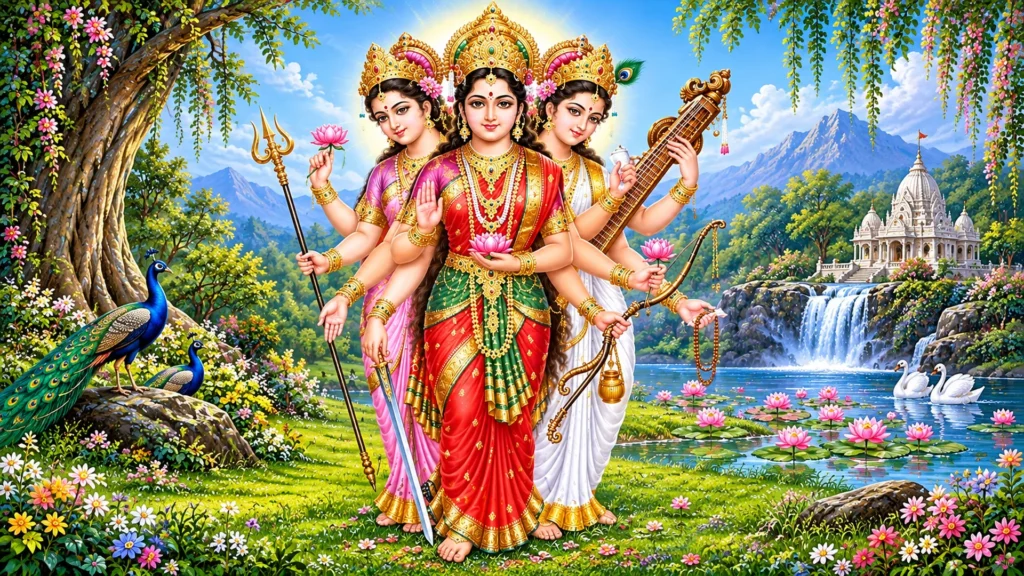
Navaratri is one of the most observed festivals observed by Hindus all across the material world. The word Navaratri (nava-nine and ratri-nights) literally means nine nights dedicated to the worship of the Mother in her three main forms i.e. Durga Devi, Lakshmi Devi and Saraswati Devi. Navaratri is observed four times a year but the main Navaratri is the one that is observed in this period for nine days and nights. During this period, devotees of the Mother observe a fast, feed Brahmins and prays to the Mother for protection, better health and the fulfillment of one’s desires.
Maha/Sharad Navaratri
Sharad Navaratri: This is the most important of the Navaratris. It is simply called Maha Navaratri (the Great Navaratri) and is celebrated in the month of Ashwina. It is celebrated during Sharad (beginning of winter in India, September–October) and is the festival of nine “Vedic” days dedicated to the nine forms of Mother Durga or the three main forms of the Mother namely Mother’s Durga, Lakshmi and Saraswati. Maha (Sharad) Navaratri is observed over 9 Gregorian days.
During the nine “Vedic” Magha Gupta Navaratri days, devotees may worship Devi in three formats, namely:
First format:
The first three days are dedicated to Mother Durga The middle three days are dedicated to Mother Lakshmi The final three days are dedicated to Mother Saraswati
Second format: (each day represents a form of the Supreme Devi):
Day 1 (Pratipada) Navaratri color of the day – ORANGE Mother Shailputri is worshipped Day 2 (Dwitiya) Navaratri color of the day – WHITE Mother Brahmacharini is worshipped Day 3 (Tritiya) Navaratri color of the day – RED Mother Chandraghanta is worshipped Day 4 (Chaturthi) Navaratri color of the day – ROYAL BLUE Mother Kushmanda is worshipped th 15 October Day 5 (Panchami) Navaratri color of the day – YELLOW Mother Skandamata is worshipped Day 6 (Shashti) Navaratri color of the day – GREEN Mother Katyayani is worshipped Day 7 (Saptami) Navaratri color of the day – GREY Mother Kalaratri is worshipped Day 8 (Ashtami) Navaratri color of the day – PURPLE Mother Mahagauri is worshipped Day 9 (Ashtami/Navami) Navaratri color of the day – PEACOCK GREEN Mother Siddhidatri is worshipped Day 10 (Dashami) Vijay Dashami/Dussehra DURGA VISARJAN
Third format:
The predominating devi deity for
Maha/Sharad Navaratri
is Adi Para Shakti Herself as Durga devi.
Who is Durga devi? A brief synopsis…

Durga Devi with Lord Raam, Ravana, Lakshman, Hanumanji, Vibhishan, and the Deva’s
Durga (Sanskrit: दर्गा ु Durga) is a major deity and supreme divinity in the Vedic scriptures. Durga devi is worshipped as one of the principal aspects of the supreme divinity Mahadevi and is also one of the most popular and widely revered among Vedic divinities. Durga devi is associated with protection, strength, motherhood, destruction and wars. Durga devi’s fame centres around combating evils and demonic forces that threaten peace, prosperity and Dharma, the power of good over evil. Durga devi unleashes her divine wrath against the wicked for the liberation of the oppressed, and includes destruction to empower creation. Durga devi is seen as a motherly figure and is often depicted as a beautiful woman, riding a lion or tiger, with many arms each carrying a weapon, and often defeating demons. She is widely worshipped by the followers of the goddess centric sect, Shaktism, and has importance in other denominations like Shaivism (devotees of Lord Shiva) and Vaishnavism (devotees of Lord Vishnu). The two most
important scriptural texts of Shaktism, Devi Mahatmya and Devi-Bhagavat, reveres Devi or Shakti (goddess) as the primordial creator of the universe, and the Brahman (ultimate truth and reality). While all major texts of Hinduism (Sanatan Dharma) mention and revere the goddess, these two texts centre around her as the primary divinity. The word Durga (दर्गा ु ) literally means “impassable”, “invincible, unassailable”. It is related to the word Durg (दर्गु ) which means “fortress, something difficult to defeat or pass”. According to the Monier-Williams Sanskrit dictionary, Durga is derived from the roots “dur” (difficult) and “gam” (pass, go through).
The beginning of summer and winter are two very important junctions of climatic and solar influence. These periods are taken as sacred opportunities for the worship of Durga Devi, the “warden of the material world.” Jai Mata Di.
Many misunderstand the importance of Mother Durga and Lord Shiva. So we shall explain briefly. Mother Durga is the warden of the material world. Durga means “fort, prison house”. So this material world is a mega prison house where one who has committed a great sin is sent. What is this great sin I am talking about? Well at one stage we where very envious of Lord Krsna and thought that we are greater than Lord Krsna and due to this grave sin we were cast into this prison house we suffer in this material world. And guess what most it seems have not learnt their lesson. Don’t you find so much of envy still taking place? It seems this world is being engulfed with hate and enviousness. In this material world Mother Durga punishes us with the Trishul (the 3 – pointed spear), which she holds in the hand. The 3-pointed Trishul represents the three fold miseries of life, which are as follows: – miseries caused by the higher beings, miseries caused by natural disasters and finally miseries caused by envious people. Now in the prison if the warden is favorable to one then that person’s prison life can be heavenly, but if one is not in favorable terms with the warden, then life can be worse than hell. That’s why we should be very humble towards Mother Durga. And remember that she is no ordinary personality. One of her names in the Durga Sahasranama is “Vaishnavi” – the female devotee of Lord Krsna. Also in Shree Krsna Lila Mother Durga appears as Lord Krsna’s sister. Now when one serves his sentence he is sent to the spiritual world. But waiting for you on the outskirts of the spiritual world is Lord Shiva (Vaishnava yatha shambu –the greatest devotee of Lord Krsna) in Shiva – loka. If one has even the slightest amount of materialism, desire, or obstacle he is sent back down by Lord Shiva to rid himself of that desire, etc.
Lord Shiva’s duty is to make sure that only qualified persons are allowed to enter the spiritual world. So the husband-wife team of Durga-Shiva really plays an extremely important in Sanatana Dharma (the eternal religion). Lord Krsna would not have given these important jobs to just anyone other than the two most qualified personalities who are also great devotees of Lord Krsna.
Jai Durga Mata …… Jai Uma pati Mahadeva
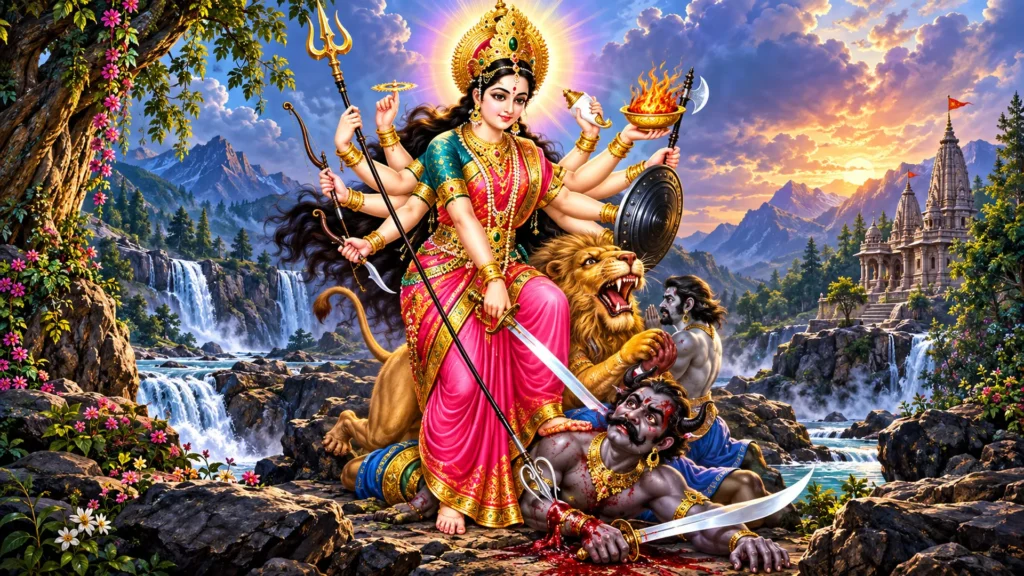
There are many versions of Mother Durga’s activities. Many ask but isn’t this confusion? Which do we believe? Well all are correct. You see different pastimes are enacted in different Yugas hence there are many many pastimes. Now who said Hinduism is boring.
So some of the Kathas are as follows: Durga Devi’s mother desired to see her daughter. So Lord Shiva permitted her to go and see her mother only for nine days in a year. The festival of Durga Puja marks this brief visit and ends on Vijaya Dasami, when Mother Durga leaves for her return to Mount Kailash. Another katha is that these nine days are held in commemoration of the victory of Mother Durga’s over the great demon Mahishasura, the buffalo-headed demon. Another version is that Mother Durga fought with Bhandasura and his forces for nine days and nine nights. This Bhandasura had a wonderful birth and life. When Lord Shiva burnt Kama (Cupid) with the fire from his third eye, Shree Ganeshji playfully molded a figure out of the ashes, and the Lord breathed life into it. Thus the terrible demon Bhandasura was created. He engaged himself in great penance and on account of it obtained a boon from Lord Shiva. With the help of that boon, he began harassing the three worlds. Then Mother Durga could not stand this and fought with him for nine nights – the demons have extraordinary strength during the night and killed him on the evening of the tenth day, known as Vijaya Dasami.
(Vijaya Dasami is a very auspicious day. On this day Mother Durga bestows her divine blessings upon those who have observed a vrat/fasting for the 10 days for Her.)
Also since learning of any science is begun on this day. It was on this day that Shree Arjuna worshipped Mother Durga before starting the battle against the Kauravas on the field of Kurukshetra. Also Shree Raam worshipped Mother Durga at the time of the fight with Ravana, to invoke her aid in the battle. This was on the days preceding Vijaya Dasami. He fought and won through her grace. (But please understand that Shree Raam did not need Mother Durga’s help, after all He is the Supreme Lord, but to engage His devotee He allowed it. This is the Lord’s mercy upon His devotees.)
A child is more familiar with the mother than with the father, because the mother is very kind, loving, tender and affectionate, and looks after the needs of the child. In the same way we cannot go to Lord Krsna, Lord Shiva, Lord Rama, etc without the mercy of their
consorts (wives), i.e. Radharani/Rukmini, Ma Durga, and Sita-devi respectively. So in the same way one can easily attain the mercy of the Lord once one receives the mercy of Their consort. So one has to receive the mercy of Mother Durga first to receive the mercy of Lord Shiva. Durga Devi’s grace and mercy, compassion, knowledge, power, glory are endless. She can bestow upon the devotee material prosperity as well as spiritual freedom. Remember she is a devotee of Lord Krsna, and to go to Lord Krsna one has to receive the mercy of a devotee and who better than Mother Durga.
Approach Ma with an open heart. Lay bare your heart to her with frankness and humility. Be as simple as a child. Ask Ma to remove your egoism, pride, vanity, envy, cunningness, selfishness and meanness but also pray to Ma to bless you with wealth (material and spiritual), auspiciousness, prosperity, knowledge and so forth. Make a total, unreserved self-surrender to Ma. Sing Ma’s glories and chant Ma’s names with total faith. Navaratri is one of the most suitable times to perform intense spiritual practices. So do not waste this opportunity.
Navaratri is actually divided into nine Vedic days. The first three Vedic days is dedicated to Mother Durga, the next three days are dedicated to Mother Lakshmi and the last three days are dedicated to Mother Saraswati.
Naivedyam (food offerings) to the Mothers during the Navaratri Fast
During Navaratri, devotees prepare sattvik offerings for the Mothers, apart from the regular food items, which include puran (a sweet made of gram and jaggery) and varan (an item made of toor-dal) in the meal. The Naivedhyam, which includes puran and varan, radiates the activated raja component and thus energy-laden, absolute Fire element frequencies, from the Universe, get attracted to it in less time. When one consumes the Naivedhyam as prasad, one benefits from the energy frequencies which are absolute Fire element oriented and, thereby, purification of one’s gross and subtle bodies takes place. The Navaratri fast is observed from the first day to the ninth day. Some devotees only observe a fast during three days i.e., a first fast during any one of the first three days and a second fast during any one of the next three and last in any one of final three days. Some devotees consume just milk and fruits during the nine days. Most devotees take a single meal during the day. Non- vegetarian food and intoxicants are totally avoided. Do note however, it’s not compulsory to offer the offerings below, it’s just a guide.
In South India, nine types of Naivedyam (food offerings) are offered to Mother Durga during Navaratri. In India, the nine Devi’s worship differ from place to place and state to state, so the Naivedhyam (food) also differs. We are kindly providing a list of Naivedhyams for Navaratri (as per the standard procedure):
1. First day – Shailaputri Devi is worshipped as Shree Kanaka Durga – Chalividi (fried rice), vadapappu (boiled Bengal grams), and payasam (sweet rice) naivedyam.
2. Second day – Brahmacharini Devi is worshipped as Balatripura Sundari Devi – sweet boondi and chickpeas naivedyam.
3. Third day – Chandraghanta Devi is worshipped as Gayatri Devi – Rava (wheat semolina) kesari and pulihora (sour rice/tamarind rice/lemon rice) naivedyam.
4. Fourth day – Kushmanda Devi is worshipped as Annapurna Devi – Pongali (cooked sweet rice-dal) naivedyam.
5. Fifth day – Skanda Mata Devi is worshipped as Lalitha Tripura Sundari Devi – Pulohorai/Pulihora (sour rice/tamarind rice/lemon rice) and Pesara boorelu (recipe of Green grams) naivedyam.
6. Sixth day – Katyayani Devi is worshipped as Saraswati Devi – bellam Atukulu (beaten rice with jaggery), Senaga pappu (Bengal gram), and coconut are offered as naivedyam.
7. Seventh day – Kalaratri Devi is worshipped as Mahalakshmi Devi – Ksheerannam (rice boiled in milk), bellam (jaggery), and sugar are offered as naivedyam.
8. Eighth day – Mahagauri Devi is worshipped as Sri Durga Devi – Garelu (Vedda) and lemon juice are offered.
9. Ninth day – Siddhidhatri Devi is decorated and worshipped as Mahishasura Mardhini Devi – Chakra Pongali (pudding) is offered as naivedyam.
10. Tenth day – Durga Devi is worshipped as Sri Rajarajeshwari Devi – Pulihora and garelu are offered.
Please note that The Nine Goddesses to worship during Navaratri, the nine types of colours, and nine types of Naivedhyams (food offerings) may differ as per the particular temple’s Agama Shastra and their owned rituals. This can also change according to the nakshatra, tithi, and year.
So the first three days we pray to Mother Durga – we pray to Ma to destroy our impurities, our vices and our defects. We pray to Ma to guide us through the many dangers and pitfalls that we experience in our lives, and to prevent such negative occurrences in the future. Thus the first three days mark the first stage of the destruction of impurities and the determined effort to root out the evil tendencies in us.
Once you have accomplished your task on the negative side- that of breaking down all the impure propensities and old, vicious habits – the next step is to build up a sublime spiritual personality, to acquire positive qualities in place of the demoniac qualities. Now the devotee must cultivate and develop all the auspicious qualities that a devotee should possess. The devotee has to earn spiritual wealth to enable him/her to receive the rare gem of divine wisdom. If this is not achieved then the old demoniac natures will surface again and again. Hence, this stage is as important in a devotee spiritual life as the first step. The difference between the first step and the second step is that the first step is ruthless and determined annihilation of the impure egoistic self and the latter is an orderly, steady, calm and serene effort to develop purity. Now this serene side is depicted by the worship of Mother Lakshmi. Ma (being the wealth– giving aspect of Lord Narayana) bestows upon the devotee the inexhaustible divine wealth. Once the devotee succeeds in rooting out the evil propensities, and develops pure, divine qualities, he/she becomes competent to attain wisdom. He/she is now ready to receive the light of supreme wisdom and divine knowledge. At this stage comes the devout worship of Mother Saraswati, who is divine knowledge personified, the embodiment of knowledge of the eternal truths. Ma bestows on the devotee the rarest gem i.e. knowledge of the Supreme Lord. (Please note Mother Saraswati is no ordinary personality. Besides being the wife of Lord Brahma, Ma along with Shree Ganesh-ji is always worshiped first at the commencement of any studying or pujas. In the Srimad Bhagavatam 1.2.4 Shree Sukadeva Goswami chants “Devim sarasvatim” – “Before reciting this Srimad Bhagavatam I offer my respectful obeisance’s to Lord Narayana, Mother Saraswati, the goddess of learning and to Srila Vyasadeva.” So for Sukadeva Goswami to chant Saraswati Devi name says it all. He gives Ma plenty of importance.
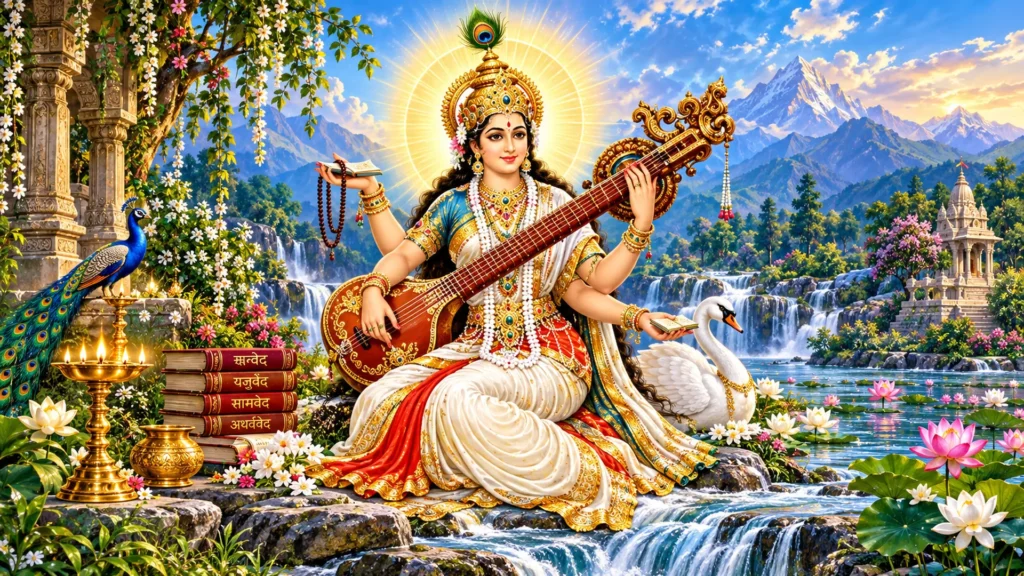
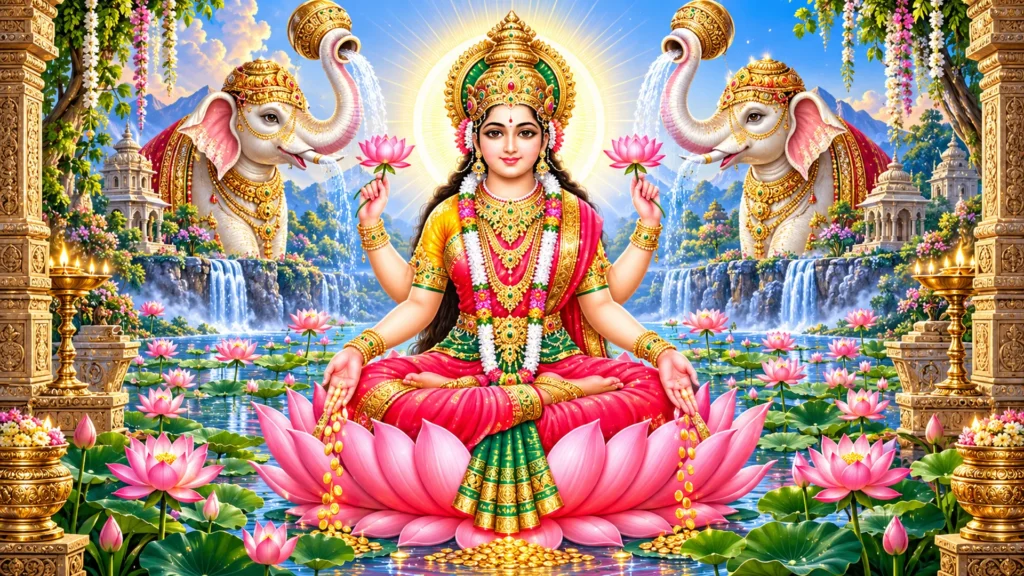
Then on Vijaya Dasami great celebrations are held.
So briefly once again during on the first three days worship a Mother Durga murti/picture at your altar place. The murti/picture should be garlanded and looking very beautiful. Offer Ma arati (incense, lamp, flowers and finally sweets/fruits/or milk). The sweets/fruits/or milk should be consumed later. Then you should chant the mantras that we have supplied below as a guide. If you have a special mantra you can also chant that as well. Mother Durga only had Dhaar to drink in the 9 days, Mata didn’t eat anything until the demons were all destroyed hence many devotees to show their commitment to Mother Durga also observe a fast/vrat for 9 days like Mother Durga did. If it’s possible, try to perform a salt less fast until the evening in these nine-days or try to perform it according to your abilities. (If you suffer from diabetes, etc it will not be possible, so as I have mentioned perform this vrata according to your abilities. The idea is to try to perform the vrata with faith and not be fanatical.
On Vijaya Dasami, Kanya Puja is performed. Nine young girls below the age of 10 are worshipped as the embodiments of the Divine Mother. They are fed sumptuously and, amongst other things, presented with new clothes (or gifted something as a present according to your means). On this day you can perform a grand puja glorifying the three mothers.
Mantras of Mother Durga/Kali to chant during this period:
Om hreeng dung durgaayai namah Om hreeng shreeng kleeng durgati naashin-yai mahaa maayaa yai namah (this is a wish fulfilling mantra) Om Aing hreeng kleeng chaamun-daayai vich-chai namah Please note the n and d are pronounced with the tip oftongue on the roof of your mouth.
Mantras of Mother Lakshmi to chant during this period:
Om Shreeng mahaa lakshma-yai namah Om shreeng hreeng kaleeng hreeng shree mahaa lakshmai ya namah
Mantras of Mother Saraswati to chant during this period:
Om shreeng hreeng sarasvat-yai namah Om aing hreeng shreeng vaag-dev-yai saras-wat-yai namah
On the first day, after having a bath, Jau seeds (a.k.a barley seeds, jau seeds, jav seeds, yava, hordeum vulgare) are planted on a tray which has sand in it so that this grows in front of the lota for the next 10 days which the Mothers will be worshipped (all of which are explained below, in the Simple D.I.Y. Navaratri Puja). On the evening before Navaratri, add one handful of Jau seeds in water and let it soak overnight. Every day a little water is sprinkled over the seeds. These seeds will germinate for the 10 days. “Why this is performed?” one may ask – this is done to honour Mother Shakambhari devi (who is mentioned in the 11 th chapter of the Durga Paath and is none other than an expansion of Mother Durga). Mother Shakambhari devi is the mother of nourishments.
For more information on Mother Shakambhari devi kindly Ctrl-Click (HERE).
Ghatasthapana Puja Vidhi during Maha Navaratri
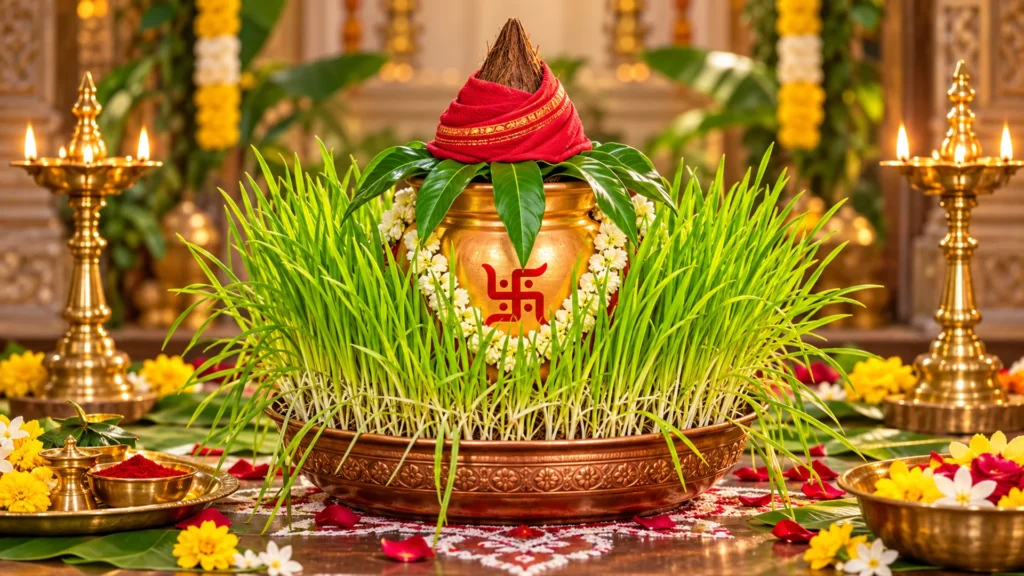
Ghatasthapana is one of the significant rituals during Navaratri. It marks the beginning of nine days of festivity. Our Vedic scriptures have well-defined rules and guidelines for performing Ghatasthapana during a certain period of time at the beginning of Navaratri. Ghatasthapana is an invocation of Goddess Shakti and commencing it wrong time, as our scriptures forewarn, might bring the wrath of the Goddess Shakti. Ghatasthapana is prohibited during Amavasya (new moon) and night time.
The most auspicious (Shubh) time to perform Ghatasthapana prayers is the first one- third of the day while Pratipada (the first Vedic day of the bright moon) is prevailing. If due to some reasons this time is not available then Ghatasthapana can be done during
Abhijit Muhurta (refer below). The most important factor to consider is that Ghatasthapana is done before midday while Pratipada is prevailing.
Ghatasthapana prayer items
1. Wide and open Clay Pot to sow Sapta Dhanya (The seven types of grains are namely: Jau {Barley}, Brown Til, Rice {white unbroken rice) Green Moong Bean Dal, Chana Dal {Chickpea}, Gehun {Wheat} and Kangani {Foxtail Millet}) If you can’t procure the Millet then substitute with Red Lentils (Masoor Dal) or Black Gram (Urad dal) or Yellow Pigeon Peas (Toor Dal), or Horse Gram (Kulthi dal). Srimad Devi Bhagavatam 8th book chapter 24 “On the worship of the Devi” Devi loves Til and Gram (pulses).
2. Clean Soil to sow Sapta Dhanya
3. Sapta Dhanya seeds of seven different grains
4. Navadaan (Nine types of grains)
5. Jau {Barley}, soaked overnight to be sowed on the first day in a small tray of sand.
6. Small clay or brass pot (Kalash)
7. Ganga Jal to fill the Kalash (pot)
8. Sacred thread (Moli / Mauli / Kalava)
9. Scent (Red perfume)
10. Supari (round betel nut)
11. A small packet (50g) of cloves with the “heads”
12. Hurdi (turmeric) powder
13. Coins to put into the Kalash
14. Five Mango leaves (it should not be torn or holes or damaged)
15. A clay (or saucer) lid to cover the Kalash
16. Raw rice or unbroken rice known as Akshat to put in the lid. I like adding a little red sindoor or hurdi with this rice.
17. A Coconut (cleaned with the turf still left). Wash and lightly smear with Hurdi (turmeric) paste. Let it dry.
18. Red Cloth to wrap the coconut.
19. Flowers and Garland preferably marigold.
20. Durva grass (common grass, the one you use for Ganesha puja)
21. Durbha grass (Kusha Grass)
22. Another small tray with clean sand to sow barley (Jau)
23. Small Ganesha photo or murti
24. Incense (preferably Rose or Jasmine as these are Devi’s favourites).
25. Clay lamp or Doobhakalsam
26. Clay lamp with cow ghee and a wick
27. Camphor + matches
28. Dhaar + a lota/cup/chumbu
29. Food offerings like Payasam (sweet rice) or other sweets. Fruits.
30. Liquid offerings like Dhaar mixture in a lota and/or a lota of milk with honey and/or a lota of water.
31. Jug of water, add a few drops of Ganga Jal.
32. Red string or Moli / Mauli / Kalava to be kept for blessing for the 9 “Vedic” days.
33. A Lakshmi red bag set (which consists of a mirror, comb, hurdi stick, various powders etc).
Kalash Preparation
The Kalash is prepared before invoking the Goddess and other Deities into it. Step 1 – On a large tray, place a yellow or red cloth or a fancy cloth. Place some Navadaan and white unbroken rice (not parboiled rice) or paddy rice in the centre of this tray on the cloth. Make sure it is designed in a circle shape. Now place the wide clay pot (the one which would be used to keep the Kalash) to sow the Sapta Dhanya grains on this Navadaan and white unbroken rice. Spread the first layer of the soil into the pot and then spread the grain and seeds. Now add the second layer of the soil and more grains. In the second layer, the grains should be spread near the periphery of the pot. Now spread the third & final layer of the soil into the pot. Step 2 – Now tie the sacred thread on the neck of the Kalash and fill it up with Ganga water up to the neck. Add the Supari, nine cloves, ½ tsp turmeric powder, red scent, Durva grass, Akshat and coins into the water. Keep five mango leaves at the edge of the Kalash (view the photo provided above) before covering it with a lid. On the lid have white rice grains (mix a little red sindoor or hurdi powder with this rice) to create stability for the coconut, otherwise, the coconut will fall to the side. Step 3 – Now take the cleaned coconut and wrap it with the red cloth. Fasten the coconut and red cloth with the sacred thread. Now keep the coconut on top of the Kalash prepared in step
2. Finally, install the Kalash in the centre of the grain pot prepared in Step
1. Now we have Kalash ready to invoke Durga Devi into it.
*** Optional and additional items to add on the Kalash and coconut if you so desire. Make a knotted Kusha grass like the photo below and place it on the top of the Coconut. A Lime garland. Lime (Nimbu) Lamp. Lime water (Nimbu Paanee). One Lime. A koki pen.
In the Devi Bhagavatam 11th Book chapter 18, mentions that Devi loves the smell of Sihlaka (Lobhaan/Samrani) and Guggula (Googul).
THE FULL PRAYERS TO LORD GANESHA AND DEVI DURGA
Lord Ganesh has been in the inner Earth since his immersing into the waters on Ganesh Visarjan powering up this Earth planet with positive energy hence he has been rather busy lately.
He appears once again once the sun rises on the first day of Navaratri in your locality.
This is the reason you find yourself rather pumped up with positive energy in the morning on the first day of Navaratri – all due to the grace of our Lord Ganesh – Mother Durga’s amazingly powerful child.
If you are observing this auspicious Maha Navaratri all the best and may the Mothers bless you with strength, good health and protection.
May the powerful force of the Mothers be with you.
This following prayer process is very simple and cost-effective.
If you cannot pronounce the Sanskrit mantras then read the English translations I have translated.
*** Before you commence I suggest sprinkling the place and yourself with Ganga Jal.
*** Next burn some Sihlaka (Lobhaan/Samrani) and Guggula (Googul). Devi loves the smell and it purifies the place from any lingering negative and stagnant energies.
Lord Ganesh Prayer Procedure
At the prayer place, place a Lord Ganesh murti or photo. Firstly offer an agarbatti, lamp (with either ghee or oil with a wick or a small piece of camphor) and a flower (or all three on a tray) to Shree Ganesh (turn seven times clockwise around the murti or photo). You may offer Lord Ganesh a sweet item and then Durva grass. Thereafter pray to Shree Ganesh, praying to him to remove all obstacles in the path of your prayer to his Mother.
Mother Durga Prayer Procedure
Now you invoke Durga Devi and request Devi to accept your prayers and to oblige you by kindly residing in the Kalash for the nine auspicious “Vedic” days.
Proceed with the prayers:
1. Hold your palms in the Namaste position and chant: Om swagatam su swagatam – Om Durga-yai namah (Swagatam means “O Mother Durga I welcome you”.) Light the clay lamp with cow’s ghee and a wick. Or should you desire to light a Lime (nimbu) lamp. You may light a Nimbu lamp daily or a few times during the nine days.
2. Offer one or three incense sticks (dhoopam) by turning them seven times clockwise around Mother Durga’s Kalash. Om tato dhoopam aghraa-payaami – Om Durga-yai namah O Mother Durga I offer you this incense, kindly accept my offering.
3. Then offer a clay or brass lamp (deepam) with either ghee or oil with a wick or a small piece of camphor by turning it seven times clockwise around the Kalash. Om prat-yaksha deepam darshayaami – Om Durga-yai namah O Mother Durga I offer you this lamp offering, kindly accept my offering.
4. Then offer flower (pushpam) or flower petals by turning it seven times clockwise around Mother Durga’s Kalash. Om idam pushpam – Om Durga-yai namah O Mother Durga I offer you this flower, kindly accept my offering. Now garland Devi with the flower garland and if you desire also garland Devi with a lime garland.
5. Then offer cut fruit or sweetmeats or sweet rice (Naivedyam). It should be in a small bowl with a teaspoon. Turn the bowl seven times clockwise around the Kalash and bring the bowl near the lips of Mother Durga suggesting she partakes in the food offering. Then leave this in front of the Kalash. This is later consumed by the family as the Devi’s Prashad. Om naivedyam samar-payaami – Om Durga-yai namah O Mother Durga I offer you this food offering, kindly accept my offering. * Other foods that Devi loves are provided below.
6. A camphor tablet with 3 or 5 cloves. Place on a tile and light this. Pray to Devi. If you don’t get a popped clove (Beera), do not stress. That’s life, move on.
7. Then in a cup (lota/chumbhu) which has * Dhaar, turn this lota seven times clockwise around the Kalash and bring the lota Dhaar near the lips of Devi suggesting she drink the Dhaar offering. Drop three little drops of the dhaar on the tile in front of the just-lit camphor.
O Mother Durga I offer you your favourite drink Dhaar, kindly accept my offering.
* (What is DHAAR? I have included further information below)
Should you desire you may offer Devi Nimbu Paanee (Lime water) with sugar added.
Optional: Only on the first day, offer the little red Lakshmi bag (which consists of a mirror, comb, hurdi stick and various powders). Turn this around Devi and leave by Her side. Just like a cultured lady carries a little bag/purse of personal items (namely her face powder, mirror, comb etc), Devi is also offered this as well.
8. Offer prayers for forgiveness Om yaani kaani cha papani janmaantara kritaani cha taani sarvaani nashyanti pradakshina pade pade // “O Compassionate Mother Durga! Victory to You O Devi! Please do forgive me for all the errors committed by myself with my hands, legs, speech, body, through actions, through my ears, eyes, mind or by not doing ordained actions or by doing prohibited actions”.
In a small separate tray sow only Jau (barley) grains in the sand. This is lightly watered daily when offering prayers to Devi. The barley should be soaked in water from the previous night.
Thereafter offer your personal prayers to Mother Durga.
Optional 1: on the first day, you may offer the Mother a lime or lemon. You may write your name or initials on the lime or lemon with a Koki pen. Hold the lime or lemon and pray for what you desire like good health or a better job etc. Turn this lime 3 times around Her, and then this lime is kept for 9 days by the Kalash. On the 10th day, it is discarded in the garden or in a river. But be careful what you desire.
Optional 2: on the first day, I suggest you write all the things you desire from Devi on an A4 paper (but please don’t be unrealistic or ask for trivial things). Fold this page a few times and put into an envelope and then place it in between your palms and pray to Devi praying that what you wrote on the page comes true and you will observe this period of Navaratri with full conviction and purpose. Now leave this envelope with a R20 inside by the Kalash. Use this money (R20) when you are buying items for the prayer a few days later. Daily pray to Devi to fulfil your desires on what you wrote on that page.
Bow down and leave the prayer place.
The Dhaar is offered in your Devi thaan and NOT a Tulsi plant.
The food offerings are eaten as prashadam.
1. Optional: Suggested Mother Durga mantra you may chant 11, 21 or 108 times: Om Dum Durga-yai namah “Salutations to the Devi who bestows compassion, fearlessness and patience”.
2. Optional: You may sing or hear the Durga Chalisa. Durga Chalisa click ( HERE ).
The brief outlay on the items on the tray
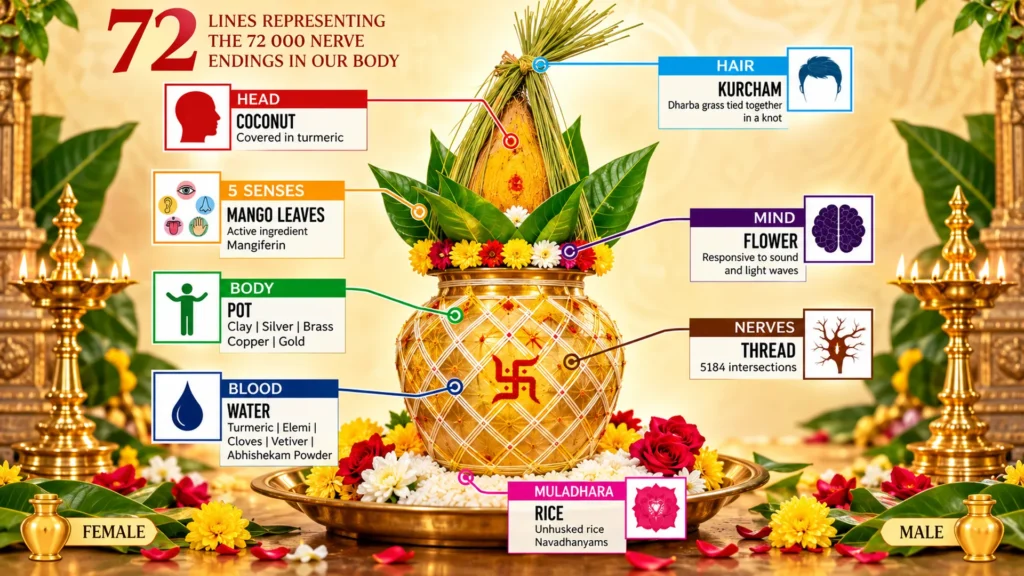
The coconut represents the head of Devi. Turmeric is lightly smeared on the coconut.
The clay pot represents Devi’s body. You may mark or design the clay pot with an Om or swastika sign with Sindhoor or Kungoo as the picture above shows.
The Five mango leaves represent Devi’s five senses.
The Darbha (Kusha) grass represents Devi’s hair (Koorcham) which is tied in a knot and placed on the top of the coconut.
The marigold flowers and garland represent Devi’s mind which is responsive to sound and light waves.
In the Kalash turmeric powder, cloves and Ganga Jal are added. This represents Devi’s blood.
The Sacred thread (Moli / Mauli / Kalava) represents the 72 nerves in Devi’s body.
The Navadaan and unhusked grains under the clay pot represent Devi’s Muladhara chakra.
The Muladhara chakra is the root/base chakra in a human’s body. The Muladhara Chakra is associated primarily with survival. Living in South Africa is all about surviving the day.
Devi’s favourite foods are as follows: Lord Narayana said one should offer Devi the following items: Payasam (Sweet Rice, a.k.a Devi Payasa), Gur (jaggery), (Panchamrit which consists of honey, ghee, milk, yoghurt, sugar/gur), Takra (buttermilk), fresh butter, Karkati (cucumber), Kushmanda (pumpkin), Panasa (jackfruit), Kaseru (a.k.a Singhada, water chestnut), Surana (Yam), coconut, Jambira (lemon/lime), citrus fruits like Oranges, Plantains (bananas), Mango, Anar (pomegranate), Amla/Amalaki fruit, Til (Sesame) seeds, Modaka (sweet dumpling) and Dates, gram (pulses).
You may cook and offer Devi any of the above items during the nine days.
All the above items are mentioned in the Srimad Devi Bhagavatam 8th book chapter 24 “On the worship of the Devi” and Srimad Devi Bhagavatam 11th Book chapter 18 “The greatness of Devi Puja”.
The significance of DHAAR offerings to the Divine Mother.
In any puja to Devi, particularly in Her Divine forms as Mother Durga/Bandi/Kali, Dhaar is offered. Unfortunately, there is no direct English translation of Dhaar from Sanskrit. The nearest being “The Divine Wine”. Now I said wine, but it does not refer to the famous wines we produce here in South Africa, rather this beverage – the “wine” – is especially Devi’s favourite. Many have been offering Devi Dhaar but have never had an idea as to why. So, below we are furnishing you with shastric proof of Dhaar and its importance in Devi puja.
What Dhaar consists of: Turmeric sticks, cloves, nutmeg (Jaiphal/Jaifar), almonds, elachie, flower petals (Hibiscus), sugar candy, camphor, turf, cows’s milk, honey, akshat (white unbroken rice) and syringaberry leaves. (kindly view the attached photo)
One may chant the following mantra from the “Shree Artha Argala Stotram” when offering Dhaar but if it’s rather difficult to pronounce then recite the English meaning… Om Jayanti Mangala Kaali Bhadra Kaali Kaapaalini Durga Shamma Shivaah Dhaatri Swaahaa Swaadhaa Namostute (Oh! Conqueror of all, Remover of darkness, Auspicious one, beyond time, the bearer of Skulls of Impure thoughts, Reliever of difficulties, loving forgiveness, supporter of the Universe. You are the one who truly receives the sacrificial offerings and the offerings to the Pitrs (Ancestors). To you I bow most merciful Devi.)
A question will be asked by some aspirants – “how many lotas of Dhaar should one offer?” I would humbly suggest one lota of Dhaar and from that one lota offer 9 times on your Thaan. Yes, you can offer 9 Lotas of Dhaar, but if you offering the Dhaar to a plant you going to drown that poor plant… So common sense should always prevail.
References of Dhaar From the Durga Paath
Devi is often depicted carrying a wine-cup enjoying Her divine wine, as noted in Devi Mahatyama (a.k.a Durga Saptashati, Chandi Homa or Durga Paath ) below:
In CHAPTER 2 of the Durga Path “Slaughter of the armies of Mahishasura” “I resort to Mahalakshmi, the destroyer of Mahishasura, who is seated on the lotus, is of the complexion of coral and who holds in her ( eighteen) hands rosary, axe, mace, arrow, thunderbolt, lotus, bow, pitcher, rod, sakti, sword, shield, conch, bell, wine-cup, trident, noose and the discus Sudarshana.”
Shloka 34. ”Enraged, Chandika, the Mother of the worlds, quaffed a divine drink again and again, and laughed, her eyes became red.”
.Shlokas 30-
33. “The lord of wealth ( Kubera) gave Devi a drinking cup, ever full of wine.
Sesha, the lord of all serpents, who supports this earth, gave Devi a serpent-necklace bedecked with best jewels. Honoured likewise by other devas also with ornaments and weapons, Devi gave out a loud roar with a decrying laugh again and again. By her unending, exceedingly great, terrible roar the entire sky was filled, and there was great reverberation. All worlds shook, the seas trembled.”
Shloka 36. “And Devi, with showers of arrows, pulverized those mountains hurled at her, and spoke to him in flurried words, the colour of her face accentuated with the intoxication of the divine drink.”
.CHAPTER 3 of the Durga Paath “The Slaying of Mahishasura”
Shlokas 37-38. “’Roar, roar, O fool, for a moment while I drink this wine. When you will be slain by me, the devas will soon roar in this very place.’”
A frequently asked question is what to do with the coconut after the Puja. During the Mothers Puja, the Three Mothers was invited into the coconut but now once the Puja is completed the Three Mothers return back to their abodes to be with Their Husbands.
WHAT DO I DO WITH THE COCONUT?
There are three (
3. options, (
1. One now proceeds to a river or Ocean to immerse the coconut.
Then recite the following mantra for immersion with raw white rice, flowers in your right hand Yaantu Deva-Ganaah Sarve, Poojaa maadaaya Maamakim Ishta-Kaama-Samriddhyartham, Punaraagamanaaya Cha॥
Mantra Meaning – May all the Devi’s accept the worship performed by me and leave here to come again for the prosperity of the desired desires.
Durga Visarjan is a ritual performed at a specific time during Vijaya Dasami. Most times, Visarjan Muhurat (auspicious time) occurs during morning.
Auspicious Muhurat of Durga Visarjan (Durban, South Africa)
(
2. Dig a hole (½ metre) in your yard. Fill with water (and the do as #
1. This is to simulate a river or ocean. This is for those that reside far from a river or ocean. (
3. The coconut placed on the kalash is broken and eaten as prashad. Distribute between your family members and friends.
Do note: BEST ADVICE IS TO FOLLOW #1 if all circumstances are ideal.
WHAT DO I DO WITH THE SARI OR CLOTH?
I am huge propagator of protecting Mother Earth. Disposing of Sari’s in the ocean is not ideal due to marine creatures may be harmed.
I humbly suggest keeping the sari and gifting it to a family member or friend to adorn herself as Matarani’s Prashad (blessings).
Question: When does one break their salt-less Navaratri vrat?
Answer: Generally, after the Durga Visarjan ritual, one break their Navaratri fasting. Hence Durga Visarjan timing can also be considered for Navaratri Parana (breaking with salted foods). If you had observed a salt-less vrat then break your vrat with salted vegetarian foods after your Vijaya-dasami prayers. Many staunch devotees do break their salt-less fast after sunset of Vijaya-dasami.
* If you are implying about breaking with non-veg foods then I am not the appropriate person to answer that. I am an advocate of vegetarianism.
*** Kindly note that all the pooja ingredients should be disposed off in a way that it should not harm our environment as well as our religious sentiments should also be maintained.
How to perform your own Navaratri Havan
The Havan can only be performed during the Navaratri period and NOT on Vijaya Dasami.
The Navaratri Havan is performed in your home. You should have a bath and put on clean clothes before proceeding to the puja place. Have all the requirements for the Puja and the havan arranged on a tray beforehand. Sit facing East or North.
Wash your hands and then place some water in your right hand and sip water from the palm of the right hand, chant Om Vishnu, wash your hands again and do this two more times.
Say in English “O Lord Krsna on this day (which ever day you are performing the havan), in this month of Ashwina, your name, I am performing my Navaratri Havan.
Take a betel leaf, betel nut, rice and flowers and pray to Shree Ganeshji “Om ganapataye aavaahayaamee sthapayamee” and keep on the bedi. Offer Lord Ganesha incense, lamp, flowers and some sweet rice and then betel leaf and then finally lamp. Then offer Lord Ganesha his favourite food viz. kheer (sweet rice), sugar candy and laddus.
Take another betel leaf, betel nut, rice and flowers and pray to The Three Mothers “Om Durga-devi, Lakshmi-devi Sarasvati-devi aavaahayaamee sthapayamee” and keep on the bedi. Then offer The Three Mothers incense, lamp, flowers and some sweet rice and then betel leaf and nut and then finally lamp.
Then light the fire with a pieces of camphor and place in the havan kund. Place some wood in the kund now. You can add more camphor in the kund.
Chant the mantra Om Agni Devtaa bhyo Namah
Offer a Tulsi Twig into the fire. (this is optional).
The Samaghree mixture consists of (Til, white rice, jaw {jau}, nav-daan, and lobhan).
Now we start the havan… every time “swaahaa” is chanted, offer samaghree into the fire. Om Ganapata-ye swaahaa Om Saraswati-yai swaahaa Om sooryaaye swaahaa Om somaaye swaahaa Om angaarkaaye swaahaa Om budhaaye swaahaa Om brihaspataye swaahaa Om shukraaye swaahaa Om shanaish-charaaye swaahaa Om raahave swaahaa Om ketave swaahaa Om Prajaapataye swaahaa Om Indraaya swaahaa Om Agnaye swaahaa Om Bhooh swaahaa Om Bhuvah Swaahaa Om Swah Swaahaa
Om Hanumate swaahaa Om aim hreem kleem chaamun daayai vich chai swaahaa x 9 “Om trayam bakkam yajaa-mahe sugan-dhim pushti-vardhanam urvaa-rooka-miva bandha-naam mrityor mooksheeya maamritaat” Om swaahaa x 11 om shareeng hareeng kaleeng hareeng shri maha lakshmiyai swaahaa X 9 Om Namo Naaraaya-naaye swaahaa Om Namo Bhagavate Vaasudevaayaa swaahaa Om Shree Vishnave swaahaa Om shreeng hreeng sarasvat-yai swaahaa X 9 Om Brahmaye Swaahaa Om Sarva Devee Devebhyo swaahaa.
Offer samaghree 9 times with the Maha Mantra “Hare Krishna Hare Krishna Krishna Krishna Hare Hare Hare Rama Hare Rama Rama Rama Hare Hare” to allay for any mistakes committed during the havan.
Offer water three times around the havan kund in a clockwise direction.
Finally place two purees on top of each other, place the balance of the samaghree on top of these, on top of this place a betel leaf, a betel nut, some white rice, a few drops of ghee and place whole into the fire while chanting “Om sarvam vai poornam swaahaa”, and place this in the middle of the fire. Offer the rest of the ghee into the fire. Thereafter you should bow down before the fire and then stand up and you can offer Artee to the fire and to your family Deities with a lamp. Your final prayer is to chant the Maha-mantra three times which is as follows (“Hare Krishna Hare Krishna Krishna Krishna Hare Hare Hare Rama Hare Rama Rama Rama Hare Hare”) to nullify any mistakes you made while performing this prayer to the Three Mothers.
Jaya Durga Ma Jaya Lakshmi Ma Jaya Saraswati Ma