


The information below is rare and sacred knowledge that most of the Hindu populace are likely not to be aware of. The sacred information provided below has been kindly supplied by our divine Mother Saraswati.
The importance of the Kush grass in ancestor worship
Srimad Bhagavatam, 3rd Canto, Chapter 13 (Ctrl+Click “HERE” – to read about the detailed katha that follows).
The Srimad Bhagavatam mentions that Lord Varaha is the third of the Das-Avatars, the ten principal avatars of Lord Krishna/Vishnu. When the demon Hiranyaksha stole the earth (personified as the goddess Bhudevi) and hid her in the primordial waters, Lord Krishna/Vishnu appeared as Lord Varaha (the boar incarnation) to rescue her.
Lord Varaha slew the demon and retrieved the Earth from the ocean, lifting her on His tusks, and restored Bhudevi to her rightful place in the universe. When the Lord picked up the earth (Mother Dharthi), the Lord automatically wedded her as He touched her.
In the previous Yugas (ages) the Vedic custom was that if a male touches a female not of his family lineage (kul) he is considered to be wedded to that female. Thank goodness this custom is forbidden in Kali-Yuga. So when Lord Varaha-deva picked up the earth, Mother Earth then assumed the name of Srimati Varahi-devi, the consort of Lord Varaha-deva. Varahi-devi is also one of the 8 Devi’s that assisted Mother Durga in the Durga Paath to destroy the powerful demonic forces.
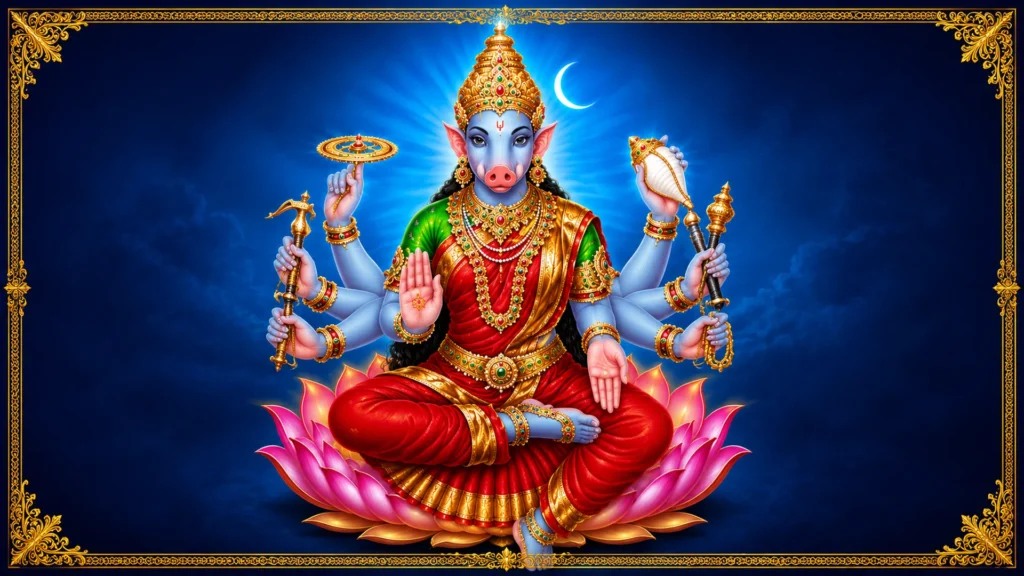
Varahi-devi (a.k.a Mother Earth/Bhumi-devi/Dharthi-devi)
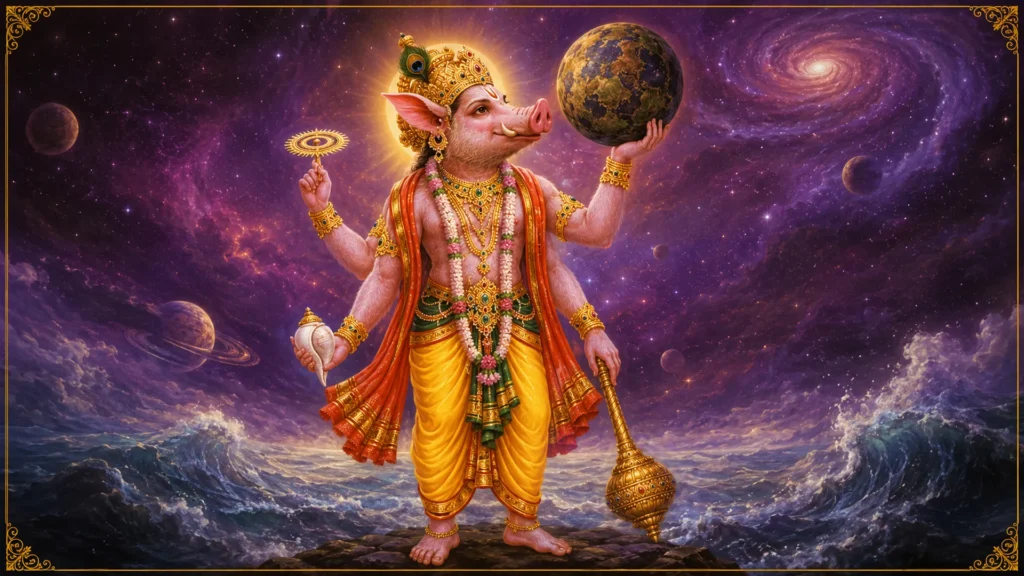

Lord Varaha-deva (a.k.a. Lord Vishnu, Lord Narayana, Lord Krishna, Lord Raam)
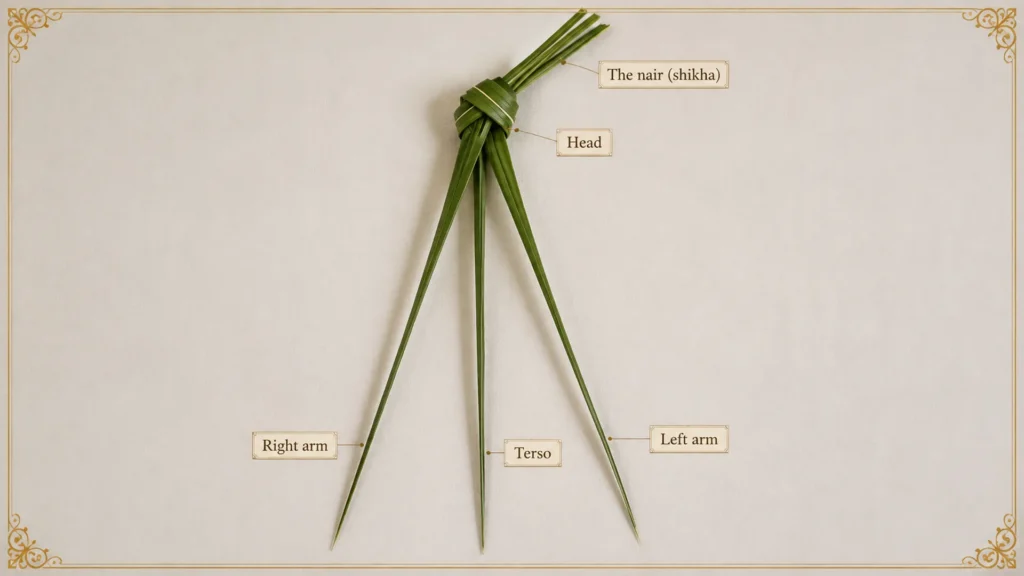
From the above picture: Just above the knotted kush grass is the Lord’s hair (like how the male devotees of Lord Krsna have a “shika” {choorkee}), the knotted kush is the Lord’s head, the right part of the kush is the Lord’s right arm/hand, the left part is the Lord’s left arm/hand and finally the middle part is the Lord’s torso/body and legs.
Hence this knotted kush grass figurine is actually a Kush Deity – the same as the one you would view in a temple. When the knotted Kush is planted in the ground (kindly view this picture on the next page), that is a deity form of Lord Varaha-deva, and the ground represents Mother Earth (Varahi-devi). So, in doing this, one is bringing together Varahi-devi and Varaha-deva. Amazing, isn’t it? So when people comment that Pitr Paksha is an inauspicious time, this cannot be further from the truth – as when the water is finally offered on the kusha grass that’s planted on the ground, you are ultimately worshipping Varahi-Varaha (a.k.a Lakshmi-Narayan, Sita-Raam, Rukmini-Krsna, etc…).
Kush (also known as Kusha grass, Darbha, Dharbhe, Dharbai, etc.) is very highly regarded and valued in ancestor prayers. In the Garuda Purana, Preta Khanda, Chapter 29, Verse 18, Lord Vishnu states to Lord Garuda: “Darbha grass is born of My hair”… More verses on the Kush grass are mentioned on the next page of this article.
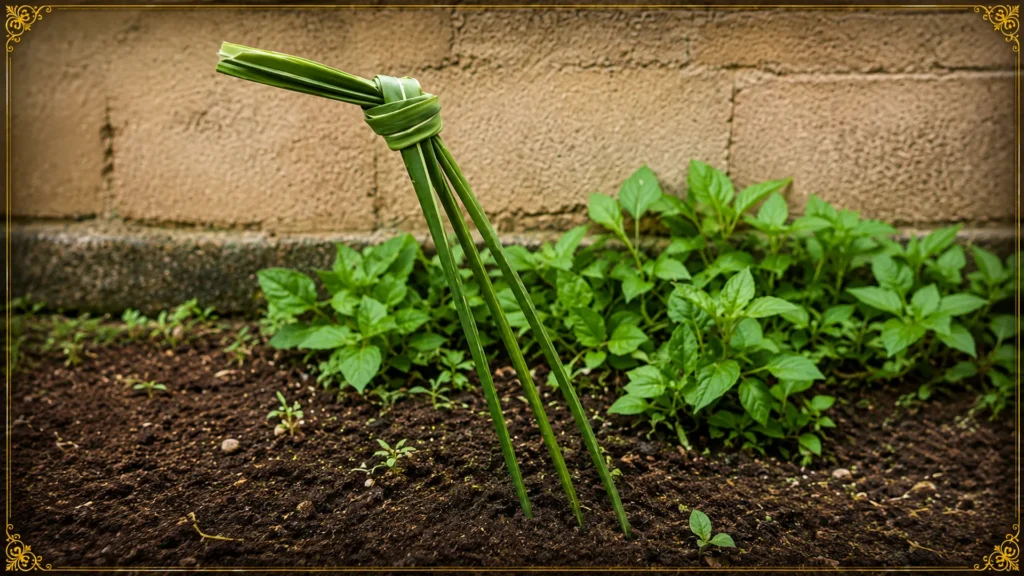
Do note:- Pitr is also spelt as Pitri, Pitars or Pitaras. On the first morning of Pitr Paksha one should make a knotted kusha grass deity and then plant it into the earth, as the picture provided depicts. Many of those who follow the “old school of thought” shudder at the thought of doing anything during an eclipse, but according to History of Dharamshastra, Yagyavalka and Satapata, it is very beneficial to perform Shraddha (which includes offering of Tarpan {water}) during an eclipse.
“Vyatipaato gajachaayaa grahanam chandrasuryayoh, shraadham prathi ruchish chaithe shraadhakaalaah prakirthithaah” which means “Gifts, baths, tapas and shraadha at the time of eclipse yield inexhaustible rewards or merit; the night is raksasi elsewhere (at other times than of the lunar and solar eclipses)”.
So, if you are not available then another family member at home can plant the kusha grass in the ground and also offer Tarpan (water libations) and food during the daylight hours. If that isn’t possible, then one can do this when one returns from work but before sunset.
Why is Kusha (Darbha) grass and Gingelly (Til/Sesame) seeds used in ancestor worship?
Kush grass is mentioned in the Atharva Veda (AV 11.6.15). Additionally, Atharva Veda, Book 8, Hymn 7, Verse 20 states “Asvattha (Ficus religiosa), Darbha/Kusha (Desmostachya bipinnata), Soma (a number of plants are identified as Soma plant, one among them is fly-agaric mushroom, ‘Amanita muscaria’), Barley (barley is a cereal grain derived from the annual grass ‘Hordeum vulgare’) and Rice (rice is the seed of the monocot plant ‘Oryza sativa’) are healing balms, the sons of Heaven who never die.”
Sesame is a small seed storing energy and hence considered a favourite of all devas, Shani-deva (Saturn) and the ancestors. Lord Ganesh is commonly offered pancha-kajjaya, a delicacy made using sesame. Lord Shiva is worshipped with sesame seeds (tilakshata). For Lord Vishnu, Lord Brahma, Mother Lakshmi and Saraswati-devi, sesame seeds are used in any of their favorite meals and offered to bestow their special favours on the worshippers. Do note – this is the brown or white-ish seeds. In addition to the above uses, it is used (the black Til seeds) as a homa dravya (an ingredient in the fire offerings) in many havans and homas. Therefore, tila (sesame) and tilatarpana should not be decreed as inauspicious.
Sesame seeds are the favourite of deceased ancestors’ souls. By using sesame seeds, the demons do not obstruct the ritual of the Shraddha. On the day of Shraddha, sesame seeds should be sprinkled all over the house, sesame seeds mixed in water should be given to the invited priests (Brahmins) and sesame seeds should be donated… as quoted from the Jaiminiya Ghruya sutra (2.1), Boudhayan Dharmasutra (2.8.8) and Boudhayan Ghruya sutra.
Garuda Purana Preta Khanda chapter 29
15-17 “Sesame seeds originate from my sweat and hence holy. Asuras, Danavas and Daityas flee from the place where gingelly seeds (til) are kept. Gingelly seeds, white, black and brown destroy sins committed by the body. One gingelly seed offered in the holy rite is on a par with a gift of a drona (basin) measure of golden gingelly seeds. Gingelly seeds offered in tarpana and homa have an everlasting benefit.”
18-19 “Darbha grass is born of My hair and the gingelly seeds originate from My sweat, not otherwise. The holy sacred thread is an essential item in all-religious rites. The whole universe rests on it. Brahma and the other deities are propitiated when the sacred thread is worn in the normal way. When it is worn over the right shoulder and under the left arm the ancestors are propitiated.”
20 “Brahma is stationed at the root of the Darbha grass. Keshava (Vishnu) is stationed in the middle and know that Shankara is stationed at the tip of the Darbha grass. Thus, the three deities are stationed in the Darbha grass.”
25 “Gingelly seeds are holy and unparalleled. Similarly Darbha grass and Tulsi too. These three ward off mishaps.”
27 “The dead person should be enveloped with Darbha grass and placed over the bed made of the same grass.”
29 “If the ground is smeared with cow dung and the death bed is made of Kusha grass, whatever charity is given from there dispels all sins.”
Garuda Purana Preta Khanda 30.6 “Gingelly seeds and cows constitute the major gifts and they quell all major sins. The two should be given only to a Brahmin”.
BLACK SESAME SEEDS:-
Using black sesame seeds in the shraddha (prayers relating to death of a loved one) means invoking the deceased ancestors (Pitars) trapped in the Martyaloka (the planet/place of death – in other words Yamaloka) with the help of the raja-tama (the mode of passion) frequencies emitted from the black sesame seeds. The recitation of mantras in the shraddha has an amazing effect on the black sesame seeds.
The dormant raja-tama energy in black sesame seeds is awakened as a result of the sound energy generated by the recitation of the mantras. This energy is emitted into the environment in the spiral form of raja-tama vibrations. At that time, according to the invocation made in the shraddha, subtle bodies of particular Pitars are attracted towards these vibrations and enter the Earth’s environment.
In this process, with the help of the raja-tama frequencies emitted from the black sesame seeds, reaching the place of shraddha ritual becomes easier for the subtle bodies of Pitars. Black sesame seeds are showered at the place of the shraddha by the host. Due to the frequencies of Pitars getting attracted towards the black sesame seeds, the place of the shraddha becomes charged with the Pitar frequencies. Donation of black sesame seeds is considered auspicious together with performing Shraddha.
Tarpan – offering of water libations to one’s ancestors
‘Trup’ means satisfy, satiate, to gratify a particular Deity, viz. the Devas, Rishi’s and one’s ancestors. The word ‘Tarpan’ has been formed from the root word ‘Trup’. Offering water to the Deva’s, Rishi’s, one’s ancestors and satisfying them through this offering is called tarpan.
*** The objective of performing tarpan is that God, one’s deceased ancestors’ souls, etc. whose names are pronounced while performing Tarpan, should bestow happiness on us.
Apart from expectation of Pinda and offering of food to priests (Brahmins) from its descendants, the deceased ancestors’ souls also expect offering of water from them. By performing tarpan, the deceased ancestors’ souls not only get satisfied and leave us, but they also bestow long life, radiance, superior intellect (brahmavarchaswa), wealth, success and eatables on the host performing the tarpan and satisfy him too.
The following ingredients are added to the water in the Tarpan container/dish: milk, jau (jaw/barley), red water perfume, sugar/gur, honey, and flower petals, (optional constituents – a little white, unbroken rice and a drop of ghee). Black til is added to the mixture only when the ancestors’ names are being chanted. The Tarpan mixture looks more like a milkshake, so to speak. A ring made of darbha (view the picture below), known as pavitram, is to be worn on the right hand ring finger during the ritual.
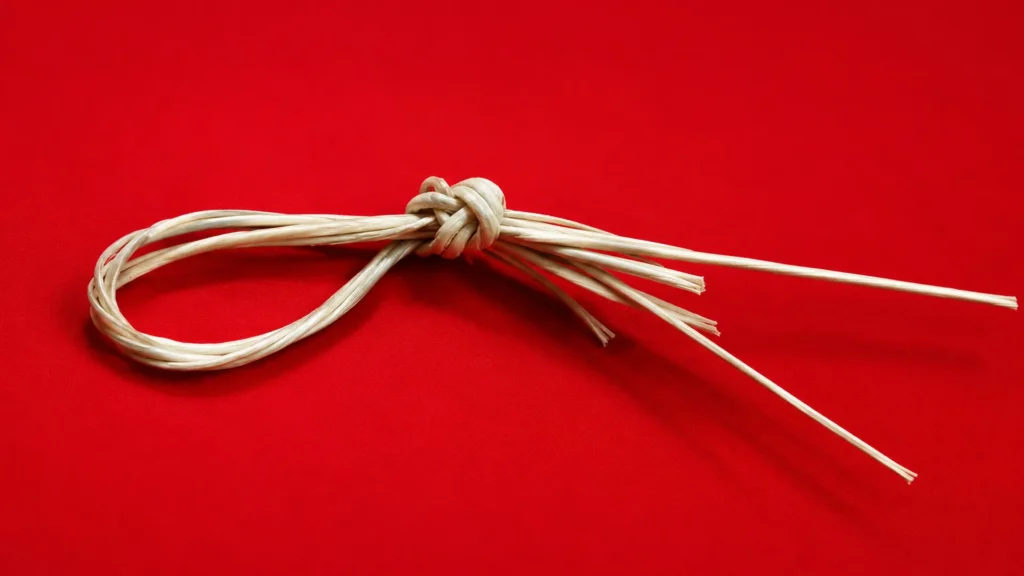
Darbha (Kush) Ring
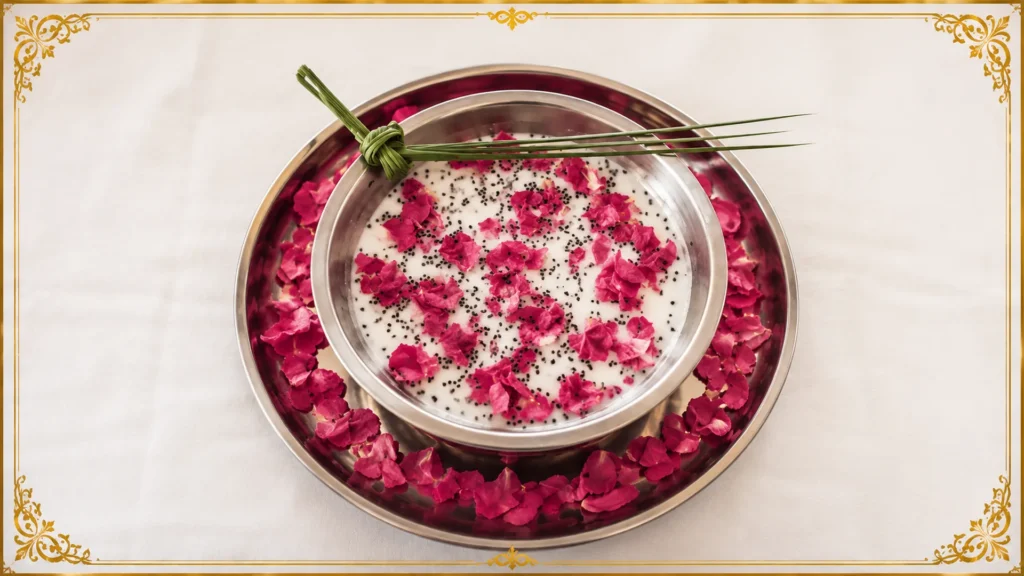
A dish containing the Tarpan ingredients.
In the years gone by, most of our ancestors used to offer tarpan left, right, forward, backwards, and bottom directions. This is not correct. The correct method is that the tarpan MUST be offered in the dish/container.
There are two ways of positioning yourself when offering Tarpan, firstly you can face east and offer the tarpan forward or you can remain in one position and offer the water tarpan either east, north or south (by tilting one’s hands and releasing the tarpan water in an easterly/northerly/southerly direction, as opposed to re-positioning oneself to face forward (East/North/South) during the tarpan).
Now that that is explained, I shall elaborate on why the Tarpan is offered into the dish/container instead of directly onto the planted, knotted kusha grass. When one offers tarpan in the East direction, one is offering that tarpan to the Devas. Tripyatam/Tripyantam means to satisfy, satiate, to gratify a particular Deity, so the first tarpan mantra is “Om Brahma Tripyatam” meaning “O Lord Brahma kindly accept this water of libation” and thereafter Lord Brahma then blesses the water and then further Deva mantras are chanted.
After the Deva tarpan is completed, whereby the devas have now blessed the tarpana water, the Rishis are now offered the tarpan water which has been blessed by the Devas. The Rishis further bless the water and when the tarpan is offered to one’s ancestors, then one’s ancestors thus receive the blessed water blessings of the Devas and Rishis.
This is why it’s not offered directly onto the planted, knotted kusha grass. Once all the offerings of water are completed, the tarpan water is then poured onto the planted, knotted kusha grass while chanting “Shree Krishna Sharanam mamah” meaning “Lord Krishna is my shelter” a few times.
A question that may arise is, “Can females offer tarpan?” – and the answer would be “most certainly, yes.” Hinduism would not discriminate by gender as the soul is neither male nor female.
Another question that may arise is, “Does every family member offer the tarpan water separately?” No. Everyone can have turns and the one that is offering will offer the water and the others touch the person’s shoulder – who is making the offering.
Do note:- To be a bit technical, for those who don’t use a Brahmin Thread/Upavitra, a towel is used instead.
Savya, Apasavya and Nivit: The Brahmin thread (or towel) should always be worn/placed on the left shoulder. This style of wearing the Brahmin thread (or towel) is known as ‘savya’. When it is worn on the right shoulder it is known as ‘Apasavya’. When worn as a necklace, it is known as ‘Nivit’.
So when offering the Deva Tarpan the towel should be on the person’s left shoulder – the person who is offering. When offering the Rishi Tarpan, the towel should be on the person’s neck – the person who is offering. When offering the ancestor Tarpan, the towel should be on the person’s right shoulder – the person who is offering.
Verses from the Garuda Purana on TARPAN
Garuda Purana Aachaara Khanda 215.1. Lord Brahma said “Tarpana propitiates the devas and the ancestors.” (Chapter 215 has all the mantras of the Deva’s, Rishi’s, and the ancestors to offer to which Lord Brahma recites).
Garuda Purana Aachaara Khanda 215.8 “Those who are born in our family, those who died issue-less, let those be propitiated. I have offered water.”
Garuda Purana Preta Khanda 4.77 “Be gratified, be gratified with this pinda, O preta of such and such gotra. Let this water reach you, ‘reciting this formula he should offer the water.”
Garuda Purana Preta Khanda 5.102 / 16.12 “Whatever is offered to him together with the oblation of water, he eats and drinks.”
Garuda Purana Preta Khanda 6.135 “He then eats the rice-ball (pinda) offered together with the offerings of water oblation (tarpan).”
Garuda Purana Preta Khanda 8.92 The pretas (spirits) said, “We trouble the person who does not perform Shraddha or Tarpana (water of libation)”
Garuda Purana Preta Khanda 10.71 “Thus, O Garuda, whatever is given to the ancestors, by their relatives while doing shraddha, they receive the same and remain gratified with the food, water and vegetable.”
Garuda Purana Preta Khanda 15.53, 57, 62 “They should offer libations of water mixed with gingelly seeds (Til) by his personal name or by the appellation of his lineage. He should not shed tears but offer libations of water to the dead. The son should offer pinda and pour handfuls of water in favour of the deceased.”
Garuda Purana Preta Khanda 36.12 “Such are the benefits derivable from Shraddhas and tarpanas. The great grandfather blesses one with plenty of foodstuffs.”
Garuda Purana Preta Khanda 40.16, 25 “Water libation should be performed with mantras from the Vedas and the Puranas. Water libations should be offered separately.”
What is acceptable to cook and offer to one’s ancestors during Pitr Paksha
*** Kindly note that research is still being carried out on this topic. The intention of this is to provide you with shastric-based information. The information that follows is based on what has already been researched.
The Kurma Purana Uttara Bhaga, 19 Shraddha Prakarana mentions, “The Pitars are highly satisfied with materials like Vrihi (sanskrit – food grains, rice SB 9.19.13) {I would suggestively advise cooking Basmati rice instead of parboiled rice}, Yava (barley), Maasha (black urad dal, vigna mungo, black gram, black lentil), Moolaa (shatavari root – Ctrl-Click “HERE” to learn more), Phalaa (fruits esp. mango, grapes {draaksha}, pomegranate {anar}), Wheat, Tilaa (sesame seeds), and Bhumi Kushmanda (Ash gourd, white pumpkin, white gourd melon). Also the Pitars are pleased with offerings of honey and gur (a form of sugar) with fruits.”
The ‘pitars’ become satisfied with pure vegetarian food, fruits and cereals. Pure and hygienic food should be offered with full devotion to our ancestors so that they become pleased and bestow their blessings of happiness, progress and remove family discords upon their descendants.
The Mahabharata – Anusasana Parva, Book 13, Section 88 states, “Bhishma-deva said, ‘O Yudhishthira, with sesame seeds and rice, barley, Masha (black urad dal), water, roots and fruits, if offered during a Shraddha, the Pitris become satisfied’”.

The above picture is one of offerings I prepared a few years ago for my ancestors. This is an example of a simple food offering and the layout of the offering that you may follow as well. Presentation of food is extremely important especially in Hindu temples in India.
On a tray the offerings are as follows (do note how I laid out each food item on the tray in little bowls):- Basmati rice, two curries, salad, sweet rice (kheer), fruit, water in a cup, and milk in a cup. The Lord and the ancestors love flowers hence I decorated the tray with flowers so that when my ancestors “eat” their food they would be uber pleased with the love and attention to detail I afforded them.
What is NOT acceptable to cook and offer to one’s ancestors during Pitr Paksha?
The Kurma Purana Uttara Bhaga, 19 Shraddha Prakarana mentions, “But, food ingredients like buffalo milk, Pippali (Indian long pepper – Ctrl-Click “HERE” to learn more), Masoor dal (lentil dal, pink lentil), Raajamaasha (cow-peas {Vigna unguiculata-Bot.}), brinjal (eggplant), pinda mula* (* research is ongoing about this item) should be avoided.”
In Chaturmasya certain foods are prohibited. The Chatur-masam “4 months” are Shravan, Bhadrapad, Ashwin and Kartik which is from approximately August (start of Shravan month) to approximately November (end of Kartik month). Pitr Paksha falls in the 3rd month viz. Ashwin.
In this period, the following are prohibited from being consumed: sugar cane, horse gram (kulthi bean, hurali, Madras gram, Macrotyloma uniflorum Bot.), white and yellow mustard (seeds), Masoor dal (lentil dal, pink lentil), gram-chickpeas (chana dal), arhar pulse (toor dal, pigeon pea {Cajanus cajan}), raajmaa beans (kidney beans), black salt, asafoetida (hing), watermelon, brinjal, radish, snake gourd (hindi – chichinda), onion, garlic and any non-vegetarian food are strictly prohibited in Shraddha food offerings.
Black and red (-coloured) flowers, strongly scented and odorless flowers like Kadamba {kadam, Neolamarckia cadamba Bot.} (Ctrl-Click “HERE” to learn more), Kevada {umbrella tree, screw pine, screw tree} (Ctrl-Click “HERE” to learn more), Bilvapatra {Aegle marmelos Bot., bael, bengal quince, golden apple, stone apple, wood apple} (Ctrl-Click “HERE” to learn more), Karvir {laurier rose flower, kaneer} (Ctrl-Click “HERE” to learn more), Maulsire {maulsari, Mimusops elengi Bot.} (Ctrl-Click “HERE” to learn more) – all these flowers should not be used for Shraddha pujas.
Keep apart five morsels of cooked food for a dog, a sinner, a leper, a sick person and for a crow – on five leaves, which is offered as ‘panchbali’ – in other words, five offerings. This is kept outside one’s home in a clean place in the yard (or in another suitable location near one’s living space). You may offer this daily or on the day you are doing your main food offering.
Can non-sattvic foods (eg. meat) be offered to one’s ancestors during Pitr Paksha?
Absolutely NOT!!! Before one offers food to one’s ancestors, one must offer the same food to Lord Vishnu – which then becomes Vishnu prasad, and then a portion of that food is offered to our ancestors.
Now ask yourself – would it be correct to offer meat, cigarettes and alcohol to Lord Vishnu? OF COURSE NOT. It is a huge sin to offer any non-sattvic foods (e.g. meat and any type of intoxicant, etc.) to one’s ancestors (and to Lord Vishnu).
The following three verses are proof of this, which are from Vedic shastras.
“It’s not Dharma that in the Shraddha feast one should offer meat nor should one eat meat. Only vegetarian food must be offered because meat is obtained by killing”. (Srimad Bhagavatam 7.15.7).
“Vegetarian food prepared with pure butter, milk, sugar and curd, etc. are most pleasing to the Pitrs (Ancestors)”. (Matsya Purana 17.30).
“Cow’s milk, honey and the sweet pudding made of milk, rice and sugar with dry nuts satisfies the Pitrs (Ancestors)”. (Matsya Purana 17.36)
Why it is so important to offer tarpan (water libations) and food offerings to one’s ancestors for the entire duration of 15 days in Pitr Paksha
If I, as a brahmin and pundit, visit your home for 15 consecutive days, I am quite certain that you would offer me something to eat and drink every day, won’t you?
Similarly, one’s ancestors are visiting one’s home for 15 days and thus it is most appropriate to offer them water and food offerings every day. When one offers water and food for the 15 days, it amounts to one year of offerings in the Pitr’s timeline.
Unfortunately, many Hindu families – due to their weakness for non-sattwic foods – only offer water and food for 3-7 days. So what about the remaining days of Pitr Paksha? This is quite unfortunate…
How sure is one that the food or donation made by one actually reaches one’s ancestor(s)?
Garuda Purana, Preta Khanda 19.26-27: Lord Vishnu said to Lord Garuda “The food, water or gifts made on behalf of the deceased made by the descendants is firstly received by Lord Varuna-deva, who then gives it to Me (Lord Vishnu), and I then hand it over to Lord Surya-deva who then hands the gifts over to the deceased in whichever form the deceased is in.”
What is forbidden in Pitr Paksha:-
- Commencement of Studies.
- Upanayanam Samskara (The Sacred thread/Jeneo ceremony).
- Entering a new house (Griha Pravesha) or signing of any papers pertaining to the house.
- Munda Samskara (Hair cutting ceremony generally performed in the 3rd or 5th year for a boy).
- Vivah Samskara (Wedding ceremony).
- Commencement of a Pilgrimage.
- Commencement of a Graha (planetary) fast or performance of a Graha Shanti Puja/Havan.
- Commencement of construction of a new building.
- Purchasing of a vehicle (vahan).
- Signing of any important papers. (On this matter common sense should prevail).
- Night, evening times should be avoided to perform ‘Shraddha-karma’.
- “Shraddhas are generally not to be performed in the evenings and nights, as a rule. However as an exception to the rule, Shraddhas may be performed during the eclipse timings of Surya (Solar) and Chandra (Lunar).”
(Note:- With regard to the points “commencement of…” – it only concerns the starting of a new aspect/event – i.e. if one has started it before Pitr Paksha, it is fine to continue through this period with said aspect/event.)
What is acceptable to perform/observe in Pitr Paksha:-
- Offering of Surya jal, lighting of deeyas, performing aartee and other forms of daily puja which constitute one’s nityakarma (daily worship) should continue.
- Japa (chanting the holy names of God).
- Performing charity liberally.
- Reading of shastras (scriptures).
- Attending satsanghs.
- Performing ceremonies relating to death and birth.
(Note: Attempt to refrain from any meat, alcohol or smoking consumption and partake in simple vegetarian foods.)
THE RITUALS OF SHRADDHA ACCORDING TO THE MAHABHARATA
The Mahabharata – Anusasana Parva, Book 13, Section 84 states: Bhishma said: When my father Santanu departed from this world, I proceeded to Gangadwara (Haridwar) for performing his Shraddha. Having with a concentrated mind performed all preliminary rites as laid down in the scriptures, I set myself to duly offer the obsequial cake (pinda). Reflecting then, by the light of the scriptures, the conviction soon came upon me that the ordinance does occur in the Vedas that the cake should not be presented into the hand of him whose Shraddha is performed. The Pitris do not come in their visible forms for taking the obsequial cake. On the other hand, the ordinance provides that it should be presented on the blades of Kusha grass spread on the earth for the purpose. What I did was perfectly consistent with the scriptural ordinance. The ritual of Shraddha is that the obsequial cake should first be offered to the deceased father. Next, one should be offered to the grandfather. Next should one be offered to the great-grandfather. Even this is the ordinance in respect of the Shraddha. Over every obsequial cake that is offered, the offerer should with concentrated attention utter the Savitri (Gayatri) Mantra.
HOW DID THE PINDA PUJA ORIGINATE?
The Pinda puja is mentioned in quite a few of our shastras – eg. the Yajurveda, Brahane, Shrout, Guhya sutras, Ramayan, Mahabharata, and Bhagavad Gita.
The Mahabharata – Shanti Parva, Book 12, Section 346 states: “The Lord said, ‘The earth, in days of yore, with her belt of seas, disappeared from the view. Lord Krsna, assuming the form of a gigantic boar, raised her up with His mighty tusks and having placed the Earth in her former position, He then with His body smeared with water and mud, set Himself to do what was necessary for the world and its denizens. When the sun reached the meridian, and the hour, therefore, came for saying the morning prayers, the Lord, suddenly shaking off three balls of mud from his tusk, placed them upon the Earth, O Narada, having previously spread thereon certain blades of Dharbha grass. The Lord dedicated those balls of mud unto His own self, according to the rites laid down in the eternal ordinance. Regarding the three balls of mud that the Lord had shaken off from his tusks as Pindas, he then, with sesame seeds of oily kernel that arose from the heat of his own body, Himself performed the rite of dedication, sitting with face turned towards the East. That foremost of deities then, impelled by the desire of establishing rules of conduct for the denizens of the three worlds, said these words: “Lord Varaha said, I am the Creator of the three worlds. I now resolved to create those that are to be called Pitris. Saying these words, He began to think of those high ordinances that should regulate the rites to be gone through in honour of the Pitris. While thus engaged, He saw that the three balls of mud, shaken off His tusk, had fallen towards the South. He then said unto Himself, these balls, shaken off My tusk, have fallen on the Earth towards the southern direction of her surface. Led by this, I declare that these should be known henceforth by the name of Pitris. Let these three that are only round, come to be regarded as Pitris in the world. Even thus do I create the eternal Pitris. I am the father, the grandfather, and the great grandfather, and I should be regarded as residing in these three Pindas. There is no one that is superior to Me. Having said these words, that God of gods, Vrishakapi by name, offered those Pindas, O learned Brahmana, on the breast of the Varaha mountains, with elaborate rites. By those rites He worshipped His own self, and having finished the worship, disappeared there and then. Agreeably to the words uttered by Lord Varaha on that occasion, the Pitris receive the worship offered by all. They who perform sacrifices in honour of and adore the Pitris, the deities, and others in thought, word, and deed, are said to adore and sacrifice unto Lord Vishnu himself.”
Do note that www.dipika.org.za has released 3 other articles regarding Pitr Paksha.
The following links are the direct web-links to these articles on DIPIKA
- Pitr Paksha How 2 Offer Your Food And DIY Havan
Quick web-link to DIPIKA http://dipika.org.za/?p=684 - FAQ’s in Pitr Paksha
Quick web-link to DIPIKA http://dipika.org.za/?p=680 - Mahalaya Paksham
Quick web-link to DIPIKA http://dipika.org.za/?p=676
*** Certain excerpts were taken from the works of the Shree Lakshmi-Narayana Mandir (Durban).
My humble thanks and prostrations to the late Pundit H.R. Maharajh of the Shree Lakshmi-Narayana Mandir.
*** Certain excerpts were taken from the brilliant book called Death and the Soul’s Journey by Pt Munelal Maharaj. Thank you Punditji for your great contribution to mankind.***