

Kartika Amavasya is a new moon observance associated with fasting, new beginnings, prayers to Mother Kali and offerings to one’s ancestors. Mother Kali prayers are optional in this tradition, while the ancestor prayers are strongly advised.
The Significance of Amavasya
The new moon day is called Amavasya and is observed as a day of fasting in many Hindu households. Since the Hindu calendar is organised according to the lunar month, Amavasya is the beginning of the new lunar month, which lasts approximately 30 days.
Many festivals, the most famous being Diwali, are observed on this day. The importance of Amavasya is that it is a day of new beginnings. It is a time to discard old habits, thought processes, failures and negative influences, and embrace the promise of new “light” that the new moon brings to us. The “dark” side of the moon is revealed on this day as the moon completes its waning cycle of approximately 15 days.
On new moon days the presiding Deities are Mother Kali and one’s ancestors, or Pitars. One offers prayers to Mother Kali as well as food offerings to one’s ancestors. Do note that Mother Kali prayers are optional, but the ancestor prayers are highly advised.
Mother Kali Prayers
Below is a simple prayer format to perform to Mother Kali. At your prayer place, stand or sit in front of a picture or murti of Mother Kali and pray to Her.
Om swagatam su swagatam – Om Kali mata-yai namah avaaha-yamee stapa-yamee.
Swagatam means, “Oh Mother Kali, I welcome you.”
Thereafter offer three incense sticks, or dhoopam, seven times clockwise around the picture or murti while chanting:
Om tato dhoopam aghraa-payaami – Om Kali mata-yai namah.
Thereafter offer a clay lamp with oil and a wick, or a piece of camphor, as deepam, seven times clockwise around the picture or murti while chanting:
Om prat-yaksha deepam darsha-yaami – Om Kali mata-yai namah.
Thereafter offer a flower or flower petals, or pushpam, seven times clockwise around the picture or murti while chanting:
Om idam pushpam – Om Kali mata-yai namah.
Thereafter offer sweet food, sweets or fruits, or naivedyam, in a bowl. Leave it in front of the picture or murti while chanting:
Om naivedyam samar-payaami – Om Kali mata-yai namah.
You may now chant this extremely powerful Devi mantra 11, 21 or 108 times:
Om Aim Hreem Kleem Chamundaye Viche Namah.
Meaning: I or we seek blessings from the Divine Mothers, who have forms of Maha Saraswati, Aim, the Giver of Knowledge; Maha Lakshmi, Hrim, the Giver of Wealth; and Maha Kali, Klim, the Giver of Justice. May they give me or us a shield of strength and energy to untangle myself or ourselves from the knots of negativity and evil in the mind and body.
If you desire, you may listen to the mantra online using the link in the Article Links section. You may also chant the Kali Chalisa.
Thereafter offer prayers for forgiveness at the lotus feet of Mother Kali:
Om yaani kaani cha paapaani janmaantara kritaanee cha, taani sarvaani vinashyanti pradakshinaa pade pade.
Finally offer your personal prayers to Mother Kali. Pray and ask for whatever you desire; the Mother, being so merciful, will grant what you desire.
Ancestor Water and Food Offerings
Pitar, for male ancestors, or Matri, for female ancestors, Dosha is not just the curse of the ancestors. It is also a debt formed as a result of bad or negative deeds performed by one’s ancestors. This debt has to be paid by the present generation, either by taking the punishment decided according to that debt or by doing specific good karmic deeds that help pay the debt so that the degree of punishment may be decreased.
The Results of Pitar or Matri Dosha
House peace is disturbed; there may be lack of progeny, separation between husband and wife, chronic diseases, accidents, depression, disturbed sleep, dreams, problems on a subconscious level, psychological problems, hidden enemies, sudden change in profession, heavy unwanted expenses, vigorous travelling, suicidal tendencies, many hurdles in life, difficulty in returning loans and large debts.
Remedial Measures for Pitar or Matri Dosha
- Offer water, or tarpan, and food offerings on new moon days every month.
- Perform Rudrabhishekam, or abhishek to Lord Shiva, in the name of your ancestors. This is something you can do yourself. In this puja Lord Shiva is worshipped in the form of a Lingam, which is bathed and worshipped.
Rudrabhishekam Procedure
In a wide, deep container, bathe the Lingam. Prepare five small lotas or chumbus as follows:
- One lota of cold milk.
- One lota with one pinch of ghee, filled with warm water and mixed.
- One lota filled with half yoghurt and half water, mixed.
- One lota with one teaspoon of honey, filled with warm water and mixed.
- One lota with one teaspoon of sugar or gur (jaggery), filled with warm water and mixed.
Then bathe the Lingam with more warm water. Wipe off the excess water with a cloth hand towel and place the Lingam back where it was.
Mark the Lingam with three stripes of chandan and dot the middle stripe with kungu powder. Dress the Lingam with a white cloth and optionally garland it.
On a tray, have three lit incense sticks, a lit clay lamp with ghee or camphor and a wick, and flower petals. Offer these to the Lingam seven or nine times in a clockwise direction. Offer the Lingam appropriate food such as sweet rice or fruits.
You can perform this on Mondays, Saturdays and especially on new moon days.
Scriptural Basis for Monthly Ancestor Offerings
Whatever vegetarian meal one cooks on that day can be offered to one’s Pitars, just as one does in Pitar Paksha or Mahalaya Paksham. By performing this act, great merit awaits that person.
In the Garuda Purana, Preta Khanda II 10.50-55, Lord Vishnu says to Shree Garudaji that on Amavasya the ancestors stand at the door of their descendants to receive their food. They remain there until sunset. When they do not receive food, they fall into despair and return suffering and cursing the descendants. Therefore, one should carefully perform shraddha and offer food to one’s ancestors on Amavasya every month.
The ancestor offerings must be made between sunrise and sunset. They should not be offered before or after this period for maximum spiritual credit.
Food Suggestions for Ancestor Offerings
According to the Mahabharata and Kurma Purana, the Pitars are highly satisfied with food ingredients such as vrihi, or rice grains. Cook rice with turmeric as well as sweet rice, or kheer. Pitars love cooked black urad dal and a variety of pumpkin preparations, cooked herbs, wheat and barley products, and root vegetables such as potato, sweet potato, yams or madumbe, beetroot, carrots, ginger and turmeric.
Pitars love phalaa, or fruits, especially mango, grapes and pomegranate, or anar. The Pitars become pleased with offerings of milk, honey and gur, a form of sugar, with fruits.
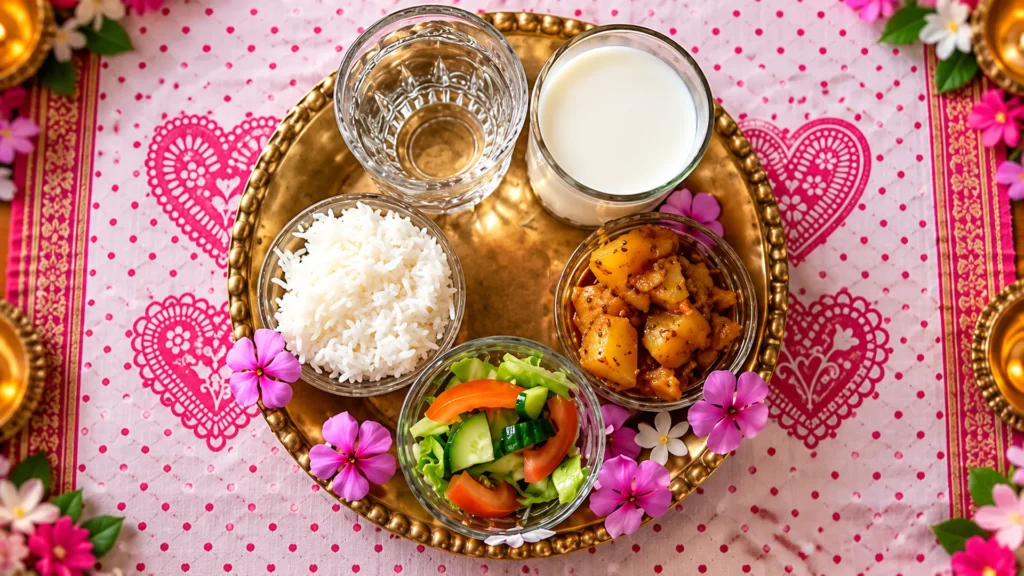
The example thari contains a cup of water, a cup of milk, basmati rice, potato curry and salad. Presentation is most important. Alternatively, one may prepare cut fruits, a cup of water and a cup of milk, depending on the time available.
How to Present the Ancestor Food Offering
Once the food preparation is complete, offer it at your prayer place to Lakshmi-Narayana, Vishnu or Hari. Leave it for five minutes. Then take the thari outside to a clean place and offer it to your ancestors while facing south.
While facing south, remember your ancestors. Light one incense stick and turn it three times around the thari. Perform arpana by sprinkling water around the offerings three times in a clockwise direction.
Now chant:
Om pitri devaaya namah – three times.
Shree Krishna sharanam mamah – three times.
Finally chant the Maha-Mantra three times:
Hare Krishna Hare Krishna Krishna Krishna Hare Hare
Hare Rama Hare Rama Rama Rama Hare Hare.
Then bow and take your leave. Leave the tray until the evening. In the evening, place the food on the ground where ants, birds and other creatures of the Lord will consume this prashad.
A human must never consume this food once it has been offered to one’s ancestors.
Questions and Answers
May Meat Alcohol or Cigarettes Be Offered
Question: Can we offer meat, alcohol and cigarettes when we perform our new moon ancestor prayers? We have been doing it this way for as long as I can remember because my grandparents used to eat meat, drink alcohol and smoke. Is this correct?
Answer: Before one offers food to one’s ancestors, one must offer the food to Lord Vishnu. It then becomes Vishnu prasad, and a portion is offered to one’s ancestors. Ask yourself whether it would be correct to offer meat, cigarettes and alcohol to Lord Vishnu. Of course not. It is a very great sin to offer any non-sattvic foods, including meat and intoxicants, to one’s ancestors.
Srimad Bhagavatam 7.15.7 states that one should never offer or eat meat at a Shraddha feast; only vegetarian food must be offered because meat is obtained by killing.
Matsya Purana 17.30 states that vegetarian food prepared with pure butter, milk, sugar and curd is most pleasing to the Pitars.
Matsya Purana 17.36 states that cow’s milk, honey and sweet pudding made of milk, rice, sugar and dry nuts satisfy the Pitars.
How Do Offerings Reach the Ancestors
Question: How certain are we that the food we offer goes to our ancestors?
Answer: In Garuda Purana, Preta Khanda 19.26-27, Shree Garudaji asks Lord Vishnu how gifts made by relatives at home in favour of the deceased reach them and who receives the gifts. Lord Vishnu replies that Varuna Deva receives the gifts and hands them to Him. He gives them to Suryadeva, and from Suryadeva the deceased person obtains them. The verse therefore explains how food or gifts offered on behalf of ancestors reach that entity in whatever form it is in.
Further Reading
Readers interested in this article may also find “Sacred Information Ancestor Prayers and Offerings” on Dipika useful. The link appears in the Article Links section. For more on the questions and answers, kindly use the email address below.