

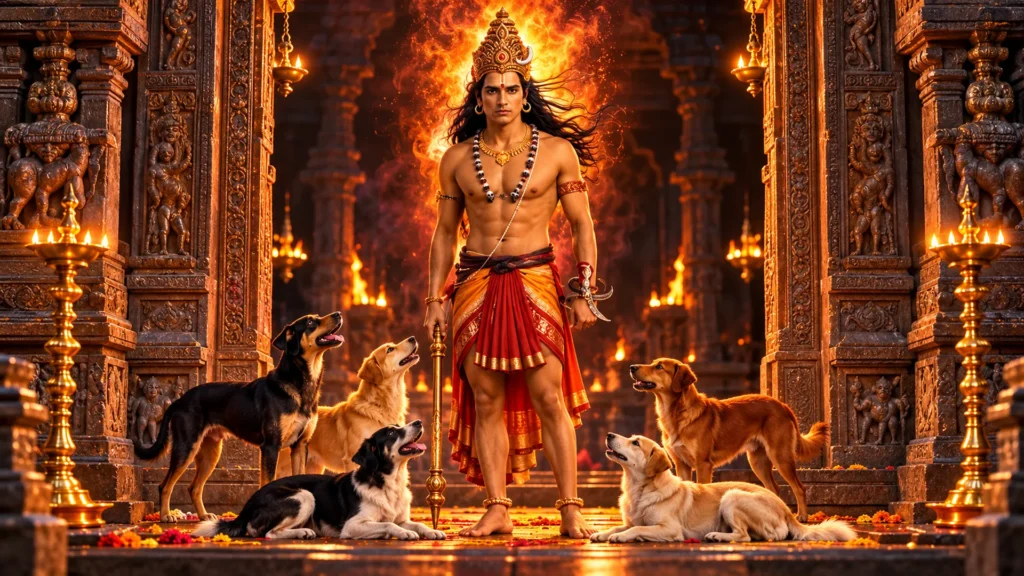
Kukur Tihar honours dogs as divine beings, companions and messengers connected with Lord Yamaraja. The observance expresses Sanatan Dharma’s care for animals and celebrates the relationship between dogs and human beings.
Kukur Tihar
Animals, especially dogs, are divine beings. Dogs generally have been looked down upon. They are treated as nasty, mad and unwanted creatures. Yet dogs, like all creatures, are the representation of God. Sanatan Dharma (Hinduism) treats all animals with love and care.
Kukur Tihar is an annual Hindu festival which originates from Nepal and falls on the second day of the festival of Tihar, around October or November. On this day, people worship dogs to please Lord Yamaraja, the Deity of death, as they are considered to be his messengers and companions. Lord Yamaraja has two dogs, Shyama and Sharvara, who guard the door of hell.
Nepali Hindus believe that by worshipping dogs they start to see death positively, because a dog follows them in their final journey. They hope that dogs will guard them against torture in hell.
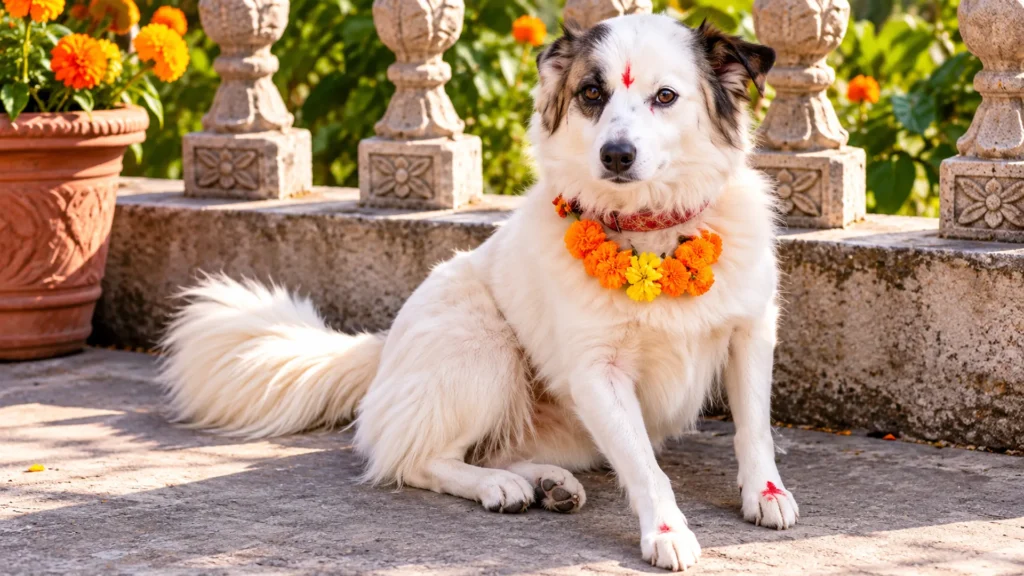
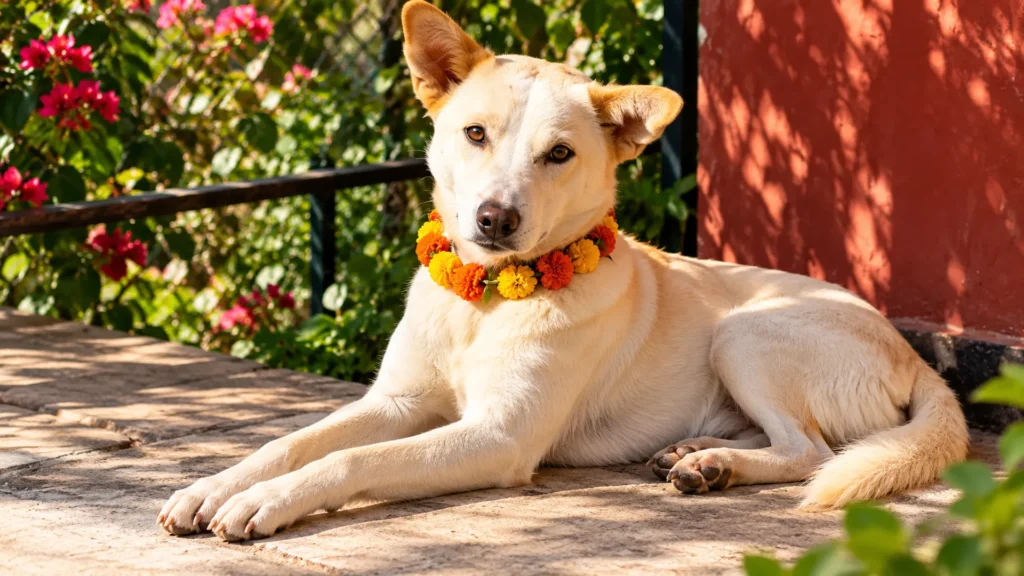
During this festival, dogs are worshipped, bathed and decorated with tilak, which is made from kumkum or gulal powders with rice and yoghurt. Flower garlands are draped around their necks, and they are offered food, including non-vegetarian food and dog food.
Owners bring their furry friends to the festival and offer them treats, special baths and garlands to appease Yamaraja. Kukur Tihar also celebrates the relationship between dogs and humans. It is considered a sin if someone behaves disrespectfully to a dog on this day. This prayer can be done at any time of the day.
Yudhishthira and the Faithful Dog
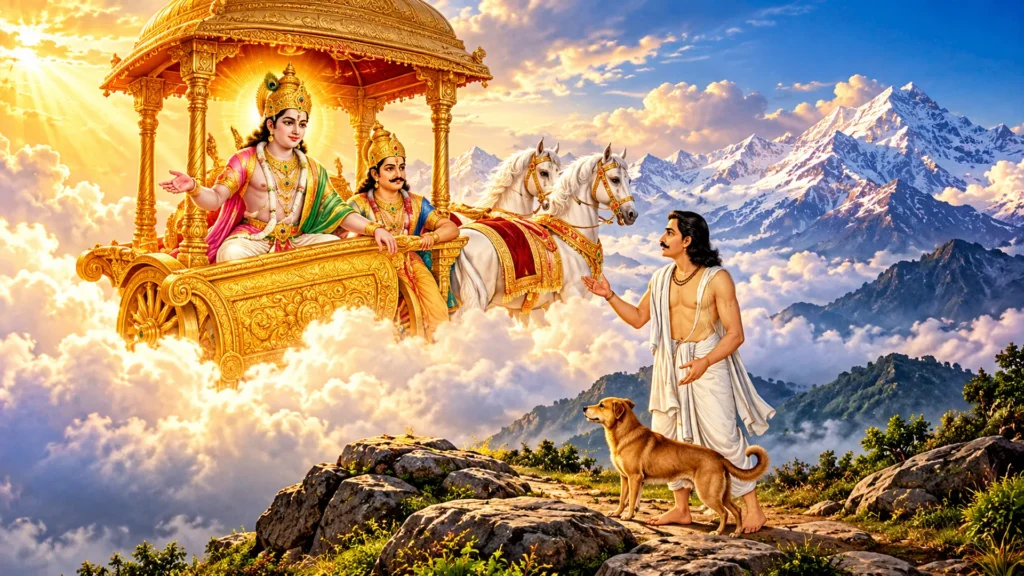
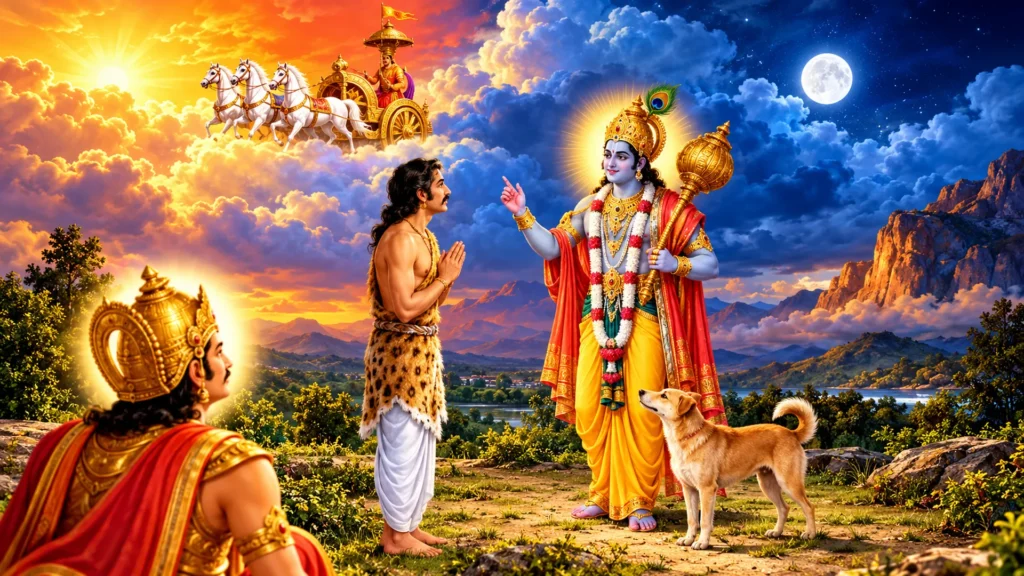
In the ancient Sanskrit epic Mahabharata, the five Pandavas on their way to heaven are accompanied by a dog. The five Pandavas, with their wife Draupadi and brothers, climb the Himalayas; all of them except Yudhishthira and his dog perish along the way.
Then Yudhishthira meets Lord Indradeva, the King of heaven, who welcomes him to heaven but tells him he has to leave his dog behind. Yudhishthira refuses to enter heaven without his dog and says he will go back to earth.
The dog disappears and is replaced by Lord Yamadeva, the presiding Deity of death. Lord Indradeva is so impressed by Yudhishthira’s actions and righteousness that the gates of heaven are opened for him.
Lord Yamaraja and His Dogs
Sharvara and Shyama are powerful dogs belonging to Lord Yamaraja. They guard the netherworlds.
Vedic Deities and Their Connection with Dogs
Deities like Lord Rudra (Shiva), Nirriti, the Rigvedic deity and guardian of the southwest direction, and Virabhadra, a powerful deity created from Lord Shiva’s hair by the angry Lord Shiva, are all associated with dogs.
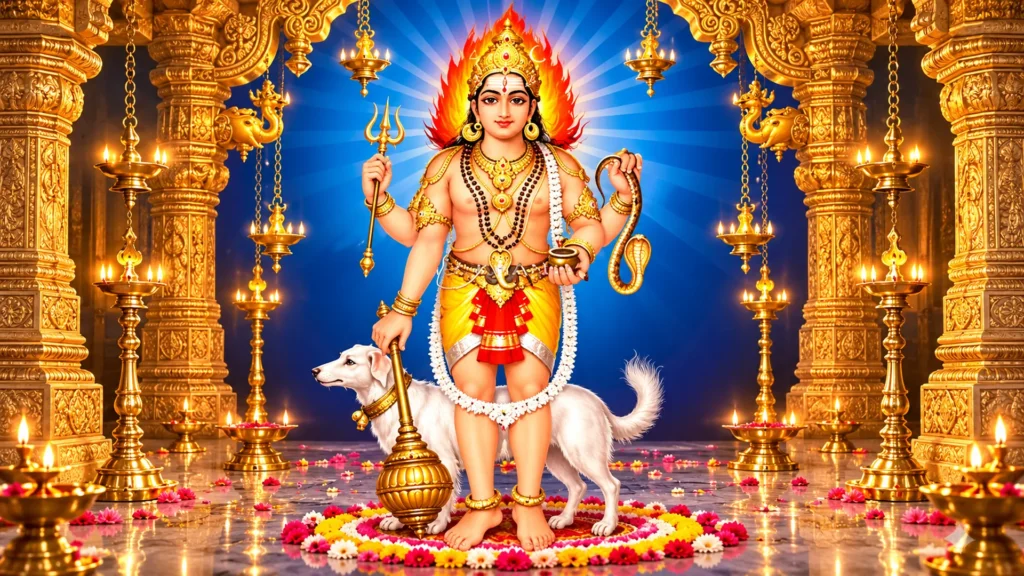
Lord Shiva, in his aspect as Lord Bhairava, had a dog named Shvan as a vahana, or vehicle, as mentioned in the Mahabharata. Khandoba, a deity, is associated with a dog on which he rides.
Bhairava means “terribly fearsome form.” He is also known to destroy fear, and he protects his devotees from dreadful enemies, greed, lust and anger. He is the fierce form of Lord Shiva associated with annihilation.
Lord Dattatreya and the Four Dogs
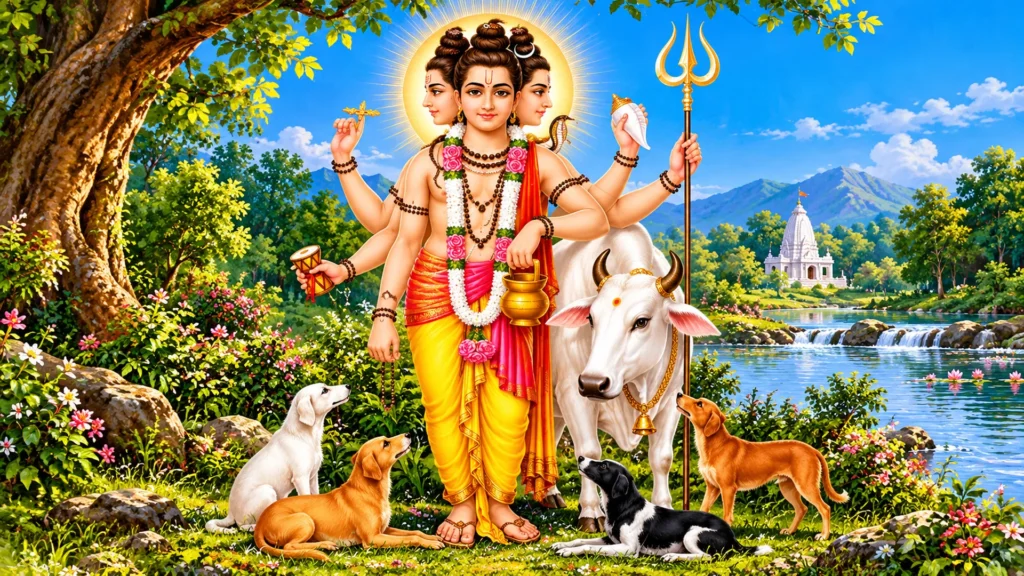
Lord Dattatreya is an avatar, or incarnation, of the three Hindu Deities Lord Brahma, Vishnu and Shiva, collectively known as Trimurti. Lord Dattatreya is associated with four dogs, considered to symbolise the four Vedas.
Scholars venture that the four dogs, each depicted in a different colour in Lord Dattatreya iconography, hold the valence of the four Vedas: Rigveda, Yajurveda, Atharvaveda and Samaveda.
Pre-Vedic Indian dogs were regarded as auspicious symbols. Later deities assumed dog forms, became associated with dogs and were linked with the glory and fidelity of warriors. There is other symbolism attachable here. Dogs also held the cultural significance of “dog eaters” (Sanskrit: chandala), those who existed beyond the confines of Varnashrama Dharma. Dogs are both wild and tame, and symbols of fidelity and devotion (Sanskrit: bhakti).
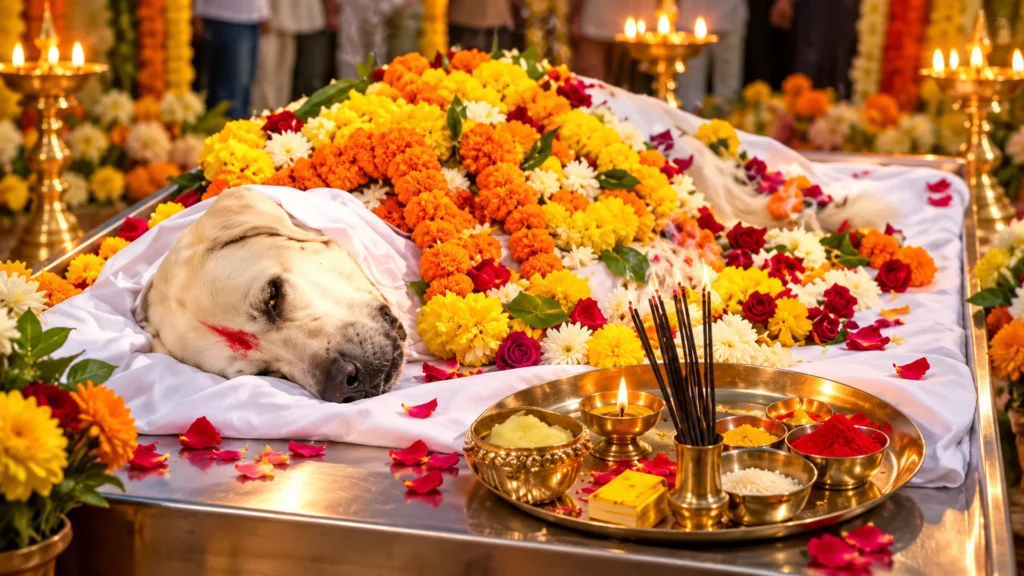
In India, a late army dog is given a full state funeral and is decorated with tilak and flower garlands around the neck.
Lord Indradeva and Sarama
Lord Indradeva, the King of heaven, has a dog named Sarama. This dog helped the Devas bring back their cows that had been stolen by demons.
Feeding and Caring for Dogs
Feeding dogs, especially black-coloured dogs, and treating them with love will remove the malefic effects of the planet Saturn and Rahu, and calms down the malefic planet Ketu. It is said to reduce the negative effects of a snake curse, or Sarpa Dosha.
Lord Krsna has two pet dogs named Brambara or Bhramaraka, meaning bumblebee, and Vyaghra, meaning tiger, in Vaikuntha. Source: Srila Rupa Goswami’s “Radha-Krishna-ganoddesha-dipika.”
Units of Life
Gurudev Sri Sri Ravi Shankar ji teaches that water has two units of life, fire has three, air has four, space has five, trees have six, animals have seven, and human beings have eight units of life and are known as Ashtavasu.
Superhuman blossomed beings who do extraordinary work, whether it be very good or very bad, have nine units of life. Furthermore, humans can develop up to sixteen units of life.
When we die we become more powerful in some way. We go between nine and ten units of life. This is strange but true. That is why ancestors are worshipped. The moment this body drops, the spirit has become free, without boundaries, and nothing can stop it. The spirit moves around freely.
If it is bound in the body, you have only eight units of life, but when you die, then you have access to the ninth and tenth units, so you gain much more access to the planet. That is why ancestors have the capacity to bless you. They have more “life” than you because their spirit is freed from the limited body.
They have the power to know, cognise and bless you. You can feel their presence. So when you pray to them, they can grant you certain boons. They are able to bestow unto you to whatever extent they are powerful. Ancestral worship can be found in China, Latin America and many other countries.
Hindu Funeral Rites for an Animal
Our website, www.dipika.org.za, has an article named “Hindu Funeral Rites for One’s Animal,” where we advise on how to comfort your furry pet in his or her last stages.