
From Darkness to light.
Diwali, a.k.a Deepavali is a major Indian festival spread over 5 days that is very significant in Hinduism known as the “Festival of Lights,” it symbolizes the victory of good over evil, and lamps (diyas) are lit as a sign of celebration and hope for humankind.
“Regardless of the explanations one prefers, what the festival of lights really stands for today is a reaffirmation of hope, a renewed commitment to friendship and goodwill, and a religiously sanctioned celebration of the simple and some not so simple joys of life.”
Before we continue with this most humble rendition of Deepavali by the mercy of our most loving and merciful Mother Saraswati we yet again read in the papers and we have received so many calls and emails on “When are we supposed to celebrate Diwali?” I am sure you have heard of this and we in this article are going to explain it in a rather simple yet dignified manner. Please note as you have read from the many articles that we send out we are totally against segregation we are fully for congregation regardless of one’s color, creed, dialect, race and whatever else that is distasteful.
OK to cut a rather long and tedious story short let’s get to the bottom of the Diwali issue. Please hold on to your seats because the information that you are going to read is going to be rather shocking to say the least. Firstly there is no such word as Hindu (Hinduism). In the Vedic shastras there is no mention of the word Hinduism. The proper term is Sanatan Dharma (the Eternal way of life). Note I didn’t say religion because Sanatan Dharma not a religion it’s an exact science.
There where two different cultures approximately 1500 years ago that was residing on the opposite sides of the INDUS River. Indus River if you don’t know cuts right through the middle of “modern” Pakistan. How the word Hindu came about is that the Muslim people from the west side of the INDUS River could not pronounce the word “indus” they said “hindus”. What I mean is that when they called the people that stayed across of the Indus River they called them Hindus and thus the name stuck.
Hence from about 1500 years ago you would notice the word Hindu being mentioned rather often.
We Sanatanists have adapted a lot of things the Muslims do which is not really Sanatan. So Sanatan Dharma encompasses those of who speak Tamil, Hindi, Gujarati, Marathi, Telugu etc. Now what really upset me is when the so called “elders” of the societies started using the term Tamil, Hindi, Gujarati for their own propagation. These are just dialects that’s all and these days it has become a platform to promote one’s ego. Oh “I am Tamil or Hindi”.
Where did “aham brahmaasmi (from the Brhad – aranyaka Upanishad 1.4.10) – “I am not this body I am spirit soul” – (The Soul b.t.w has no creed, caste, dialect, race etc attached to it) go to? It’s so frustrating to see people fight amongst themselves when they should be promoting peace, harmony and congregation amongst fellow Sanatanists rather than confusion, instability and segregation. So you see there is no Tamil Diwali or Hindi Diwali.
Diwali is celebrated over 5 days but especially on KARTIK Amavasya (new moon) night which is observed on Kartik Amavasya night. I am sure you are shocked now aren’t you. Well we shall further discuss this below. To avoid confusion for now we shall for the time being call ourselves Hindus. Deepavali is celebrated over a period of five days, with the main observance associated with Kartik Amavasya night.
Because Diwali falls over 5 days, one can conclude that that one is free to observe Diwali on any of the 5 days depending on which of the significance one attaches to it, or one may observe all five days. The more the better I rather say.
Diwali is one of the most popular and eagerly awaited Hindus festivals around the world. Hindus regard it as a celebration of life and use the occasion to strengthen family and social relationships. For Hindus it is one of the most important festivals, and beginning of the year in some Hindu calendars.
The Deepavali lights represent the time when Shree Raam returned from the forest, and all about in Ayodyhya lit lamps to welcome their most beloved Lord back home after fourteen years of exile. Many do believe that when the lamps are lit this helps Mother Lakshmi find her way into people’s homes. Celebrations focus on lights and lamps, particularly traditional dipa or deeya (earthen lamp). Diwali is a colloquial name used in North India, while the festival is formally called Deepavali in South India.
The Sanskrit word Deepavali means an array of lights that stands for victory of brightness over darkness. As the knowledge of Sanskrit diminished, the name was popularly modified to Diwali, especially in northern India.
In South India, Diwali does not coincide with the beginning of a new year as South Indians Hindus follow a different calendar, the Shalivahana calender while in North India Hindus follow the Vikrama calendar, where it falls on the New moon in the month of Kartik.
Hindus find cause to celebrate this festival for variegated reasons namely…
- It commemorates the killing of Narakasura, an evil demon who created havoc and was killed by Lord Krishna Himself. Before Narakasura’s death, he requested a boon from his mother (Mother Earth), that everyone should celebrate his death with colorful light.
- According to the Skanda Purana, Mother Parvati observed 21 days of austerity starting from ashtami of shukla paksha (eighth day of the waxing period of moon) to get half of the body of her dear husband Lord Shiva. This vrat (austerity) is known as Kedhara Vrata. Deepavali is the completion day of this austerity. This is the day Lord Shiva accepted Mother Parvati into the left half of his form and appeared as Ardharishvara.
- Diwali also celebrates the return of Shree Ramachandra, King of Ayodhya, with His wife Sita and brother Shree Lakshmanji to Ayodhya from a war in which He killed the demon king Ravana. People lit oil lamps along the way to light Their path in the darkness.
- In Bhavishyottara and Brahma Vaivarta Purana, Diwali is associated with Bali Maharaja, who is allowed to return to earth once a year.
The Five Days of Diwali
Diwali is celebrated over five days in most of India. All the days except Diwali are named using the designation in the Indian calendar. A lunar halfmonth is 15 days. Diwali as a newmoon day marks the last day of a 15day period. Diwali being festival of lights, across India people celebrate it via symbolic diyas or kandils (colorful paper lanterns) as an integral part of Diwali decorations.
First Day of Diwali
Dhantrayodashi or Dhanteras: Dhan means “wealth” and Trayodashi means “13th day”. Thus, as the name implies, this day falls on the 13 th day of the second half of the dark lunar Vedic month. .
Prior to sunrise on the morning of Dhantrayodashi you should keep a tray (thari), which should have scattered white rice grains, as well as a ghee/oil lamp with a wick. Light this lamp, at the main door (FRONT DOOR) of the house, the flame facing south and you should pray to the Lord in the form of Yamaraja (the Vedic Deity of death), to be spared from untimely death. One should maintain a strict vegetarian diet on this day – however this is optional. .
The Dhanvantari Puja
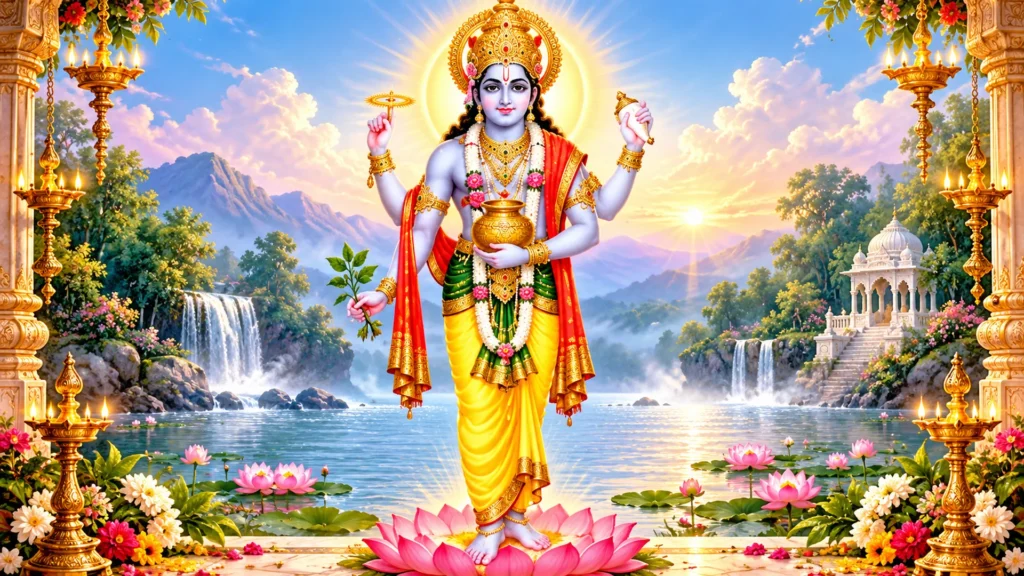
Dhanteras or Dhantrayodashi is observed two days before Diwali in many parts of North India. The day is dedicated to Lord Dhanvantari, the physician of the Celestials. There is no straight forward answer to what to do on Dhan Teras or how to observe Dhanteras, as the rituals and celebrations vary from region to region in India. But Dipika is providing a general idea of what Hindu’s do on Dhanteras. Dhanteras is considered a highly auspicious day to commence with new purchases and investments. Most complete their Diwali shopping on the day.
The first lamps of Diwali are lit on the day as this day as well. Some Hindus hang up paper lanterns with festoons and send out the messages of the arrival of Diwali. Dhanteras is not all about material wealth it is also a time to develop spiritual wealth and family bonding. All family members arrive at ancestral home on this day. Grandparents and parents wait for the day as sons, daughters and grandchildren arrive from distant places.
Dhanteras Puja constitutes the worshipping of Lord Dhanvantari on Dhanteras to ensure good health and freedom from of illness and the like, since the Lord is the physician of the Celestials.
For the Puja proper: After having a bath proceed to your prayer place and then sit facing east wards. Have all the requirements for the Puja arranged beforehand on a tray.
On your tray you should have the following: 1 large tray (to place all your puja items on that tray), another large rectangular tray, 1 banana leaf the size of your rectangular tray, 1 small Ganesh murti/picture, the laminated picture of Lord Dhanvantari (given above), a small bowl of sweet rice, a small lota/chumbu/cup add water with a small spoon, 3 incense sticks, one incense holder, 1 block of camphor, 1 box matches, a small clay lamp which should be placed on a saucer, 5 yellow flowers, a clay lamp on saucer lamp, 100g uncooked raw rice, 5 betel leaves, 3 turmeric sticks, 1 yellow flower garland.
Next pour a little water into your hand from your small lota and sip it three times chanting “Om Vishnu” (Wash your hands after each Om Vishnu chant). Now wipe your hands.
Anoint your third eye (the place between your eyebrows) with a chandan dot. Now offer Lord Ganesha 4 drops of water, chandan dot, sprinkle rice and then flower petals, offer one stick of incense (turn the incense around the murti/picture 7 times in a clockwise direction, and place in the incense holder, next offer the clay lamp on a saucer (which has a small piece of camphor in it, light it) and turn the lamp around the murti/picture 7 times in a clockwise direction, offer a spoon of sweet rice on a betel leaf and then finally offer the clay lamp (7 times around the picture) to end.
Next pray to Lord Dhanvantari on this day of Dhanteras that being the Presiding Deity of health, that may He grant you (and your family) good health and freedom from of illness and the like.
Now garland the picture of Lord Dhanvantari and then offer the Lord 4 drops of water, chandan dot, sprinkle rice and then flower petals, offer one stick of incense (turn the incense around the picture 7 times in a clockwise direction, and place in the incense holder, next offer the clay lamp on a saucer (which has a small piece of camphor in it, light it), then offer the 3 whole hurdi sticks and turn the lamp around the picture 7 times in a clockwise direction, offer a spoon of sweet rice on a betel leaf and then finally offer the clay lamp (7 times around the picture) to end. .
Yama Deepa Daan Night Ritual
*** Yes, I am aware that many perform this special ritual a day before Diwali day proper, however the Vedic Panchang is complicated and some years it is observed two days before the actual Diwali day .
The very important ritual of the Yamadeepa Daan is also performed during this particular night, after sunset. .
PLEASE REFER TO THE FULL ARTICLE (YAMA DEEPA DAAN RITUAL) ON DIPIKA.
Akash Deepa Dhan prayers are performed during the evening on this day.
Akash Deep Dhan Puja
This puja/prayer is dedicated to the Supreme couple Shree LakshmiNarayana/Vishnu.
The puja is performed in the evening.
Requirements for this special Puja are as follows: 8 small clay lamps (diya) with oil or ghee and wicks for Mother Lakshmi Devi. 1 large Clay lamp (diya) with oil or ghee & a wick for Lord Narayan/Vishnu. One small lota Milk, 9 betel leaves, 3 whole flowers, Sweets (like Jalebi, Laddo, Channa Magaj, etc), Chandan (Sandalwood paste).
PROCEDURE/PREPARATION: In a large rectangular tray, arrange the nine betel leaves and lamps as illustrated.
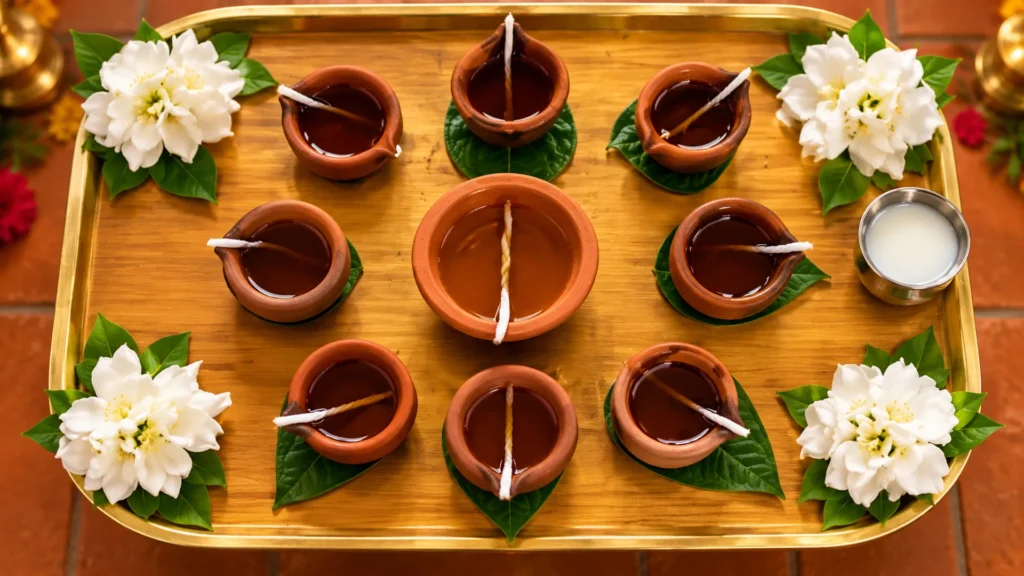
Now dot the outside of each diya with chandan. Place the small clay lamps on the betel leaves, in a circle in 8 directions and the large clay lamp in the centre of the tray. Place the flower petals, sweets and a small lota milk on the tray. Next light the diyas inside the house or outside. Next take the tray outside one’s home and in the open area and place in a clean area under the skies. Now recite the following mantra a few times or if you have a favored LakshmiNarayan mantra you can chant that mantra.
Om Shree Hreem Kleem Lakshmee – Naaraayanaaye Namah
While chanting the above mantra offer the milk in a clean place in your yard. Leave the tray outside, overnight the following morning pick up the tray and place the puja items in a clean place under a tree.
The eight Diyas that are offered are to the eight forms of the Supreme Goddess Lakshmi devi. The eight types kinds of wealth are associated with Mother Lakshmi and they are: 1. Adi Lakshmi: The Main Goddess 2. Dhanya Lakshmi: Granary Wealth 3. Dhairya Lakshmi: Wealth of Patience 4. Gaja Lakshmi: Elephants, symbols of wealth 5. Santhana Lakshmi: Wealth of Progeny 6. Vijaya Lakshmi: Wealth of Victory 7. Vidya Lakshmi: Wealth of Knowledge 8. Dhana Lakshmi: Monetary Wealth
Dhanteras Vrat Katha of Mother Lakshmi and the Farmer
Once, Mother Lakshmi insisted Lord Vishnu to accompany Him during one of His visits to the earth. Lord Vishnu agreed but on the condition that She would not fall for earthly temptations and would not look in the south direction. Mother Lakshmi agreed to this condition of Lord Vishnu. However during Their visit to the earth, due to Her Chanchala nature Mother Lakshmi got tempted to look in the south direction. When Mother Lakshmi was not able to resist Her urge to look in the south direction, She broke Her pledge and started moving towards south.
As soon as Mother Lakshmi started moving in southern direction, She was mesmerized with the beauty of yellow mustard flowers and sugarcane fields on the earth. Finally, the Mother Lakshmi fell for the earthly temptations and decorated Herself with the mustard flowers and started enjoying sugarcane juice. When Lord Vishnu saw that Mother Lakshmi has broken Her pledge, He got annoyed and asked Her to spend the next twelve years on the earth as a penance, serving at the field of the poor farmer who has cultivated mustard and sugarcane in the field.
With the arrival of Mother Lakshmi, the poor farmer became prosperous and wealthy overnight. Gradually, twelve years passed and the time for Mother Lakshmi to return back to Vaikuntha had come. When Lord Vishnu came to the earth in disguise of an ordinary man to take Mother Lakshmi back, the farmer refused to relieve Mother Lakshmi from his services.
When all attempts to by Lord Vishnu failed and the farmer didn’t agree to relieve Mother Lakshmi from his services, Mother Lakshmi revealed Her true identity to the farmer and told him that She could not stay any longer on the earth and need to go back to Vaikuntha. However, Mother Lakshmi promised the farmer that She would visit him every year during the night of Krishna Trayodashi before Diwali. As the katha goes, the farmer started cleaning his home every year to welcome Mother Lakshmi on the day of Krishna Trayodashi before Diwali.
He also started lighting an earthen lamp full of Ghee throughout the night to welcome Mother Lakshmi. These rituals to appease Mother Lakshmi made the farmer rich and prosperous year after year. People who came to know about this incident also started worshipping Mother Lakshmi on the night of Krishna Trayodashi before Diwali. This is how devotees started worshipping Mother Lakshmi along with Lord Kubera on the day of Dhanteras which is also known as Dhantrayodashi.
Second Day of Diwali
Naraka Chaturdashi:
Chaturdashi is the fourteenth Vedic day of the waning moon in which demon Narakasura was killed. (The katha is provided below). It signifies the victory of good over evil and light over darkness.
In South India, this is the actual day of festivities. One can save oneself from the terrible Yama Yathna (as described in the Garuda Purana) simply by taking the morning bath before sunrise on this day.
Oil bath ritual: Apply sesame oil (til oil) mixed with this mixture which is optional (made of gram flour, turmeric, sandalwood, etc.) on the body, massage gently, and bathe with lukewarm water. However, just Til Oil is acceptable. Additional information on Page 12.
Significance: The bath purifies the body and soul, ward off evil, and honor the triumph of good over evil (linked to Narakasura’s defeat).
One loses one’s accumulated virtues by bathing after sunrise. After the sun rises in a deep dish of water add just black til and offer 3 times per mantra below to the 14 names of Lord Yamaraja. Face South for this offering. A clean towel should be place on your right shoulder.
The mantras are as follows: om yamaaya namah om mrityave namah om vaivasvataaya namah om sarvabhootakshayaaya namah om dadhnaaya namah om parameshthine namah om chitraaya namah om dharmmaraajaaya namah om antakaaya namah om kaalaaya namah om audumbaraaya namah om neelaaya namah om vrikodaraaya namah om chitraguptaaya namah
Do note one family member can offer the above offerings while the others touches the right shoulder of the offerer. The offerer can male or female, widow/widower or not, married or unmarried. After this offerings offer the dish of water on a plant or under a tree.
Kali Chaudas Night Puja
Kali Chaudas Puja, is a Sanatani puja dedicated to Mother Kali. This puja is performed to ward off evil spirits, seek protection from negativity, and honor Mother Kali’s fierce, protective energy. It’s significance is to commemorate the victory of Lord Krishna, Satyabhama, and Mother Kali over the demon Narakasura, symbolizing the triumph of good over evil. It’s also to cleanse sins and protect one from malevolent forces.
Simple puja: offer incense, camphor lamp and flowers (Ma’s favourite flower is Hibiscus), red coloured sweets to Mother Kali and chant her mantra “Om Kreem Kaaleeka-yai Namah” 7 , 9 or 108 times.
Optional: You may offer Ma a lime to dispel evil energies and a oil/ghee lamp to symbolize light overcoming darkness.
Deepavali Hanumanji Night Puja
The night of Hanumanji Puja coincides with the night of Kali Chaudas. Malevolent spirits are most powerful during the night of Kali Chaudas. Shree Hanumanji, who gives strength to fight evil spirits, is worshipped to seek strength, power and the protection from all sorts of malevolent spirits. Diwali is celebrated to mark the return of Shree Raam to Ayodhya after defeating demon Ravana and completing His fourteen years of exile.
The devotion and dedication of Shree Hanumanji pleased Shree Raam so much that He blessed Shree Hanumanji for getting worshipped before Him. Hence people worship Shree Hanumanji a day before Diwali celebrations.
This day of Naraka Chaturdashi is also regarded and widely accepted as the actual birthday of Shree Hanumanji. It is also on this day that Srimati Sita Devi gifted our Shree Hanumanji Her priceless necklace studded with gems and diamonds/pearls. Shree Hanumanji, however, being unable to find Shree Raam in it, was not satisfied or pleased. Mother Sita then presented to Shree Hanumanji, some sindhur from Her maang.
Therefore in the worship of Shree Hanumanji on this day, one should offer sindhur mixed with jasmine (chameli/jasmine) oil on Shree Hanumanji’s murti esp his tail. Flour mixed with ghee and gur (sugar) should be mixed and prepared and thereafter shaped as ladoo, should be offered to Shree Hanumanji as prashad. It is highly recommended to recite the Hanuman Chalisa as much as possible on this day.
Simple puja: offer Jasmine incense, camphor lamp and flowers (red), sweets (Jalebi) to Shree Hanumanji and chant his mantra “Om Han Hanumate Namah” 11 or 108 times.
Optional: You may offer a Til oil/ghee lamp to symbolize light overcoming darkness.
The mantra “Om Han Hanumate Namah” is a powerful mantra dedicated to Shree Hanumanji, the embodiment of strength, devotion, and courage. It is often recited to invoke Shree Hanumanji’s blessings for protection, courage, and removal of obstacles.
In addition to the lamp on Dhan Teras, one diya should be lit in each of the rooms of the house together with one lit diya under e.g. the Tulsi plant or Bael tree (if you don’t have a Tulsi plant or Bael tree then any non thorny tree/plant)
Third Day of Diwali Main Day
Diwali:
On the day of Diwali, people should get up early in the morning and pay tribute to their ancestors and worship family Deities. Being Amavasya day, Sanatani’s also perform Shraddha for their ancestors. The actual day of Diwali, is celebrated on the third day of the festival, when the moon completely wanes and total darkness sets in the night sky.
The principal Diwali observance is associated with the dark night of Kartik Amavasya.
Taking a bath before sunrise, when the stars are still visible in the sky is equivalent to taking a bath in the Ganga River. Hence, when people greet each other in the morning, they ask “Have you performed your Ganga Snaanam?” (Most of us are not in India so what you can do in this case purchase Ganga Water from your nearest puja shop and in a bucket pour a cap of Ganga water from the bottle and fill the bucket with normal water and have a bath. It is the same thing as bathing in Mother Ganga herself).
As this is a day of rejoicement, many will have very elaborate breakfasts and lunches and meet family and friends. In the evening, lamps are again lit and Mother Lakshmi is worshipped and offered special dishes. This being a no moon day (New moon/Amavasya), many will offer food and tarpana (offerings of water and sesame seeds) to their ancestors. This is from the Garuda Purana. Like Christmas in the West, Diwali is very much a time for buying and exchanging gifts.
Lakshmi Puja Vrat and Rituals
The devotees of Mother Lakshmi observe a day long fast on this day. Their fast is broken after Lakshmi Puja in the evening.
Lakshmi Puja Preparations
Many Sanatini families decorate their homes and offices with marigold flowers, mango and banana leaves on the day of Lakshmi Puja. For Lakshmi Puja with havan (optional) with full rituals is provided on DIPIKA, as this current article is already quite lengthy. You may access that article named “Diwali = Lakshmi, Kali and DIWALI Puja and Havan”, on Dipika.
On Diwali, Lakshmi Puja should be done during Pradosha Kaal which starts after sunset.
THE BEST TIME TO PERFORM YOUR LAKSHMI PUJA (Evening)
Kartik Amavasya is also observed through water offerings (Tarpan) and bhoga offerings (Food) are offered to one’s Pitars. On New Moon days the presiding Deities are one’s ancestors/manes (Pitars) and Mother Kali.
Ancestor Food and Tarpana Offerings
Whatever vegetarian meal one cooks on that day he/she can offer to one Pitar’s – just as one does in Pitar Paksha. By performing this act great merits awaits that person. In the Garuda Purana Preta Khanda II 10.50-55 Lord Vishnu says to Shree Garudaji “On the day of Amavasya (new moon day), the airy manes (the ancestors) stand at the door of their descendants in order to receive their food. They remain there till sunset. When they do not receive their food they fall in despair and out of suffering heave long sighs and go back cursing the descendants.
Therefore, one should carefully perform shraddha (offer food) to one’s ancestors on the new moon day (Amavasya) every month”. So why are you hearing this for the first time? Well that’s a million Zimbabwe dollar question, which I can’t answer.
DO NOTE: The ancestors offerings should be offered within daylights hours. It should not be offered before or after this period for maximum spiritual credits.
Fourth Day of Diwali
Smartha Govardhan Puja. Observed by Non Vaishnavas.
Fifth Day of Diwali
Vaishnava Govardhan Puja or also known as Annakut. Is celebrated as the day Shree Krishna defeated Lord Indra-deva. For Annakut a mountain of food (normally halva) is decorated symbolizing Govardhan Mountain lifted by Lord Krishna. On this day husbands present gifts to their wives. Kindly (due to space in this article) view the full article on “Govardhana Puja” DIPIKA to read the full kathas on how Shree Krishna defeated Lord Indradeva from the Srimad Bhagavatam Maha Purana.
Bhai Dooj, on this day, brothers and sisters meet to express their love and affection for each other. Most Indian festivals bring together families; Bhai dooj brings together sisters and brothers, and is a significant festive day for them. This festival is ancient, and predates ‘Raksha Bandhan’ another brother-sister festival being celebrated today. The Aparahna period is traditionally considered auspicious for the tilak ceremony and rituals.
Key Rituals During Aparahna Time:
Tilak Ceremony: Sisters apply a tilak (vermilion, rice, or sandalwood paste) on their brothers’ foreheads, perform aarti, and pray for their longevity and prosperity.
Gift Exchange: Brothers offer gifts or money, and sisters prepare sweets or meals.
The celebrations vary in different regions:
In South India, Naraka Chaturdashi is the main day.
The main festival in North India is on Amavasya evening with Lakshmi Puja which is followed by lighting of oil lamps around the house.
Three Diwali Kathas
Three of the Kathas of Diwali show the triumph of Good over Evil, and tell of thedestruction of two monsters that preyed on humanity.
(1) The killing of Narakaasura: Narakasura was the evil king of Pragjyotishpur, near Nepal. He ruled with a reign of terror, abducted 16,000 daughters of the deva, and stole the earrings of Aditi, mother of the devas. The devas asked Lord Krishna for help, and after a mighty battle He killed the demon, freed the girls, and recovered the earrings. The rescue of the 16,000 girls is the origin of the story that Shree Krishna had 16,000 wives. After His victory Lord Krishna returned very early in the morning and was bathed and massaged with scented oils.
Taking an early morning bath with oil is still a Diwali tradition. Kindly CtrlClick (HERE) to read the full katha of the killing of Narakaasura from the Srimad Bhagavatam Maha Purana.
(2) The killing of the demon Ravana: Ravana, who had ten arms and ten heads, was the wicked king of the island of Shree Lanka, who kidnapped the wife of Shree Raam. Shree Raam had been in exile for 14 years because of a disagreement as to whether He or His brother should be the next king in Ayodhya. After a great battle Shree Raam killed Ravana demon and recovered Mother Sita. Shree Raam’s return with Mother Sita to Ayodhya and His subsequent coronation as king is celebrated at Diwali.
When Shree Raam and Mother Sita first returned to Ayodhya it was a dark moonless night and they couldn’t see where they were going. Their people put little lamps outside their houses so that the new king and queen could find Their way, thus beginning the tradition of the festival of lights.
(3) The Katha of Bali Maharaj: In the Srimad Bhagavatam 8th canto chapters 1523 narrates the katha of Bali Maharaj and Lord Vamanadeva. Kindly CtrlClick (HERE) to read the full katha from the Srimad Bhagavatam Maha Purana. But FYI we shall briefly narrate the katha.
Bali Maharaj was born in a demon family and due to his penance he ruled over material creation including Mother Lakshmi. In the absence of Lakshmi Mata the world was deprived of their basic needs and suffered immensely. The devas approached Lord Vishnu who didn’t need much coaxing to incarnate to save the world. The Lord incarnated as the son of Aditi devi and the great sage Kashyapa Muni.
Then the Lord known as Vamana (dwarf) deva approached Bali maharaja for three steps of land which Bali Maharaja immediately agreed despite being asked not to do so by his Guru. The Lord first step covered the entire surface of the world, and by extending His body He covered the entire sky. With His hands He covered all directions, and with His second footstep He covered the entire upper planetary system. Therefore there was no vacant place where He could take His third footstep.
The Lord accepted Bali Maharaja’s defeat because he couldn’t deliver on his promise and was sent to planet Sutala. When this happened Mother Lakshmi and all the Devi’s and Deva’s were released and order restored. This happened on Diwali day.
How to observe this auspicious day: After you have taken an oil bath early in the morning and wearing clean clothes proceed to your prayer place and offer incense, lamp and flowers (all seven times in a clockwise around the picture of Shree SitaRaam. After that all the food that has been prepared should be offered first to Shree SitaRaam. Leave the unoffered food before Their Lordships to bless and after about 10 minutes remove from the prayer place and then that prashad (blessed food) is for all to eat. But most importantly enjoy these 5 days.
These five days one should not consume any nonsattwic foods and drinks.
Why Hindus Take an Oil Bath on Naraka Chaturdashi and Diwali
Oil baths stems from the Ayurvedic Shastras hence beneficial in so many positive ways. Abhyanga is the Sanskrit Ayurvedic term for an oil massage which is an integral part of the daily routine recommended by this healing system for overall health and wellbeing. An oil bath will leave you feeling profoundly relaxed – mentally and physically. Oil applied to the skin is warming, moistening, nourishing, and soothing – everything that Vatta in one’s body needs to be balanced.
Sesame oil is the most penetrating and nourishing of all the oils which makes it ideal for pacifying dry Vatta in/on one’s body. Sesame Oil is warming as well, another characteristic that pacifies Vatta. While Vatta is cold and dry, Kapha is cold and wet, so for Kapha a warm, spicy oil that stimulates lymphatic drainage like mustard oil is often used. If mustard is unavailable, one can use a spicy olive oil or a lighter oil like sunflower.
Pitta on the other hand is fiery and hot, so coconut oil and even diluted neem oil are used in oil bath for Pitta dominant types.
Match the Oil to your Dosha: • Vata: Sesame, Almond, Olive (but not a spicy variety) – dry skin, drier in cold weather, dry type psoriasis or eczema and painful joints. • Pitta: Coconut, Neem – red, hot skin, easily irritated skin, oily skin, headaches from hot sun. • Kapha: Mustard, Olive (prefers a spicy variety), Sunflower – cool, moist skin, large boned, slow, easy going and gains weight easily.
I would suggestedly advise using a combination of Til (Sesame), Coconut and Mustard oils.
So it’s not uncommon that the tradition of taking a oil bath during Naraka Chaturdashi and Diwali mornings is still continued to be observe up to today. This ritual is known as Tēl Snaana (oil bath). Symbolically oil baths on Narak Chaturdasi and Deepavali suggest new beginning – removing the negativities viz the ego, anger, fights, pride and jealousy of the previous year and a fresh new beginning. So this is a physical cleansing of the body and a spiritual cleansing of the mind with new hope ritual.
Lord Krishna after killing the mighty demon Narakasura took an oil bath to get rid of the blood spattered on His body. The ritual of cleansing of the body also is symbolic of removing all dirt, evil and inauspicious things before the arrival of Srimati Lakshmidevi on the following day of Diwali. The oil bath thus has a symbolic meaning – a new beginning after washing away all dirt. Traditions mentions that those who perform the oil bath on Naraka Chaturdashi and Diwali will be blessed with prosperity, progeny and wealth.
Celebrations begin before dawn with the ritualistic oil bath. While taking an oil bath seems to be a Diwali tradition, it’s by no means restricted to just this festival. In most Indian homes, the oil bath is a weekly affair.
How to Take an Oil Bath: Ensure that the bathroom is as dry as possible. Ensure that body is dry. Now apply the 3 kinds of oils (which you have selected from the list above) on your scalp and the length of the hair (if you have hair). Now apply the mixed oils all over your body. Massage the oils gently until it is absorbed thoroughly. Wait for 5 minutes. Now you may also apply a thin layer of the besan paste (gram flour) all over your body. Stand still while it dries and thereafter wash off the rest of the oil and besan using just warm/hot water. Do not use soap or body wash.
The benefits of taking oil bath: It clears oily substances from the skin of total body and facilitate the same to transfer heat from its inside to outside. By giving healthy cold to our body we can have good appetite and feeling of taste. Healthy cold prevailing in our body prevents many diseases like jaundice, cancer and other viral diseases. We can get healthy, deep sleep and good concentration in our daily activities. Side effects of severe
diet control can be cleared by this good healthy habit. Skin and hair health can be maintained as it removes surface tension on the body. It is very economical and also required once in a week.
A bit of controversy to end. Many will email us asking but we cannot take 5 days off from work. Yes we are aware of that. I cannot understand why this is such a big issue. You can choose any of the 5 days. Yes many will choose the 3 rd but we got to look at the bigger picture and that this is a time for joy and celebrations. We should be proud other religions have one main day we have 5 main days to celebrate Diwali. Wow its makes you feel great to be a Hindu now.