

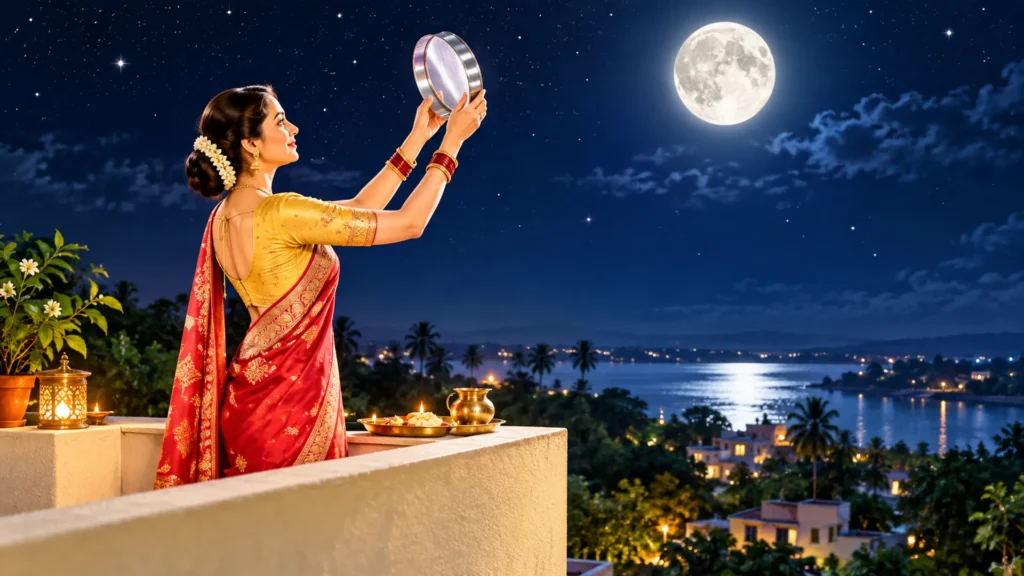
Karwa Chauth is an important fast observed mainly by Hindu women in India (but catching fast around the world) and is a fast undertaken by married Hindu women who offer prayers seeking the welfare, prosperity, well being, and longevity of their husbands. BUT I like to add something to this fast (and do note that this is my opinion). If the wife is going to fast for the husband then why the husband also join his wife and give her company and fast with her. I think that’s fair. In India, a marriage is considered to be a bond of a lifetime. This marital bond is considered very sacred and can only be broken when one passes on. That’s why in the Sanatan (Hindu) Culture – in the Sanskrit language – there’s no such word for divorce.
The Karwa Chauth festival falls on the Kartik kee Chauth which means the fourth vedic day of the waning moon or dark fortnight of Hindu month of Kartik.
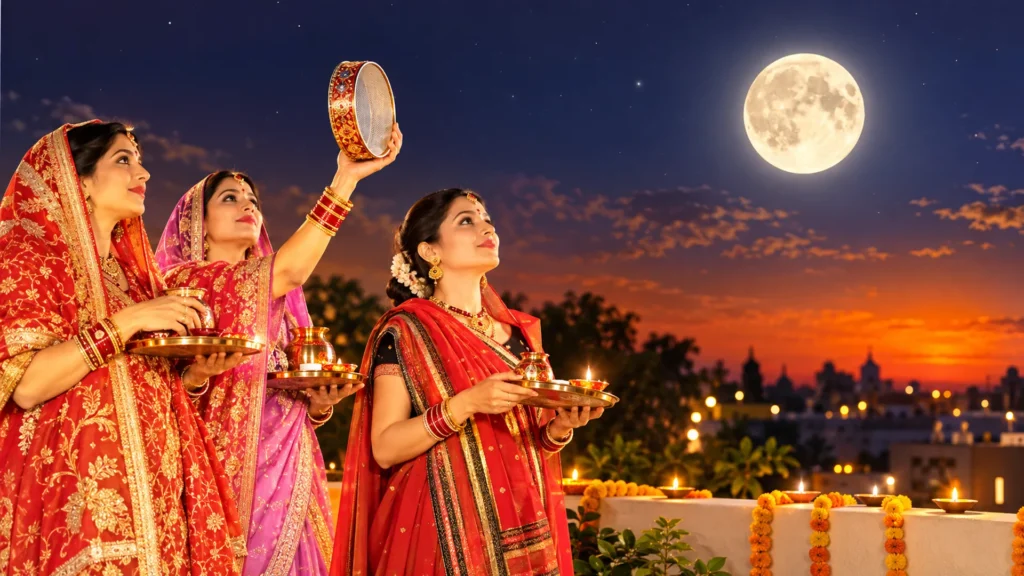
The fast starts before sunrise and ends only after offering prayers and worshipping the Moon. No food or water is to be taken after sunrise. The fast is broken once the moon is sighted and rituals of the day have been performed. At night when the moon is sighted, the wife goes out to view it. Once the moon rises, the women try to spot its reflection in a thali (shallow plate) of water. The moon is worshiped by offering water and the wife seeks blessings from Chandradeva.
The wife prays for the safety, prosperity and long life of her husband (and the husband too should pray to the Moon-god for his wives safety, prosperity and long life as well), and she then turns to view her husband’s face through the pores of a dupatta or sieve. The first sip of water and the first morsel of food are offered by the husband. A sumptuous dinner follows. This marks the end of the day long fast, praying for his long life.
For the MOON RISE times in your locality kindly click here.
Source: https://www.timeanddate.com/moon/
This fast has all the trappings of festivity. Women dress up in their best finery, in special clothes, usually red or pink coloured and apply bindis on their foreheads and with henna-decked hands, bindis, colorful bangles, vermilion in their hair parting and the best of jewelry.
Sargi A Gift from Your Mother in Law
Sargi is given by mothers-in-law to their daughters-in-law for good fortune.Usually a collection of sumptuous food, a traditional sargi package consists of various types of sweetmeats and clothes. Vermicelli kheer is an essential part of the package especially prepared by mothers-in-law for the occasion. According to traditional custom, a married woman leaves (with her sargi) for her mother’s house on the day prior to Karwa Chauth. She eats it in the early hours of the morning with her mother and other aunts who have gathered there. The fast begins at twilight, all day she will abstain from food and water.
A Traditional Recipe for Sargi
Ingredients
- 250 g wheat vermicelli
- 50 g ghee
- 1 Litre full cream milk (you can replace with 2% reduced fat or even skim milk)
- 200 g sugar (again, this amount gives the kheer a mild sweetness, up or own the amount to suit your palate). Here sugar can also be substituted for brown sugar or jaggery for a better flavor
- A few pods of whole cardamom seed
- A few strands of saffron
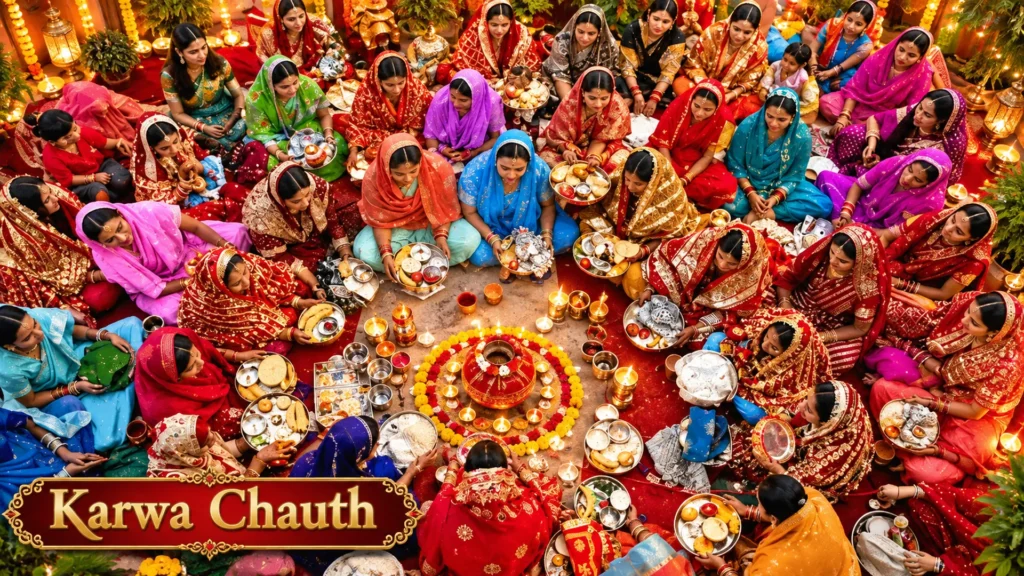
- Chopped nuts of your choice What to do 1. In a large pot roast the vermicelli in the ghee. Stir frequently to allow equal roasting. 2. Add the milk and cardamom pods and bring to the boil. 3. When the milk boils, reduce gas to a simmer and cook for a further 10-12 minutes. The vermicelli will swell in size and soak up the milk. 4. Switch off the gas and decorate with saffron and nuts. The kheer can be had warm and or it can be cooled, refrigerated and served chilled. The puja process: Early in the morning, before sunrise, the women bathe and then they pray to Lord Shiva and Parvati Mata, that their married life would be as successful as theirs. As the morning passes by and other festive activities like decorating the hand and feet with henna, decorating the pooja thali (i.e. the prayer tray) and meeting friends and relatives are done. The women prepare food and have it ready before sunrise. In the late afternoon women gather at either a temple or a garden or someone’s’ place who has arranged the pooja. A deity of Parvati Devi (or as in Devi Puja the coconut is dressed in a sari and kept on a tray) is invoked and kept on a stand. Sindoor, rice, flower petals, incense stick, lamp, and sweets are kept in one’s thali (tray). A simple pooja to Parvati Devi is performed (please see at the end of this article on how to perform this prayer). Married women thereafter sit around Parvati Devi and pray to her for the well-being and long life of their husbands. A small pitcher or Karva with some water in it is placed in the centre. Every one lights a clay lamp in their thalis (prayer tray) while listening to the Karwa katha. While the katha is being narrated, ladies circulate their Baya – basket full of goodies – from her mother, which is meant for the mother-in-law. The basket contains sweets, almonds, fruits, a sari and so forth. After the puja this Baya is given to the eldest female member of the family who blesses the woman with all the happiness in life. The wait for the moonrise begins after sunset, and as soon as the moon is sighted the women try to spot its reflection in a thali of water. The moon is worshiped by offering water and the wife seeks Chandra’s blessings. The wife prays for the safety, prosperity and long life of her husband (and the husband too should pray to the Moon-god for his wives safety, prosperity and long life as well), and she then turns to view her husband’s face through the pores of a dupatta or sieve. The first sip of water and the first morsel of food are offered by the husband. A sumptuous dinner follows. This marks the end of the day long fast, praying for his long life.
The Earliest Mahabharata Reference
The earliest reference of a Karva Chauth can be found in the great epic of Mahabharata. As per Mahabharata, Arjun, a supreme warrior and one of the Pandavas, went to the Nilgiri Hills to offer his prayers and worship to the Devas. Draupadi, wife of the Pandavas, was accompanying him. On the way, Draupadi was struck with fear believing that she was alone in the forest with no one to protect her. As she treated Lord Krishna as her brother, she invoked Him to appear before her and help her out of this grave situation. On listening to her fear and perplexity, Lord Krishna cited an example of Parvati Devi. Parvati in a similar situation asked Lord Shiva’s help.
Lord Shiva explained to her that to ward off such apprehensions, a woman could observe a fast on Kartik Krishna Chaturthi as a remedy. Lord Krishna advised Draupadi to undertake this fast and also assured her of the victory of the Pandavas.
Katha of Karwa Chauth
(To be recited on Karwa Chauth): In a village, seven brothers and one sister were staying with their parents. The sister was youngest among them. That’s why everybody adored her. When she was very young they got her married. After marriage on first Karwa Chauth, she came to her mother’s house. Her mother-in-law affectionately sent sargai for her. She put mehndi on her hands along with her mother and her brother’s wife and did sargai in the morning before sunrise and kept Nirjala fast (without taking water). By the evening the brothers got worried that how can their small sister live without food and water till night.
They consulted among themselves and decided that we will create artificial moon for our sister. Two brothers went to the forest and burnt cow dung coal. The other two brothers went home and said let’s go sister the moon has risen. All her brother’s wife’s kept quite. Sister said, “let’s go Bhabhi the moon has risen, lets worship the moon and offer ark (water is offered to the moon) to it. All the Bhabhi’s said, “So early only your moon could have risen, you go.” She was not only young but also simple hearted; she really thought everyone’s moon rises separately. She hurriedly took the pooja material to the terrace. There in the forest one brother was
standing with a sieve in front of the cow dung coal fire, so from distance she thought that the moon is rising from behind bushes. She offered her worship and ark to the moon. As soon as she started eating; she received a message from her in laws that her husband has become seriously ill suddenly. On hearing this, the Girl’s father and brothers along with her rushed to her in law’s house. There her husband was seriously ill. Every body was worried. The Ayurvedic doctor was called but nobody could understand the illness. Then the family inquired from priests and astrologers. They told them that this has happened because the girl has eaten food, after seeing the artificial moon.
Now the only solution is that till the next year Karwa Chauth, the girl takes good care of her husband, then keep fast on Karwa Chauth and exchange Karwa with Gauri Maata and make her say “le suhaagan karwa le”,”de suhagaan karwa de”. Then her husband will be well and will live long. On hearing this, the girl decided to take good care of her husband for one year. Next year Karwa Chauth arrived, her mother sent sargai for her. As per the tradition, she did sargai and kept fast. Her mother also sent material for baya, karwa and money. In the evening, all married ladies dressed up wore chunari, making preparation for the pooja, she waited to exchange Karwa with Gauri Maata.
When the first Gauri Maata arrived. The girl held her feet and pleaded her “O’ Gauri Maata, Please exchange karwa with me.” After lot of pleading Gauri Maata sat with her and said “Sister of seven brothers karwa le”, “Jo bhukhi naa reh sake (who can’t stay hungry) karwa le”, “Jo payasi naa reh sake (who can’t stay thirsty) karwa le”, “Jo Chalni meh chaand dakhe (One who see moon in sieve) karwa le.” She begged her again and again to say “Le Suhaagan Karwa Le” Gauri Maata said, “I won’t say this. My other sisters will come, you make them say. “And after saying this, she went away.
After some time the 2nd Gauri Maata came and she also went away saying what the earlier one had said. In this way they came one by one when the ninth Gauri Maara came, the girl was worried. When she begged her again and again and held her feet, then Gauri Maata said,” when my youngest sister will come, you ask her, I will not say. My sister is scary looking but good at heart, don’t let her go, make her say it.”
After some time 10th Gauri maata came. She had dark complexion, had big teeth, horrible face and was wearing lot of jewelry. When she heard the small girl pleadings, she sat down with her to exchange karwa and like other Gauri Maata’s said “Sister of seven brothers karwa le”, “Jo bhukhi naa reh sake (who can’t stay hungry) karwa le”, “Jo payasi naa reh sake (who can’t stay thirsty) karwa le”, “Jo Chalni meh chaand dakhe (One who see moon in sieve) karwa le.” The girl fell on her feet and said “O’ Mother please forgive my mistakes, Please say “Le suhaagan karwa le”. If you will say this, my husband will live. I will always worship you. Please bless me.
On girls repeated pleading, Gauri Maata felt pity for her and said. Let it be so and said “Le suhaagan karwa le” and the girl said “de suhaagan karwa de”. Then, the same thing was repeated by both of them in reverse order. When they
said this ten times the girls husband was well again. Everybody touched Gauri Maata’s feet”.
Importance of Fasting
It is not easy to unceasingly pursue the path of spirituality in one’s daily life. Therefore a worshiper must strive to impose restrains on to get the mind focused. And one form of restraint is fasting. However, fasting is not only a part of worship, but a great instrument for self-discipline too. It is a training of the mind and the body to endure and harden up against all hardships, to persevere under difficulties and not give up.
Medicative Properties
The ancient Indian medical system of Ayurveda sees the basic cause of many diseases as the accumulation of toxic materials in the digestive system. Regular cleansing of toxic materials keeps one healthy. By fasting, the digestive organs get rest and all body mechanisms are cleansed and corrected. A complete fast is good for heath, and the occasional intake of warm lemon juice during the period of fasting prevents the flatulence.
How to Perform Parvati Durga Devi Puja
Lord Ganesh Prayer Procedure
At the prayer place, place a Lord Ganesh murti or photo. Firstly offer an agarbatti, lamp (with either ghee or oil with a wick or a small piece of camphor), a flower (or all three on a tray) to Shree Ganesh (turn seven times clockwise around the murti or photo). Then offer Lord Ganesh Naivedhyam (either sweet rice, Soji, sugar candy or fruits, etc). Finally pray to Shree Ganesh, praying to him to remove all obstacles in the path of your prayer that follows.
Mother Parvati Durga Prayer Procedure
At the prayer place, place a Mother Parvati murti or photo. Now chant the following: 1) Hold your palms in the Namaste position and chant: Om swagatam su swagatam – Om Durga-yai namah (Swagatam means “O Mother Durga I welcome you”.) 2) Offer one or three incense sticks (dhoopam) by turning it seven times clockwise around Mother Durga’s deity/photo. Om tato dhoopam aghraa-payaami – Om Durga-yai namah O Mother Durga I offer you this incense, kindly accept my offering. 3) Then offer a clay or brass lamp (deepam) with either ghee or oil with a wick or a small piece of camphor by turning it seven times clockwise around the deity/photo.
Om prat-yaksha deepam darshayaami – Om Durga-yai namah O Mother Durga I offer you this lamp offering, kindly accept my offering. 4) Then offer flower (pushpam) or flower petals by turning it seven times clockwise around Mother Durga’s deity/photo. Om idam pushpam – Om Durga-yai namah O Mother Durga I offer you this flower, kindly accept my offering. 5) Then offer cut fruit or sweet meats or sweet rice (Naivedyam). It should be in a small bowl with a teaspoon. Turn the bowl seven times clockwise around the deity/photo and bring the bowl near the lips of Mother Durga suggesting she partakes in the food offering. Then leave this in front of the deity/photo.
This is later consumed by the family as the Devi’s Prashad.
Om naivedyam samar-payaami – Om Durga-yai namah O Mother Durga I offer you this food offering, kindly accept my offering. 6) Then in a cup (lota/chumbhu) which has * Dhaar turn the lota seven times clockwise around the deity/photo and bring the lota near the lips of Devi suggesting she drink the Dhaar offering. O Mother Durga I offer you your favourite drink Dhaar, kindly accept my offering. * (What is DHAAR?. I have included more information below) 7) Offer prayers for forgiveness Om yaani kaani cha papani janmaantara kritaani cha taani sarvaani nashyanti pradakshina pade pade // “O Compassionate Mother! Victory to You!
Please do forgive all the errors committed by me with the hands, legs, speech, body, through actions, through the ears, eyes, mind or by not doing ordained actions or by doing prohibited actions”. Then offer your personal prayers to Mother Durga. Ask Mother Durga for whatever you desire (within reason) and Devi being so merciful will grant what you desire. But be careful what you desire for. Bow down and leave the prayer place. The Dhaar is offered in your Devi thaan. The food offerings are eaten as prashadam. 1. Optional: Suggested Mother Durga mantra you may chant 11, 21 or 108 times: Om Dum Durga-yai namah “Salutations to the Devi who bestows compassion, fearlessness and patience”. 2.
Optional: You may sing or hear the Durga Chalisa. Durga Chalisa click ( HERE ). 3. Optional: on the first day you may offer the Mother a lime or lemon. You may write your name on the lime or lemon. Hold the lime or lemon and pray for what you desire like good health or a better job etc. This is kept for the 9 days by the Photo or Murti of the Mother. On the 10th day it is discarded in the garden or in a river. =========================================================== .
The Significance of Dhaar Offerings to the Divine Mother
In any puja to Devi, particularly in Her Divine forms as Mothers Durga/Bandi/Kali, Dhaar is offered. Unfortunately there is no direct English translation of Dhaar from Sanskrit. The nearest being “The Divine Wine”. Now I said wine, but it does not refer to the famous wines we produce here in South Africa, rather this beverage – the “wine” – is especially Devi’s favourite. Many have been offering Devi Dhaar but have never had an idea as to why. So, below we are furnishing you with shastric proof of Dhaar and its importance in Devi puja.
What Dhaar consists of: Turmeric sticks, cloves, nutmeg (Jaiphal/Jaifar), almonds, elachie, flowers petals (Hibuscus), sugar candy, camphor, turf, cows’s milk, honey, akshat (white unbroken rice) and syringaberry leaves. (kindly view the attached photo)
One may chant the following mantra from the “Shree Artha Argala Stotram” when offering Dhaar but if it’s rather difficult to pronounce then recite the English meaning… Om Jayanti Mangala Kaali Bhadra Kaali Kaapaalini Durga Shamma Shivaah Dhaatri Swaahaa Swaadhaa Namostute
(Oh! Conqueror of all, Remover of darkness, Auspicious one, beyond time, the bearer of Skulls of Impure thoughts, Reliever of difficulties, loving forgiveness, supporter of the Universe. You are the one who truly receives the sacrificial offerings and the offerings to the Pitrs (Ancestors). To you I bow most merciful Devi.)
A question will be asked by some aspirants – “how many lotas of Dhaar should one offer?” I would humbly suggest one lota of Dhaar and from that one lota offer 9 times on your Thaan. Yes you can offer 9 Lotas of Dhaar, but if you offering the Dhaar to a plant you going to drown that poor plant… So common sense should always prevail.
Questions and Answers on Karwa Chauth
What is the meaning of the words Karwa and Chauth?
Karva meaning a clay pot (pitcher) and chauth corresponds to The Karwa Chauth festival which falls on Kartik ki Chauth which means the fourth VEDIC day of the waning moon or dark fortnight of Hindu month of Kartik .
Can only married women observe this fast?
Traditionally yes because this is a fast for a married woman who wants long life for her husband.
Just say you have a steady boy-friend or a guy that you are going to marry, can’t an unmarried girl and boy also observe this fast?
Great question Hmm I don’t see what’s wrong with that to be honest… wow that’s would be one lucky guy. hope he realizes that. Nice gesture tho but this is for married women. The reason I can give is that what if hypothetically you guys’ don’t end up together.
Is one allowed to eat or drink anything for the entire day?
No nothing not even water should be consumed.
What about the swallowing of your saliva?
As far as possible one should not even do that but that’s a bit difficult… but we must not lose the focus of this fast.
Why is such an important and significant festival not popular or even known and observed in South Africa?
Simply because of ignorance and unawareness… We at www.dipika.org.za are trying to create awareness amongst South Africans about this fast.
Can I fast if I have my menstruation?
Of course you can. Menstruation should be seen as a gift from God not as a curse. Should you need to learn more about Menstruation and prayers email info@dipika.org.za and we shall email you the very comprehensive article called “The Hindu View on Menstruation”.
Why should a woman fast for her husband?
In the Sanatan culture a good conscious boy is generally seek-ed out by the girls family because whatever good the husband does half goes to the wife and thus that’s why in Vedic culture the wife stayed at home and took care of the children and the man worked as in seeking employment to get money, to perform austerities and so forth… The wife on the other hand did not have time for that but she plays an even more important part and that’s bringing up her children. Actually she has the most important job because the pillar of a strong culture is the women folk and when the women folk starts to stray then the entire cultures starts to crumble… as started in B.G. So the wife prays for her husband long life because its very beneficial to her.