

Pranaams, Namaste, Vanakkum, Hare Krsna, Jai Shree Krsna, Jai Shree Raam
All glories to our eternal Parents Shree Shree Radha Krsna
All glories to the most merciful Shree Shree Lakshmi Nrsimhadeva
All glories to Srila Prabhupada, and the other wonderful and inspiring gurus.
All glories to the wonderful servants of the Supreme Lord.
Please refrain from eating grains and meat on this most auspicious day.
(N.B We have included what to eat and what not to eat and 16 different meals to have on Ekadashi at the end of this email)
The benefits of fasting on this day are endless. This Ekadashi bestows upon that devotee eradication of the greatest sins that he has committed and is awarded passage to the spiritual abode. One is granted freedom from obstacles in his spiritual progress and grants him the perfection of life. This day of fasting removes all sins eternally. This is the most meritorious day for destroying all kinds of sins.
Please note that this auspicious day is not only for Hindus to observe. This fast can be observed by anyone. There’s no catch here. One who is truly universal does not discriminate; rather he/she respects and embraces all cultures.
One very important point of note. Many perform different prayers like for example nullifying the negative effects of the planets and wonder why the prayer did not work – “What happened, I did the prayer as the priest said and yet I feel the same”. Well what you are not told that is that if you don’t follow the Ekadashi fast and perform the planetary fast then its like bathing and then rubbing mud all over yourself again. So by fasting for a particular planet on a specific day you are removing the negative effects of that planet but when Ekadashi come and you have grains then the obstacles comes back since by eating grains on Ekadashi you are creating obstacles on your path and life. BUT by observing the Ekadashi fast you are removing all obstacles in your life.
Papankusha Ekadashi from the Brahma Vaivarta Purana
Yudhishthira Maharaj said, Oh Madhusudana, what is the name of the Ekadashi that comes during the light fortnight of the month of Ashvina (September – October)? Please be merciful and disclose this truth to me.”
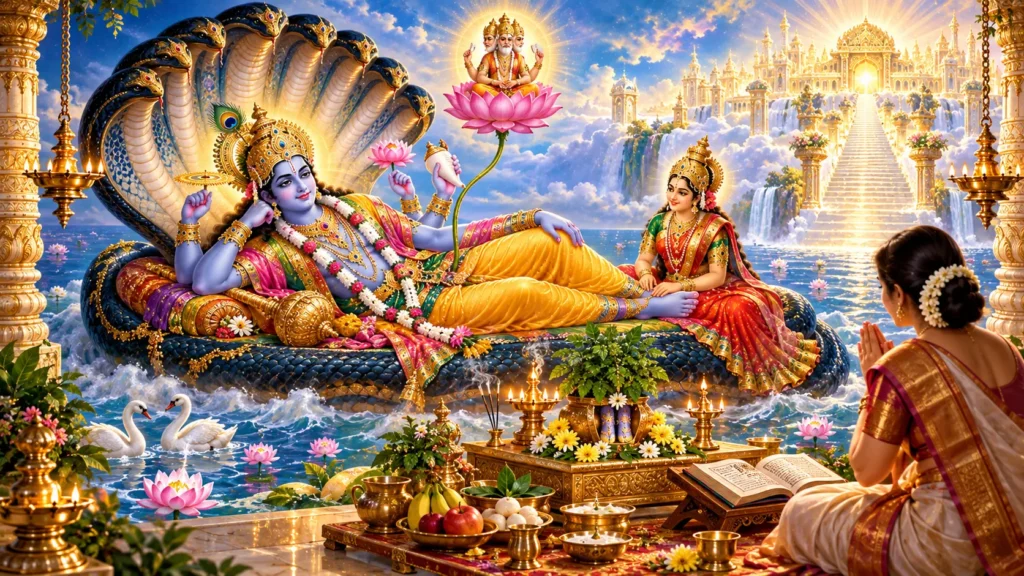
The Supreme Personality of Godhead Shree Krishna replied, “Oh king, please listen as I explain the glories of this Ekadashi – Papankusha Ekadashi – which removes all sins. On this day one should worship the Deity of Padmanabha, the lotus naveled Lord Vishnu, according to the rules of archana viddhi (regulations). By so doing, one achieves whatever heavenly pleasures one may want in this world, and at last attains liberation from this world thereafter. Simply by offering one’s humbly obeisance’s unto Lord Vishnu, the rider of Garuda, one can achieve the same merit as is gained by performing great penances for a long time restraining and controlling the senses. Although a person might have committed unlimited and abominable sins, he can still escape hellish punishment just by paying his obeisance’s to Lord Shree Hari, the taker away of all sin.”
“The merits gained by going on pilgrimage to the Holy Tirthas of this earthly planet can also be achieved simply by chanting the Holy names of Lord Vishnu. Whosoever chants these sacred names – such as Rama, Vishnu, Janardana or Krishna – especially on Ekadashi never sees Yamaraj, the Lord of death’s punishing abode. Nor does such a devotee who fasts on Papankusha Ekadashi, which is very dear to Me, see that plutonic abode.”
“Both the Vaishnava who criticizes Lord Shiva and the Shaivite who criticizes Me certainly go to hell. The merit obtained by performing one hundred horse sacrifices and one hundred Rajasurya sacrifices is not even equal to one sixteenth of the merit a devotee is able to attain by fasting on Ekadashi. There is no higher merit one can achieve than that attained by fasting on Ekadashi. Indeed, nothing in all the three worlds is as pleasing or as able to purify one of accumulated sin as Ekadashi, the day of the lotusnaveled Lord, Padmanabha.
“O king, until a person observes a fast on the day of Lord Padmanabha named Papankusha Ekadashi, he remains sinful, and the reactions of his past sinful activities never leave him like a chaste wife. There is no merit in all the three worlds that can match the merit that one gains by observing a fast on this Ekadashi. Whosoever observes it faithfully never has to see death personified, Lord Yamaraj. One who desires liberation, elevation to the heavens, good health, beautiful women, wealth, and food grains should simply fast on this Papankusha Ekadashi. O king, neither the Ganges, Gaya, Kashi, nor Pushkara, nor even the Holy site of Kurukshetra, can grant as much auspicious merit as this Papankusha Ekadashi.
“O Maharaj Yudhishthira, protector of the earth, after observing Ekadashi during the daytime, the devotee should remain awake through the night (if this is possible), absorbed in hearing, chanting and serving the Lord – for by so doing he easily attains to the Supreme abode of Lord Vishnu. Not only that, but ten generations of ancestors on his mother’s side, ten generations on his father’s side, and ten generations on his wife’s side are all liberated by a single observance of a fast on this Ekadashi. All these ancestors attain their original, four armed transcendental Vaikuntha forms. Wearing yellow garments and beautiful garlands, they ride to the spiritual realm on the back of Garuda, the renowned great enemy of the snakes. This is the benediction My devotee earns simply by observing one Papankusha Ekadashi properly.
“O best of kings, whether one is a child, a youth, or in old age, fasting on Papankusha Ekadashi frees him from all sins and makes him immune to suffering a hellish rebirth. Whosoever observes the Papankusha Ekadashi becomes free of all his sins and returns to the spiritual abode of Lord Shree Hari. Whosoever donates gold, sesame seeds, fertile land, cows, grain, drinking water, an umbrella, or a pair of shoes on this most auspicious of Holy days will never have to visit the abode of Yamaraj, who always punishes the sinners. But if a resident of earth fails to perform spiritual deeds, especially the observance of a fast on days such as Ekadashi, his breathing is said to be no better, or of as much use as the breathing/puffing of a blacksmith’s bellows.
“O best of the kings, especially on this Papankusha Ekadashi, even the poor should first bathe and then give some charity according to their means, and perform other auspicious activities in accordance with their ability.
“Whosoever performs sacrifices and benefits the people, or builds public ponds, resting places, gardens, or houses does not suffer the punishments of Yamaraj. Indeed, one should understand that a person much have performed such pious activities as these in the past life if he is long lived, wealthy, of high birth, or free from all diseases. But a person who observes Papankusha Ekadashi goes to the abode of the Supreme Personality of Godhead, Vishnu.)
Lord Shree Krishna then concluded, “Thus, Oh saintly Yudhishthira, I have narrated to you the glories of the auspicious Papankusha Ekadashi.”
Thus ends the narration of the glories of the Papankusha Ekadashi from the Brahma-Vaivarta Purana.
Sometimes if you cannot fast due to circumstances then you can chant the names of all the Ekadashi and read the above true story and you will receive the same benefits.
Suta Goswami said: There are twelve months in a year, and two Ekadashi’s in each month. Thus there are twenty-four Ekadashi’s in one full year, and in a leap year there are two extra Ekadashi’s. O great sages, please listen attentively as I declare to you the names of these auspicious Ekadashi’s.
Ekadashi Names and Western Months
| Ekadashi | Occurs in Western Month |
| Utpan-naa | November-December |
| Moksha-daa | November-December |
| Saphalaa | December-January |
| Putra-daa | December-January |
| Shat-tilaa | January-February |
| Jayaa | January-February |
| Vijayaa | February-March |
| Aamalakee | February-March |
| Paapamo-chanee | March-April |
| Kaamadaa | March-April |
| Varoothinee | April-May |
| Mohinee | April-May |
| Aparaa | May-June |
| Nirjalaa | May-June |
| Yoginee | June-July |
| Padmaa | June-July |
| Kaamikaa | July-August |
| Putradaa | July-August |
| Ajaa | August-September |
| Parivartinee | August-September |
| Indiraa | September-October |
| Paapaankushaa | September-October |
| Ramaa | October-November |
| Haribodhinee | October-November |
The two extra Ekadashis occurring during a leap year are Padminee and Paramaa.
***Please note the t is pronounced as follows, place the tip of your tongue on the roof of your mouth and say t.
***Please note the n is pronounced as follows, place the tip of your tongue on the roof of your mouth and say n.
“O sages, one who hears about these Ekadashi’s will learn how to observe them properly. Each Ekadashi bestows particular benefits on the faithful observer.
One who is physically unable to fast on Ekadashi may read the glories of each Ekadashi when it occurs and recite all the names of the Ekadashis; thus he will achieve the same goal as the person who observes the full Ekadashi vow.”
Ekadashi Preparations
For a detailed what to eat or not and over 100 Ekadashi recipes please visit our website www.dipika.org.za And look under the sub-menu called EKADASHI – THE DAY OF LORD HARI.
Abstain from: grains (cereals, breads, wheat, flour, beans, rice, dhals, green beans, roti, coffee, etc) meat.
Do not cook with: Powdered hing, shop turmeric (you can use whole turmeric), shop masala and shop chilli powder.
You can cook with the following: Whole turmeric, clean salt, cinnamon sticks, clean oil, butter, ghee, ginger, chilli, curry leaves, maas (yogurt), cheese, cottage cheese, yogurt, clean sugar, rooibos tea, spinach, dhania, thyme, peppers, ground pepper, mint, green bananas, fresh cream, sour cream, bay leaves.
Potatoes, tomatoes, peanuts, cabbage, pumpkin, butternut, gem squash, carrots, lettuce, all kinds of fruits, paneer.
Sixteen Ekadashi Meal Ideas
1. Tomato Chutney with Scrambled Paneer: Make tomato chutney. Add scrambled paneer and dhania. Optionally add a little maas (yogurt) or fresh cream.
2. Eggplant and Potato Mash Casserole: Cut eggplant into thin slices and deep fry. Keep aside. Prepare potato mash and keep aside. Lay the eggplant on the bottom of a casserole dish and cover with mash. Sprinkle cheese on the mash, place thin slices of tomato on the cheese, and place strips of peppers on the tomato slices. Bake for a few minutes and serve.
3. Potato Soup: Prepare potato soup with salt, thyme and black or white pepper.
4. Mixed Vegetable Stew: Prepare a mixed vegetable stew using the listed vegetables. Add black pepper, thyme, a little butter, fresh cream and liquid from the baked vegetables.
5. Crispy Baked Vegetables: Cut potato into large pieces, butternut into big pieces, carrots into thin strips, cauliflower into florets and sweet potato into rounds. Boil the vegetables for 15 minutes, drain them and save the liquid. Mix butter, black pepper, salt, origanum and lots of thyme and rub well into the boiled vegetables. Bake in the oven until crispy on the outside.
6. Vaikuntha Curry: Prepare the curry using curry leaves and ginger. Combine the sliced cabbage, pepper strips, carrot strips, fried paneer cubes, thyme and dhania.
7. Cheese Baked Potato Rounds: Cut potato into rounds and deep fry. Drain to remove excess oil, ghee or butter. Place flat in a baking tray, grate cheese over the potato and bake until the cheese melts.
8. Loaded Potato Rounds: Cut potato into rounds and deep fry, then drain excess oil. Place the rounds in a baking tray with spaces between each. Mix scrambled curds, tiny cubed tomatoes, green peppers, salt, grated cheese, black pepper and thyme. Place the mixture on the potato, add more cheese on top and bake until the cheese melts.
9. Baked Jacket Potato: Bake the whole potato with its jacket in the microwave until soft. Make a cross in the top and press it open. Dot with butter, add a tablespoon of sour cream, top with cheese and bake until the cheese melts.
10. Cabbage and Potato with Tomatoes: Cook cabbage and potato with tomatoes.
11. Creamy Mixed Vegetables: Cook the mixed vegetables in butter, ghee or oil. When cooked, add sour cream or fresh cream. Cook until it thickens.
12. Fried Peanuts and Green Bananas: Fry the peanuts. Fry the green bananas.
13. Salads and Fruit Salads: Make salads and fruit salads.
14. Chevda: Fry the nuts. Fry grated potatoes coloured with red, green or yellow food colour. Optionally fry thin slices of green bananas.
15. Saigo Milk: Add 4 cups of water to a pot. Add 1 cup of saigo and bring to the boil, stirring continuously. Add sugar to taste and a few drops of vanilla essence. Cook on medium heat for about 20 minutes until the saigo becomes clear. Add 2 cups of milk and boil until slightly thick.
16. Saigo Patties: Soak 1 cup of saigo in cold water for 20 minutes and remove the excess water. Boil three medium potatoes and mash while hot, then add the saigo. Finely cut 2 chillies, chop some dhania and add salt to taste. Optionally add grated cheese. Form into patties and deep fry until golden brown. Serve with tomato chutney.
Reference
“Ekadashi: The Day of Lord Hari” 1986. HH Krishna Balaram Swami. Bhaktivedanta Institute Press