

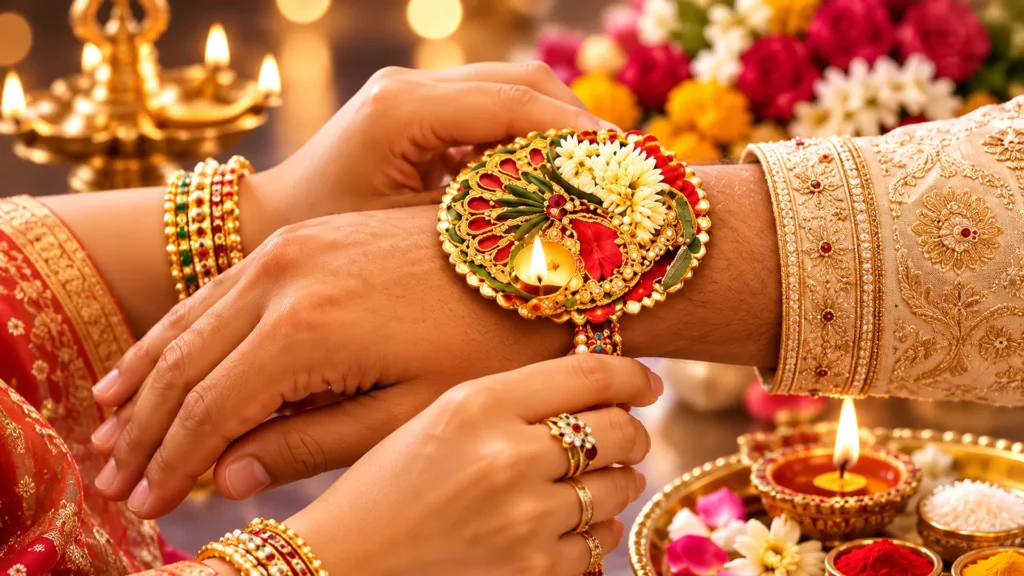
This important and auspicious festival falls on Full Moon day in the month of Shravan (July-August). This year it falls on the 27th of August 2026. The literal meaning of Raksha Bandhan is Raksha (Protection) Bandhan (the process of binding or tying). During this day the meeting of brothers and sisters takes place. Their sisters tie an amulet of coloured thread known as a rakhee around the right wrist of the brothers. This is done to protect the brother from evil and inauspiciousness during the coming year.
Significance and Purpose of Raksha Bandhan
The brother pledges to protect his sister in every birth. To symbolize this he allows her to tie a string on his wrist. The sister complies so that he keeps his promise. Since the historical ages this custom is prevalent to keep a brother and sister in a relationship. The rakhi is a symbol of the purity of a relationship between a sister and brother. Just as the brother is bound by a promise to protect the sister after getting a string tied onto his wrist, so also the sister prays to God for his protection. On this day frequencies of Lord Ganesh and Mother Saraswati reach the earth in greater quantities and both the siblings benefit from the custom to a greater extent. The more the spiritual emotion in the sister, the more her motivation to attain God and the more the grace of the Guru upon her the greater is the effect of her prayer unto God for her brother which results in greater spiritual progress for him.
Most Essential Things for Ritualistic Raksha Bandhan Celebrations
On a tray have the following items:
A small diya, akshat (uncooked white or basmati rice mixed with turmeric), kumkum paste, sweets and the Rakhi.
Tilak Ceremony
Tilak is considered as promising and holy in Hindu conventions and culture. Applying a tilak of kumkum on the forehead of the siblings implies opening the third, knowledge or wisdom eye. Sprinkle akshat over the brother’s head.
Aarti
This one is basically done to ward off all evil and dangers from the life of the brother. The flames of the holy diya eliminate the darkness and keep the person grounded and safe in the real world. This is performed not only on rakhi but on other auspicious occasions as well.
Tying Rakhi
This is the most crucial part of the whole celebration, tying the holy thread on the wrist of your brother and wishing all the luck, and success to him. Also, taking the promise that he will be there for you besides you regardless of the situation and will always stand with you and for you. This is certainly an emotional moment for most of us as it signifies our love for our brothers who are our strengths as well as weaknesses.
Traditionally the sister “charges” the rakhee/rakhi with the power of the following raksha (protection) mantra:
“Om yena baddho balee raajaa daana
vendro mahaa balah tenatvaa mabhi
badhnaami, rakshe maachala maachala”.
The meaning of this mantra is as follows:
“I am tying on your hand this Raksha, with which the most powerful and generous King Bali himself was bound; O Raksha, don’t go away; don’t go away.”
Sweetening the Brother’s Mouth
All the prayers and blessings then are accompanied with some sweets. Offering sweets is considered to add sweetness to the strong bond of brother and sister.
Gift Exchange
Finally comes the time which most of us wait eagerly for, exchanging gifts. At last brothers present some gifts as a token of love to their sisters and sisters do the same.
So, these are the complete Raksha Bandhan rituals.
The power of this mantra protects the wearer from any evil influences. His sister should perform aarti around her brother to ward off any evil and then the sister should offer her brother some sweets and the brother; in turn, he should shower his sister with some gifts.
This festival is also celebrated in South India and is called Avani Avittam. Recitation of mantras is highly recommended and highly beneficial on this day. This festival is also known as Upakarmam, and is especially sacred to the Brahmins, who have been invested with the Brahmin thread. In India this holy festival of Upakarmam reminds one who wears the sacred thread of its glorious spiritual significance. Brahmins also offer water to their ancestors, to whom they owe their birth to; to the great rishis, to whom they are highly indebted for their spiritual knowledge; and to the shastras (scriptures). A spiritual inclined person never forgets his benefactors.
On this day, Sachi Devi, the wife of Lord Indra (the lord of the heavens), tied a holy thread or amulet around the wrist of her husband, when he was defeated by the asuras (demons). Then Lord Indra, the king of the Devis and Devas, gained victory over the demons by the powers of this protection.
He then recovered the lost city of Amaravati.
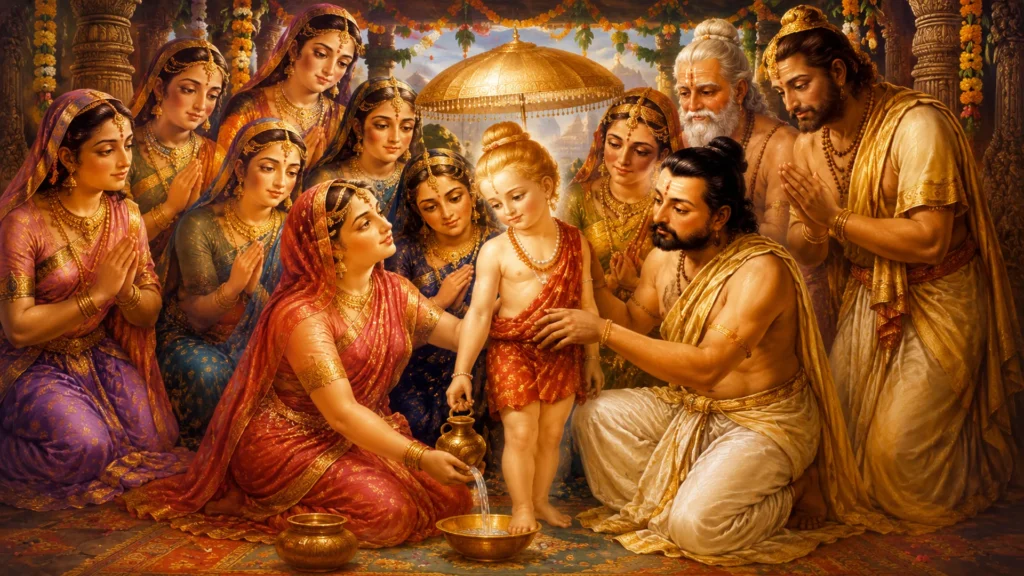
Lord Vamanadeva with His parents
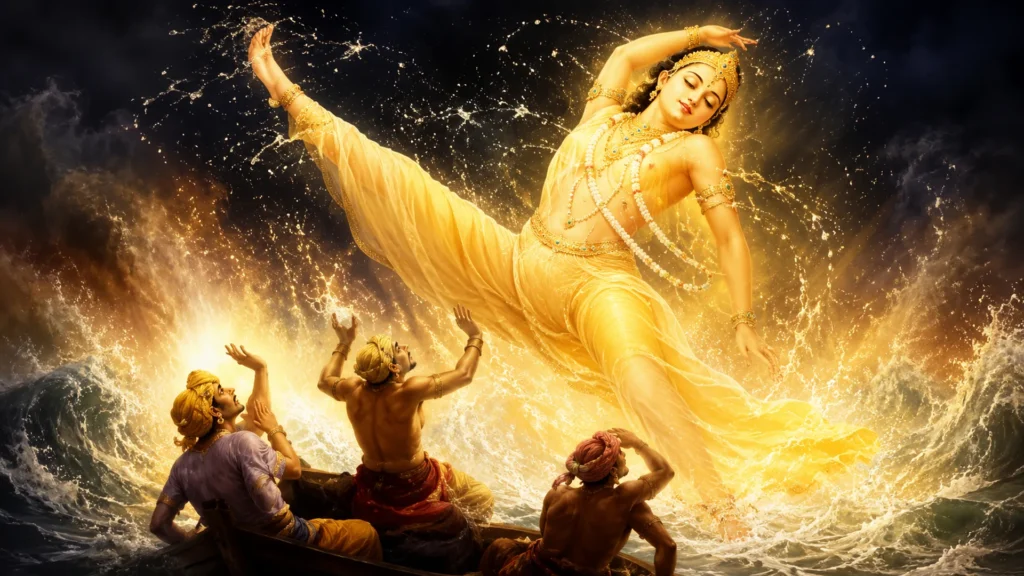
Lord Vamanadeva three steps defeating Bali Maharaja
The Katha of King Bali
The katha of King Bali is very auspicious and purifying to read and hear. In the Srimad Bhagavatam 8th canto chapter 18-22 Shukadeva Goswami himself narrates the katha of King Bali. Bali Maharaja was a descendant of an asura (demon) dynasty and when he defeated the mighty Indra and all the Devi’s and Deva’s being afraid of him, left the heavenly planets and went into hiding. Thereafter Lord Vamanadeva (the dwarf incarnation of Shree Krsna) appeared in a sacrificial arena of Maharaja Bali. Maharaja Bali was well versed in the etiquette of Vedic shastras and when he saw Lord Vamanadeva he immediately got up from his chair and washed the Lord’s lotus feet. He then inquired about the Lord’s welfare and requested the Lord to ask him for anything He desires. The Lord responded by saying that He only wants three paces of land. Bali Maharaja was a bit shocked to hear such an insignificant request but being a man of his word Bali Maharaja granted the Lord’s request.
Despite his knowledge that Lord Vamanadeva was cheating him, Bali Maharaja still gave the three steps in charity to the Lord. Thereafter Lord Vamanadeva extended His body and assumed a gigantic form as Lord Vishnu. In His first step the Lord covered the entire surface of the world and with His second step He covered the entire upper planetary systems. But there was no vacant place where He could place His third footstep. Because he could not fulfill his promise in regard to the Lord’s third step, he was arrested and bound with the ropes of Lord Varuna. So in the raksha mantra we chant today, baddho (binds) balee raja (Bali Maharaja) with ropes, we are chanting the Rakshaa vidhaanam mantra, which are mainly chanted by priests. In order to fulfill his promise Bali Maharaja offered his head as the third step. Being pleased with Bali Maharaja’s humility, his behavior and his magnanimity, the Lord released him and made him the ruler of the Sutala planetary system (3 planets below Earth).
A word of note
Nowadays Om or pictures of deities are seen on rakhis. After use the rakhi is thrown out so in a way that it is a ridicule of the religious symbol and disrespect of the deities, which in turn is very sinful. To avoid this immerse the rakhis in water after use.
The Purpose of Red Strings (Raksha Sutra)
PLEASE NOTE: I WAS REQUESTED BY A PRIVATE SOUTH AFRICAN SCHOOL TO GIVE A SHORT TALK ABOUT RAKHI. MY TIME WAS LIMITED.
I pray that this will assist school authorities to have a better understanding about certain Hindu traditions.
Question: What is the purpose of wearing Red Strings tied around the wrist?
Answer: The ritual of tying the red string originated thousands of years ago in the Hindu scripture named “Sarva Deva Pratishthaa Paddhati”, which explains that after a Hindu prayer is completed, the priest traditionally “powers up/charges/imbues” the red string with a sacred hymn (mantra). This raksha sutra (red string) is then tied on the left wrist for a female, and on the right wrist for a male. The power of this mantra on the red string protects the wearer from evil influences and wards off dangers, diseases and enemies. Strings should be thin and presentable. It should not be a fashion statement, instead, its spiritual purpose should be commemorated.