
Pranaams, Namaste, Vanakkum, Hare Krsna, Jai Shree Krsna, Jai Shree Raam.
All glories to our eternal Parents Shree Shree Radha Krsna.
All glories to the most merciful Shree Shree Lakshmi Nrsimhadeva.
All glories to Srila Prabhupada, and the other wonderful and inspiring gurus.
All glories to the wonderful servants of the Supreme Lord.
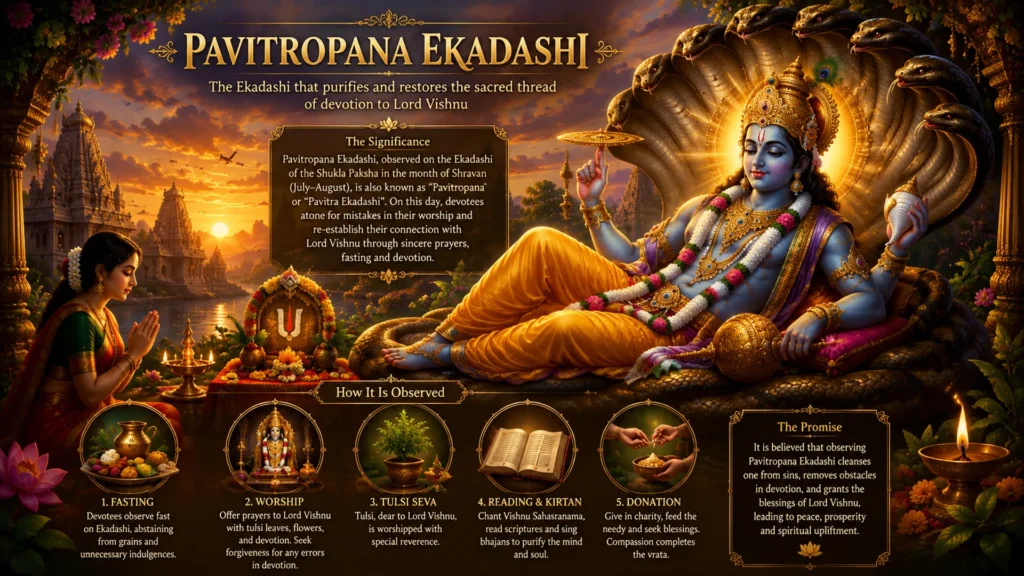
On 23rd of August (Sunday), Shravana Pavitropana/Putrada Ekadashi is observed. Please have your last grain meal on Saturday night. The times to break your fast with grains is on Monday morning:
On 24th of August Parana Time (Break-fast):
- Durban: 07:19 AM to 08:36 AM
- Gauteng: 07:19 AM to 08:45 AM
- Cape Town: 07:19 AM to 09:29 AM
Please refrain from eating grains and meat on this most auspicious day. (N.B. I have included what to eat and what not to eat and 16 different meals to have on Ekadashi at the end of this email).
The benefits of fasting on this day are endless. This Ekadashi bestows upon that devotee eradication of the greatest sins that he has committed and is awarded passage to the spiritual abode. One is granted freedom from obstacles in his spiritual progress and grants him the perfection of life. This day of fasting removes all sins eternally. This is the most meritorious day for destroying all kinds of sins.
Please note that this auspicious day is not only for Hindus to observe. This fast can be observed by anyone. There’s no catch here. One who is truly universal does not discriminate; rather he/she respects and embraces all cultures.
One very important point of note: Many perform different prayers like, for example, nullifying the negative effects of the planets and wonder why the prayer did not work – “What happened, I did the prayer as the priest said and yet I feel the same”. Well, what you are not told is that if you don’t follow the Ekadashi fast and perform the planetary fast, then it is like bathing and then rubbing mud all over yourself again. So by fasting for a particular planet on a specific day you are removing the negative effects of that planet, but when Ekadashi comes and you have grains, then the obstacles come back since by eating grains on Ekadashi you are creating obstacles on your path and life. BUT by observing the Ekadashi fast you are removing all obstacles in your life.
Pavitropana Ekadashi from the Bhavishya Purana
Shree Yudhisthira Maharaja said, “Oh Madhusudana, Oh killer of the Madhu demon, please be merciful to me and describe to me the Ekadashi that occurs during the light fortnight of the month of Shravana (July-August).”
The Supreme Lord, Shree Krishna, replied, “Yes, Oh king, I shall happily narrate its glories to you, for just by hearing about this sacred Ekadashi one attains the merit of performing a horse sacrifice. At the dawn of Dvapara-yuga there lived a king by the name of Mahijita, who ruled the kingdom of Mahismati-puri. Because he had no son, his entire kingdom seemed utterly cheerless to him. A married man who has no son gains no happiness in this life or the next. The Sanskrit word for ‘son’ is putra. Pu is the name of a particular hell, and tra means ‘to deliver.’ Thus the word putra means ‘a person who delivers one from the hell named Pu.’ Therefore every married man should produce at least one son and train him properly; then the father will be delivered from a hellish condition of life. But this injunction does not apply to the serious devotees of Lord Vishnu or Krishna, for the Lord becomes their son, father, and mother.
For a long time this king tried very hard to obtain an heir, but to no avail. Seeing his years advancing ever onwards, King Mahijita became increasingly anxious. One day he told an assembly of his advisers: ‘I have committed no sin in this life, and there is no ill-gotten wealth in my treasury. I have never usurped the offerings to the devas or brahmanas. When I waged war and conquered kingdoms, I followed the rules and regulations of the military art, and I have protected my subjects as if they were my own children. I punished even my own relatives if they broke the law, and if my enemy was gentle and religious I welcomed him. Oh twice-born souls, although I am a religious and faithful follower of the Vedic standards, still my home is without a son. Kindly tell me the reason for this.’
Hearing this, the king’s brahmana advisers discussed the subject among themselves, and with the aim of benefiting the king they visited the various ashrams of the great sages. At last they came upon a sage who was austere, pure, and self-satisfied, and who was strictly observing a vow of fasting. His senses were completely under control, he had conquered his anger, and he was expert at performing his occupational duty. Indeed, this great sage was expert in all the conclusions of the Vedas, and he had extended his life span to that of Lord Brahma himself. His name was Lomasa Rishi, and he knew past, present, and future. After each kalpa passed, one hair would fall out of his body (One kalpa, or twelve hours of Lord Brahma, equals 4,320,000,000 earth years.) All the king’s brahmana advisers very happily approached him one by one to offer their humble respects.
Captivated by this great soul, King Mahijita’s advisers offered obeisances to him and said very respectfully, ‘Only because of our great good fortune, Oh sage, have we been allowed to see you.’ Lomasa Rishi saw them bowing down to him and replied, ‘Kindly let me know why you have come here. Why are you praising me? I must do all I can to solve your problems, for sages like me have only one interest: to help others. Do not doubt this.’
Lomasa Rishi had all good qualities because he was a devotee of the Lord. The king’s representatives said, ‘We have come to you, Oh exalted sage, to ask for your help in solving a very serious problem. Oh sage, you are like Lord Brahma. Indeed, there is no better sage in the entire world. Our king, Mahijita, is without a son, though he has sustained and protected us as if we were his sons. Seeing him so unhappy on account of being sonless, we have become very sad, Oh sage, and therefore we have entered the forest to perform severe austerities. By our good fortune we happened upon you. Everyone’s desires and activities become successful just by your darshana. Thus we humbly ask that you tell us how our kind king can obtain a son.’
Hearing their sincere plea, Lomasa Rishi absorbed himself in deep meditation for a moment and at once understood the king’s previous life. Then he said, ‘Your ruler was a merchant in his past life, and feeling his wealth insufficient, he committed sinful deeds. He traveled to many villages to trade his goods. Once he became thirsty while traveling from place to place. He came upon a beautiful pond on the outskirts of a village, but just as he was about to drink at the pond a cow arrived there with her newborn calf. These two creatures were also very thirsty because of the heat, but when the cow and calf started to drink, the merchant rudely shoved them aside and selfishly slaked his own thirst. This offense against a cow and her calf has resulted in your king’s being without a son now. But the good deeds he performed in his previous life have given him rulership over an undisturbed kingdom.’
Hearing this, the king’s advisers replied, ‘Oh renowned rishi, we have heard that the Vedas say one can nullify the effects of one’s past sins by acquiring merit. Be so kind as to give us some instruction by which our king’s sins can be destroyed; please give him your mercy so that a prince will take birth in his family.’ Lomasa Rishi said, ‘There is an Ekadashi called Putrada, which comes during the light fortnight of the month of Shravana. On this day all of you, including your king, should fast and stay awake all night, strictly following the rules and regulations. Then you should give the king whatever merit you gain by this fast. If you follow these instructions of mine, he will surely be blessed with a fine son.’
All the king’s advisers became very pleased to hear these words from Lomasa Rishi, and they all offered him their grateful obeisances. Then, their eyes bright with happiness, they returned home. When the month of Shravana arrived, the king’s advisers remembered the advice of Lomasa Rishi and under their direction all the citizens of Mahismati-puri, as well as the king, fasted on Ekadashi. And on the next day, Dvadashi, the citizens dutifully offered their accrued merit to him. By the strength of all this merit, the queen became pregnant and eventually gave birth to a most beautiful son.
“O Yudhisthira,” Lord Shree Krishna concluded, “the Ekadashi that comes during the light fortnight of the month of Shravana has thus rightfully become famous as Putrada [“bestower of a son”]. Whoever desires happiness in this world and the next should certainly fast from all grains and legumes on this holy day. Indeed, whoever simply hears the glories of Putrada Ekadashi becomes completely free of all sins, is blessed with a good son, and surely ascends to heaven after death.”
Thus ends the narration of the glories of Pavitropana Ekadashi from the Bhavishya Purana. Sometimes if you cannot fast due to circumstances then you can chant the names of all the Ekadashi and read the above true story and you will receive the same benefits.
Suta Goswami said: There are twelve months in a year, and two Ekadashis in each month. Thus there are twenty-four Ekadashis in one full year, and in a leap year (like this year) there are two extra Ekadashis. O great sages, please listen attentively as I declare to you the names of these auspicious Ekadashis.
List of Auspicious Ekadashis
| Name of Ekadashi | Occurs in (Western month) |
| Utpan-naa | November-December |
| Moksha-daa | November-December |
| Saphalaa | December-January |
| Putra-daa | December-January |
| Shat-tilaa | January-February |
| Jayaa | January-February |
| Vijayaa | February-March |
| Aamalakee | February-March |
| Paapamo-chanee | March-April |
| Kaamadaa | March-April |
| Varoothinee | April-May |
| Mohinee | April-May |
| Aparaa | May-June |
| Nirjalaa | May-June |
| Yoginee | June-July |
| Padmaa | June-July |
| Kaamikaa | July-August |
| Putradaa | July-August |
| Ajaa | August-September |
| Parivartinee | August-September |
| Indiraa | September-October |
| Paapaankushaa | September-October |
| Ramaa | October-November |
| Haribodhinee | October-November |
The two extra Ekadashis, which occur during a leap year, are called Padminee and Paramaa.
*** Please note the t is pronounced as follows, place the tip of your tongue on the roof of your mouth and say t.
*** Please note the n is pronounced as follows, place the tip of your tongue on the roof of your mouth and say n.
“O sages, one who hears about these Ekadashis will learn how to observe them properly. Each Ekadashi bestows particular benefits on the faithful observer. One who is physically unable to fast on Ekadashi may read the glories of each Ekadashi when it occurs and recite all the names of the Ekadashis; thus he will achieve the same goal as the person who observes the full Ekadashi vow.”
Ekadashi preparations
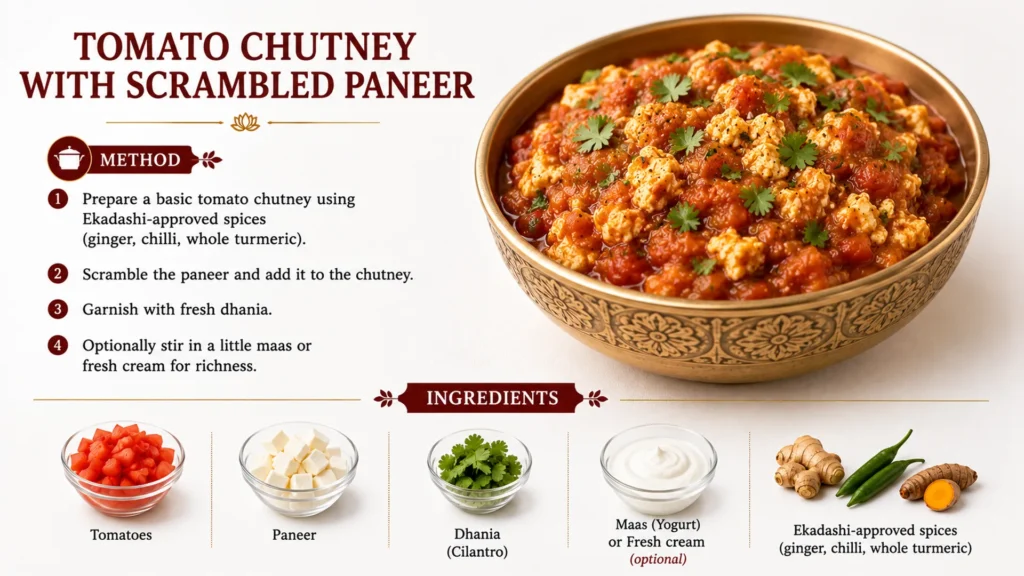
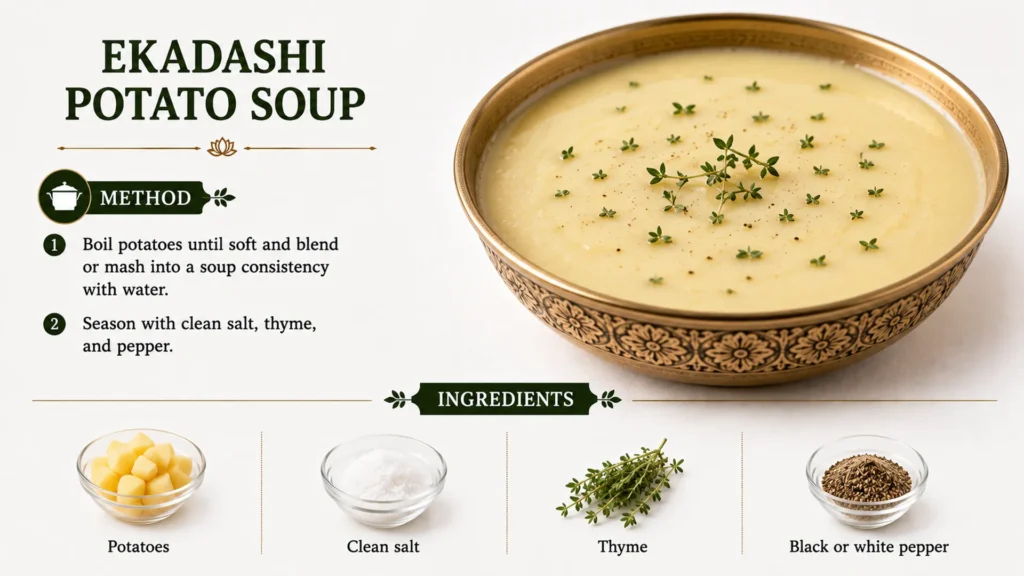
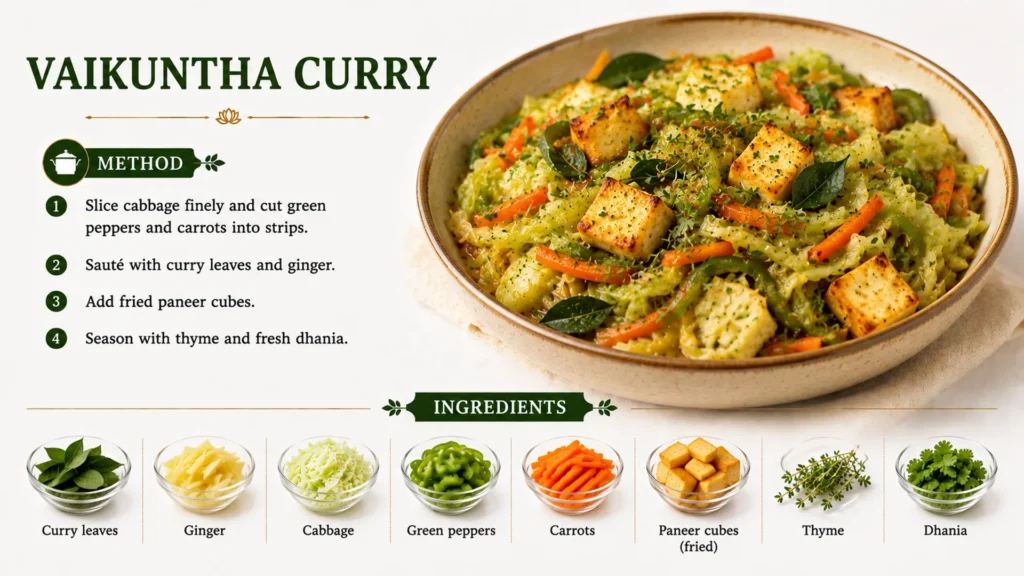
For a detailed what to eat or not and over 100 Ekadashi recipes please visit our website www.dipika.org.za and look under the sub-menu called EKADASHI – THE DAY OF LORD HARI.
- Abstain from: Grains (cereals, breads, wheat, flour, beans, rice, dhals, green beans, roti, coffee, etc.) and meat.
- Do not cook with: Powdered hing, shop turmeric (you can use whole turmeric), shop masala and shop chilli powder.
- You can cook with the following: Whole turmeric, clean salt, cinnamon sticks, clean oil, butter, ghee, ginger, chilli, curry leaves, maas (yogurt), cheese, cottage cheese, yogurt, clean sugar, rooibos tea, spinach, dhania, thyme, peppers, ground pepper, mint, green bananas, fresh cream, sour cream, bay leaves.
- Vegetables and Fruits: Potatoes, tomatoes, peanuts, cabbage, pumpkin, butternut, gem squash, carrots, lettuce, all kinds of fruits, paneer.
RECIPES