
Vijayotsava – Victory Celebration of the Killing of the Demon Ravana
On the tenth day of the waxing moon of Padmanabha (Ashvina) month occurs Vijayotsava. On this day Lord Ramachandra heard from Shree Hanumanji that he had found and seen Mother Sita beneath the Sami tree in Shree Lanka. Hearing this, Lord Ramachandra held a festival, and then set out for Shree Lanka.
On this day one may perform prayers to Lord Ramachandra (We have added at the bottom of this article a simple way on how to perform this prayer to Shree Raam) and then in His honour feed the poor. This is a popular festival in north India, where, on this occasion, large paper effigies of the demon Ravana are burned to the resounding chants of Victory to Shree Rama, Victory to Shree Rama.
If any Vaishnava wants victory everywhere, then he should observe the victory day of Lord Shree Hari, which falls on tenth day of the light part of the month of Ashvina (September – October). (HARI BHAKTI VILASA 15/661 from BHAVISYA UTTARA PURANA)
The Katha on Vijaya Dashami
This day has much to do with the life Shree Raam. Below is a katha from the Ramayana. “Lord Raam then ordered, “Matali, drive quickly to where Ravana is staying, but at the same time be very cautious.” Then, remembering that He was speaking to Lord Indra’s charioteer, Lord Raam felt embarrassed and so He apologized, “I’m very sorry to have instructed you as if I were your master.
It’s just that I am eager to kill Ravana, so please excuse My offense.” Matali was very touched by Lord Raam’s wonderful display of humility. As he maneuvered Lord Indra’s chariot close by Ravana’s side, Lord Raam and His adversary began to exchange arrows. Soon, the fighting became very intense. Clouds rained blood upon Ravana’s chariot, and a flock of vultures followed him from behind.
A huge meteor fell nearby and so all the Rakshasas (the monster/demon clan) became exceedingly despondent, while Ravana became convinced that he would soon die. On the other hand, very pleasing signs appeared before Lord Raam, and so He became convinced that victory would soon be His. In the duel that followed, Lord Raam and Ravan gradually exhibited the entire wealth of their respective prowess.
The competition became so intense that both armies became stunned with amazement. Indeed, all the soldiers stood motionless, just like paintings, and because they were so absorbed in
watching the fight, they did not even think of attacking one another. When Ravana tried to knock down Lord Indra’s flag, Lord Raam deflected his arrows with His own. Then, because He was determined to match Ravana, blow for blow, Lord Raam knocked down the Rakshasa King’s flag. Ravana then pierced Lord Indra’s horses, but when the celestial steeds did not even stagger, he became angry and frustrated.
At last, Ravana resorted to the Rakshasa power of illusion to send forth maceclubs, huge shuriken discs, trees, and mountain peaks. Lord Ramachandra was able to counteract all these before they reached His chariot, and so they fell upon the army of monkeys. Lord Raam and Ravana continued to dispatch thousands of weapons at each other, and as they collided in the air, they fell down onto the battlefield. In this way, the fighting continued for about an hour.
Lord Raam matched Ravana, blow for blow, while all created beings looked on, their minds astonished with wonder. Both drivers also displayed great skill. But, when the chariots came side by side, Lord Raam forced Ravana’s four horses to turn away by piercing them with four arrows. This incited Ravana’s anger, and so he repeatedly pierced Lord Raam in retaliation.
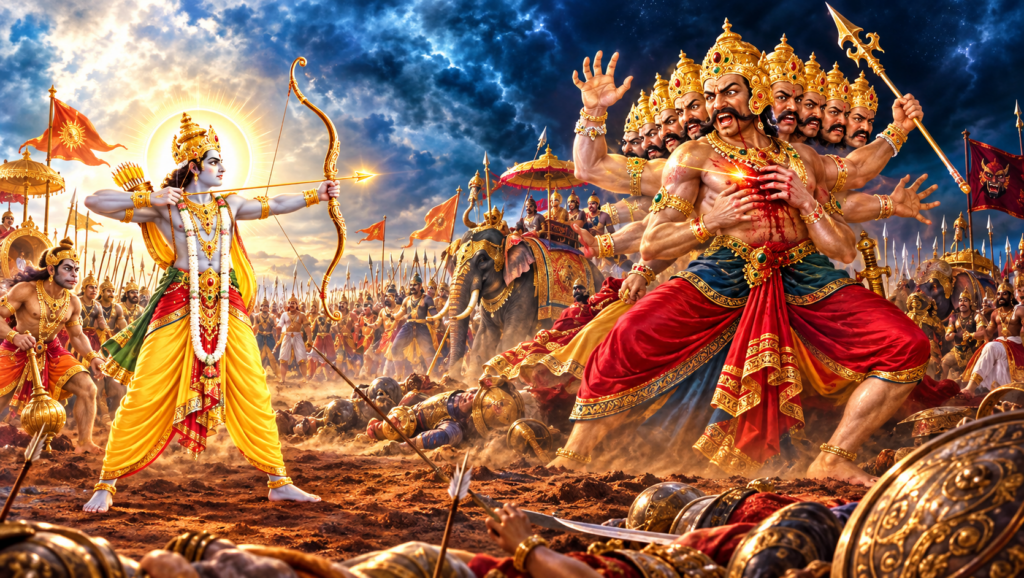
Lord Raam remained undisturbed, and thereafter, the exchange of all varieties of weapons became so feverish, that the fighting that took place was unparalleled in the history of warfare. Sometimes Ravana fought in his tenheaded feature, and at other times he fought in his normal form, having one head. On one occasion, Lord Raam managed to sever Ravana’s head with an arrow. But, as that head fell to the ground, a duplicate one miraculously cropped up in its place.
Lord Raam then severed that head, but once again, another one immediately manifested itself as a replacement. Again and again Lord Raam cut off Ravana’s head, until; altogether one hundred such heads lay on the battlefield. Because each time a new head appeared to replace the old one, Lord Raam began to wonder, “With these arrows I formerly killed Maricha, Khara and Viradha. I pierced seven Sal trees and killed the invincible Vali.
These arrows had humbled great mountains and agitated the fathomless sea. How is it that they are now ineffectual against Ravana?” The duel continued at a furious pace. Both combatants were obsessed with the desire for killing the other. At last, when Matali saw that Lord Raam was not gaining His desired victory, he inquired, “Why are you simply fighting defensively? My Lord, are You not aware of Your limitless potencies?
The hour of doom has now arrived for the King of the Rakshasas. Why don’t You employ the divine Brahmastra?” Being thus reminded of this ultimate weapon, Lord Raam picked up the arrow that Agastya Rishi had formerly given Him at the time of their meeting in the Dandaka forest. Lord Brahma had constructed that arrow personally for Lord Indra’s use, and later on it was presented to Agastya Muni.
Garuda supplied the feathers of that wonderful arrow and the sharp head combined the energy of the Fire god, Agnidev, and Sun god (Suryadev). Mount Meru and Mount Mandara contributed their gravity to the arrow’s weight, and its shaft was made from the subtle ethereal element. This Brahmastra weapon was omnipotent and infallible, and its dazzling effulgence made it rival the splendor of the sun.
After empowering the Brahmastra with the required mantras, Lord Raam placed it upon His bowstring. As the monkeys gazed upon that flaming arrow, their hearts became filled with delight, while a dreadful fear penetrated the cores of the hearts of all the Rakshasas. As Lord Raam pulled the bowstring back to His ear, the earth trembled and the heavens also appeared to become disturbed.
When Lord Raam released the Brahmastra, it sped through the air like death itself, and then violently fell upon the chest of the wicked Ravana. After piercing right
through the King of the Rakshasas heart, that effulgent arrow entered deep into the earth, taking his sinful life along with it. As that awesome Brahmastra came and re entered Lord Raam’s quiver, Ravana dropped the bow from his hand and fell down dead from his chariot. With great, transcendental ecstasy, the monkey warriors loudly proclaimed Lord Raam’s victory as they attacked the fleeing Rakshasa army. From the sky, the devas shouted, “Sadhu! Sadhu!” (“Well done!
Excellent!”), as they completely covered Lord Raam’s chariot with showers of flowers, and beat upon their celestial drums. Now that Ravana was dead at last, the devas and great rishis felt blessed relief and a peace of mind that they had not enjoyed for a long time. A cool and gentle, fragrant breeze began to blow, and the sun spread its rays very serenely, so that happiness seemed to pervade all directions. Jai Shree Raam
Another Katha on Vijaya Dashami
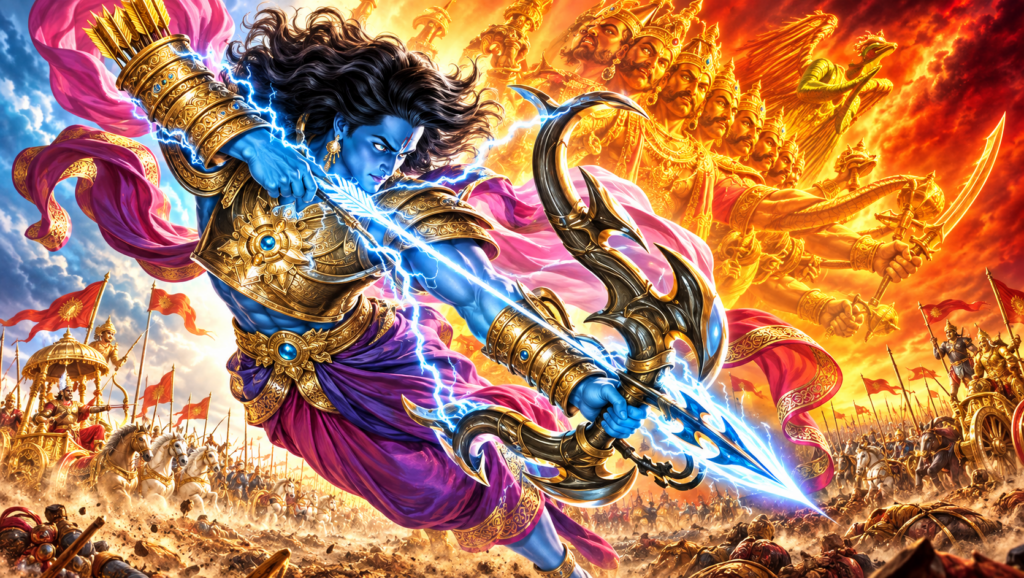
Mother Durga fought with a very powerful demon named Bhandasura and his forces for nine days and nights. This Bhandasura had a wonderful birth and life. When Lord Shiva burnt Kamadeva with the fire of his “third eye”, Lord Ganesh playfully molded a figure out of the ashes and he breathed life into it. This was the terrible demon Bhandasura. He engaged himself in great penance and on account of it obtained a boon from Lord Shiva.
With the help of the boon, he began harassing the three worlds. Because of this Mother Durga fought against him for nine nights and on the 10 th day in the evening she killed him and thus this day is known as Vijaya Dashami. The learning of any science is begun on this highly auspicious day. It was on this day that Shree Arjun worshipped Mother Durga before starting the battle against the Kauravas on the field of Kurukshetra.
On Vijaya Dashami, all aspirants are given initiation of various mantras, according to their Deities. Deserving aspirants are initiated into the holy order of Sannyasa. Initiation in the study of the alphabet is imparted to young children and to the older children also. New students commence their lessons in music and so forth. On Vijaya Dasami Kanya puja (Prayers to Virgin/unmarried girls) is also performed.
Nine girls below the age of ten are worshipped as the embodiments of the divine mother. They are fed sumptuously and amongst other things presented with new clothes. (The Kanya Puja proper is given at the end of this article). On this day a grand havan is performed in temples with the recitation of the Durga Saptashati (700 verses glorifying Mother Durga) and other verses in praise of the Divine mother.
Simple Prayer for Mother Sita and Shree Raam
This is only a guideline. You may add more according to your means and circumstances. It is always auspicious to worship Lord Raam with His consort, Mother Sita.
Preparation
1. Have a bath and wear clean, fresh clothes.
2. Prepare a clean prayer place beforehand with a picture or murti of Sita-Raam and Lord Ganesh.
3. Light incense or agarbatti and play devotional music suitable for the occasion to create a special prayer ambience.
Lord Ganesh Prayer Procedure
1. At the prayer place, position a Lord Ganesh murti or photograph.
2. Offer an agarbatti, a lamp with ghee or oil and a wick (or a small piece of camphor), and a flower. Turn the offering seven times clockwise around the murti or photograph.
3. Offer Lord Ganesh naivedhyam such as sweet rice, soji, sugar candy or fruit.
4. Pray to Shree Ganesh to remove all obstacles from the prayer that follows.
Shree Sita-Raam Prayer Procedure
At the prayer place, position a Sita-Raam murti or photograph. Then make the following offerings.
1 Welcome and Flower Offering
Hold your palms in the Namaste position and chant:
Om swagatam su swagatam – Om Sita-Raam-ye namah
(Swagatam means “O Sita-Raam, I welcome you.”)
Offer a flower (pushpam) or flower petals by turning the offering seven times clockwise around the Sita-Raam Deity or photograph.
2 Incense Offering
Offer one or three incense sticks (dhoopam) by turning them seven times clockwise around the Sita-Raam Deity or photograph.
Om tato dhoopam aghraa-payaami – Om Sita-Raam-ye namah
O Sita-Raam, I offer you both this incense. Kindly accept my offering.
3 Lamp Offering
Offer a clay or brass lamp (deepam) with either ghee or oil and a wick, or a small piece of camphor. Turn it seven times clockwise around the Deity or photograph.
Om prat-yaksha deepam darshayaami – Om Sita-Raam-ye namah
O Sita-Raam, I offer you both this lamp offering. Kindly accept my offering.
4 Flower Offering
Offer a flower (pushpam) or flower petals by turning the offering seven times clockwise around the Sita-Raam Deity or photograph.
Om idam pushpam – Om Sita-Raam-ye namah
O Sita-Raam, I offer you both this flower. Kindly accept my offering.
5 Food Offering
Offer cut fruit, sweetmeats or sweet rice (naivedyam) in a small bowl with a teaspoon. Turn the bowl seven times clockwise around the Deity or photograph, bring it near the lips of Sita-Raam to suggest that They partake of the food offering, and then leave it in front of the Deity or photograph. The family later consumes this as prashad.
Om naivedyam samar-payaami – Om Sita-Raam-ye namah
O Sita-Raam, I offer you both this food offering. Kindly accept my offering.
6 Milk Offering
Place milk with sugar in a cup, lota or chumbhu. Turn it seven times clockwise around the Deity or photograph and bring it near the lips of the Divine Couple to suggest that They drink the offering.
O Sita-Raam, I offer you both this milk offering. Kindly accept my offering.
7 Prayers for Forgiveness
Om yaani kaani cha papani janmaantara kritaani cha
taani sarvaani nashyanti pradakshina pade pade //
“O Compassionate Divine Couple! Victory to You! Please do forgive all the errors committed by me with the hands, legs, speech, body, through actions, through the ears, eyes, mind or by not doing ordained actions or by doing prohibited actions”.
Then offer your personal prayers to Shree Sita-Raam. Ask for whatever you desire, within reason. Bow down and leave the prayer place. The milk offering is consumed as prashadam.