
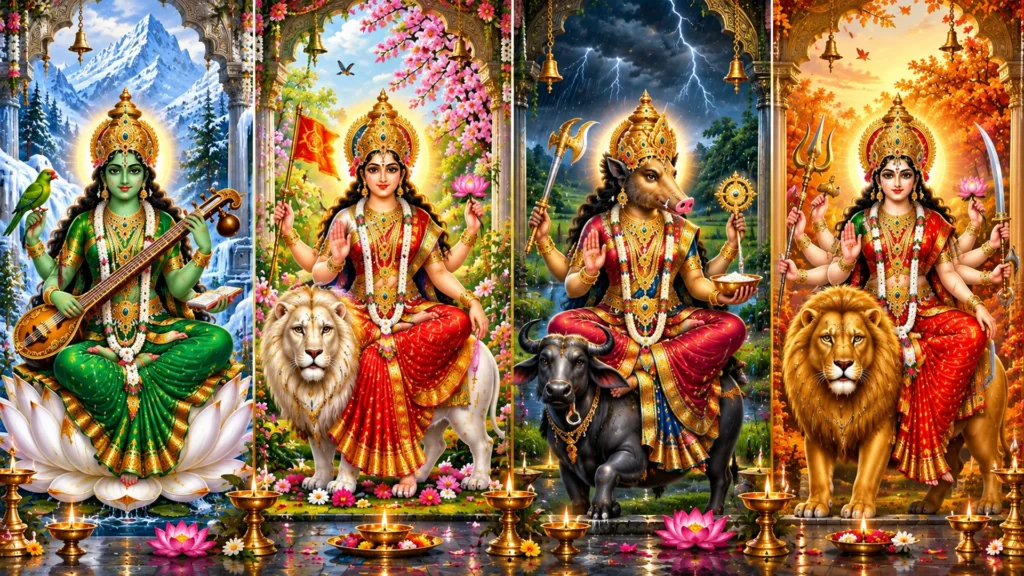
Navaratri is a Hindu (Sanatan Dharma) festival of worship of the Supreme Universal Devi, Adi Para-Shakti. The word “Navaratri” literally means “nine Vedic nights” in Sanskrit “Nava” meaning “nine” and “ratri” meaning “nights”. Navaratri is observed and celebrated four times a year according to India’s seasons. These are: Magha (Gupta) Navaratri, Vasant/Chaitra Navaratri, Ashadha (Gupta) Navaratri, and Sharada Maha Navaratri.
The popular two Navaratris that are known to many are Vasant/Chaitra Navaratri (March-April) and Sharada Maha Navaratri (September–October).
The other two Navaratris are known as Gupta (secret) Navaratris. They are equally significant and are meant for Tantrik. Tantrik combines elements of Hinduism and paganism including magical and mystical elements like mantras and mudras (hand signs) and erotic rites or sadhakas (sadhaka is a Sanskrit term which describes a devotee who follows a certain sadhana, a spiritual practice or way of life, with the aim of achieving a certain goal). The term can be translated to mean “spiritually adept”. The benefits of observing Gupta Navaratri puja include protection from danger, injury or destruction, whereby the devotee can obtain Siddhi (spiritual power), and Riddhi (prosperity). During these two Navaratris, Tantrik goddesses are worshipped.
During the nine Vedic Navaratri days, devotees may worship Devi in three formats, namely:
First format:
The first three “vedic” days are dedicated to Mother Durga.
The middle three “vedic” days are dedicated to Mother Lakshmi.
The last three “vedic” days are dedicated to Mother Saraswati.
Second format: (each day represents a form of the Supreme Devi):
On the first “vedic” day Mother Shailputri is worshipped.
On the second “vedic” day Mother Brahmacharini is worshipped.
On the third “vedic” day Mother Chandraghanta is worshipped.
On the fourth “vedic” day Mother Kushmanda is worshipped.
On the fifth “vedic” day Mother Skandamata is worshipped.
On the sixth “vedic” day Mother Katyayani is worshipped.
On the seventh “vedic” day Mother Kalaratri is worshipped.
On the eighth “vedic” day Mother Mahagauri is worshipped.
On the ninth “vedic” day Mother Siddhidatri is worshipped.
Third format:
The predominating devi deity for Magha (Gupta) Navaratri is the Tantrik form of Mother Saraswati called MAATANGI DEVI.
The predominating devi deity for Vasant/Chaitra Navaratri is BANDI DEVI.
The predominating devi deity for Ashadha (Gupta) Navaratri is the Tantrik form of Mother Earth (Bhumi) called VARAHI DEVI.
The predominating devi deity for Sharada Maha Navaratri is DURGA DEVI/KALI DEVI.
* Kindly note that Hindu Vedic days differ completely from Western Gregorian days. A Gregorian day commences at midnight and ends the following midnight, whilst a Vedic day (Tithi) can begin at various times of a Gregorian day and can vary in duration from approximately 19 to 26 hours. Hence one may often find that there are two Vedic days (Tithis) in one Gregorian day or two Gregorian days in one Vedic day (Tithi). So, a Navaratri (nine Vedic days) period can vary between eight to ten Gregorian days.
Who is MAATANGI DEVI? (the predominating devi deity of Magha {Gupta} Navaratri)?
Magha Gupta Navaratri typically begins at the end of January or early February and is observed over eight to ten days. The main day for this Navaratri falls on Vasant Panchami (the fifth Vedic day of this Navaratri). On this day Mother Saraswati or Maatangi devi is worshipped.
Who is Maatangi devi? A brief synopsis…
Devi Maatangi (Sanskrit: मातङ्गी, Maataṅgee) is one of the Das Mahavidyas, ten Tantric goddesses and an aspect of the Vedic Divine Mother.
Devi Maatangi is named as the ninth Mahavidya devi. She is the Tantric form of Mother Saraswati, the goddess of music and learning. Maatangi devi governs speech, music, knowledge and the arts. Her worship is prescribed to acquire supernatural powers, especially gaining control over enemies, attracting people to oneself, acquiring mastery over the arts and gaining supreme knowledge.
Maatangi devi is represented as emerald green in colour, with the crescent moon upon her forehead. She has long hair, a smiling expression with intoxicated eyes, and wears a garland of kadamba (neolamarckia cadamba) flowers and various other ornaments. Maatangi devi plays the veena (string instrument), wears conch-shell earrings and flower garlands, and has flower paintings adorning her forehead. Her green complexion is associated with deep knowledge and is also the colour of Budha, the presiding deity of the planet Mercury who governs intelligence. Maatangi devi is often depicted with a parrot in her hands, representing speech. The veena symbolizes her association with music.
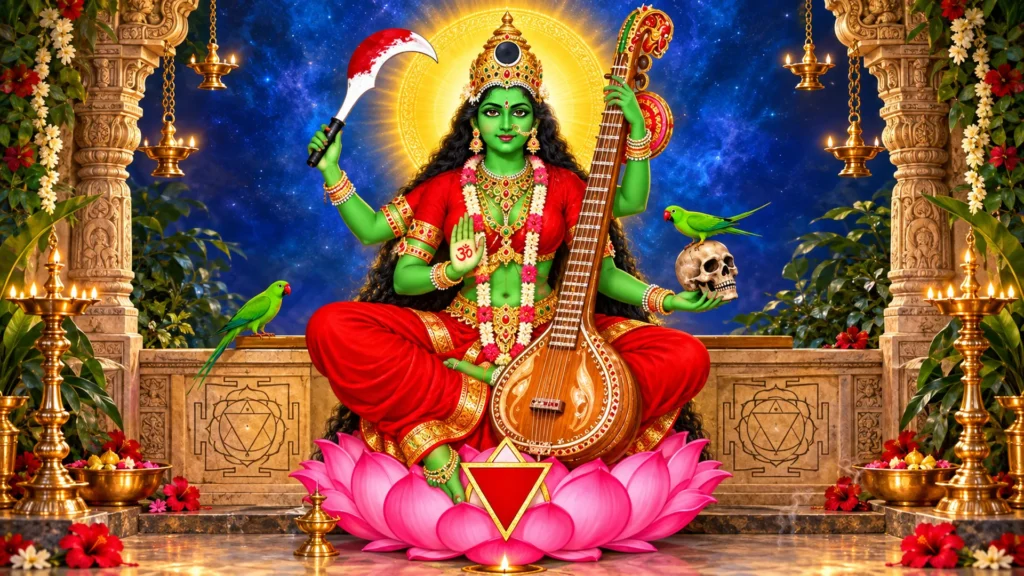
MAATANGI DEVI
Maatangi devi’s worship becomes fruitful only if the devotee reveres women as goddesses and refrains from criticizing them (within reason of course).
How to observe Magha Gupta Navaratri?
Every year www.dipika.org.za releases the article on how to observe and perform this Navaratri a month prior to the actual starting period of this Navaratri. However we are providing a simple Maatangi devi / Saraswati devi prayer procedure below.
Devi Maatangi / Saraswati devi Prayer Procedure
At the prayer place, place a Lord Ganesh murti or photo and a picture/photo of Mother Saraswati or Maatangi devi. Firstly offer an agarbatti, lamp (with either ghee or oil with a wick or a small piece of camphor) and a flower (or all three on a tray) to Shree Ganesh (turn seven times clockwise around the murti or photo), and pray to Shree Ganesh, praying to him to remove all obstacles in the path of your prayer to the Mother. Mother Maatangi or Saraswati devi is now invoked and worshipped. Pray to Mother Maatangi or Saraswati devi asking Devi to please accept your prayers.
Now chant the following:
Hold your palms in the Namaste position and chant:
1. Om swagatam su swagatam – Om Saraswati-yai (or Maatangi-yai) namah (Swagatam means O Mother Saraswati {or Maatangi devi} I welcome you.)
Then offer flower (pushpam) or flower petals by turning it seven times clockwise around the photo.
2. Om idam pushpam – Om Saraswati-yai (or Maatangi-yai) namah
Then offer one or three incense sticks (dhoopam) by turning it seven times clockwise around the photo.
3. Om tato dhoopam aghraa-payaami – Om Saraswati-yai (or Maatangi-yai) namah
Then offer a clay or brass lamp (deepam) with either ghee or oil with a wick or a small piece of camphor by turning it seven times clockwise around the photo.
4. Om prat-yaksha deepam darshayaami – Om Saraswati-yai (or Maatangi-yai) namah
Then offer cut fruit or sweet rice (Naivedyam). It should be in a small bowl with a teaspoon. Turn the bowl seven times clockwise around the photo and bring the bowl near the lips of the Mother suggesting she partakes the food offering. Then leave this in front of the photo. This is later consumed by the family as Devi Prashad.
5. Om naivedyam samar-payaami – Om Saraswati-yai (or Maatangi-yai) namah
6a. Mother Saraswati: then in a cup (lota/chumbhu) which has only milk turn the lota seven times clockwise around the photo and bring the lota near the lips of the Mother suggesting she drink the milk offering.
or
6b. Mother Maatangi: then in a cup (lota/chumbhu) which has only dhaar mixture turn the lota seven times clockwise around the photo and bring the lota near the lips of the Mother suggesting she drink the dhaar offering.
7. Offer prayers for forgiveness Om yaani kaani cha papani janmaantara kritaani cha taani sarvaani nashyanti pradakshina pade pade //
Then offer your personal prayers to Mother Saraswati or Maatangi devi. Ask Devi for whatever you desire (within reason) and Devi being so merciful will grant what you desire. But be careful what you desire for.
Optional: You may sing or hear the Saraswati or Maatangi Chalisa. Saraswati Chalisa click ( HERE ). Maatangi Chalisa click ( HERE ).
Suggested Devi mantras you may chant 11, 21 or 108 times:
Maatangi devi mantras: Maatangi devi is often worshipped with the mantra syllable Aim, which is associated with Saraswati devi and is the seed-syllable (beeja mantra) of knowledge, learning, and teaching. A longer mantra is also used: Om Hreem Aim Shreem Namo Bhagvatee Ucchishta-chaandaalee Shree Maatangeshwari Sarvajana-vasham-kaaree Swaahaam “Reverence to adorable Maatangi, the outcast and residue, who gives control over all creatures”
You may chant this simple Dashakshar Maatangi devi Mantra (10 Syllables Mantra) ॐ ह्रीं क्लीं हूं मातंग्यै फट् स्वाहा॥ Om Hreem Kleem Hoom Maatang-yai Phat Swaahaa॥
After the worship is over offer the lota milk or lota Dhaar in your Devi Thaan.
One may chant the following mantra from the “Shree Artha Argala Stotram” when offering Dhaar or milk but if it’s rather difficult to pronounce then recite the English meaning. Om Jayanti Mangala Kaali Bhadra Kaali Kaapaalini Durga Shamma Shivaah Dhaatri Swaahaa Swaadhaa Namostute (Oh! Conqueror of all, Remover of darkness, Auspicious one, beyond time, the bearer of Skulls of Impure thoughts, Reliever of difficulties, loving forgiveness, supporter of the Universe. You are the one who truly receives the sacrificial offerings and the offerings to the Pitars (Ancestors). To you I bow most merciful Devi.)
Who is BANDI (Vindhyeshvari) DEVI (the predominating devi deity of Vasant/Chaitra Navaratri)?
Vasant Navaratri (March–April) is observed over eight to ten days. The main day for this Navaratri falls on Navami (the last day of this Navaratri). On this day Mother Bandi is worshipped.
Who is Bandi devi? A brief synopsis…
Bandi Devi (also known as Vindhyeshvari devi) is a manifestation of the Supreme Mother Goddess Shakti. Scriptural proof regarding her can be found in the Kashi Khand of the Skanda Purana and the Rig Veda VIII 101-13 “She, Bandi devi yonder, bending down, rich in rays, clothed in red hues is seen, advancing as one wonderful form, amid the ten surrounding arms”. It must be noted that in prayers, Mother Bandi is equated with Durga devi. Bandi devi interchanges riding a tiger and a lion, with depictions of her riding a tiger being the more popular choice. The Bandi Paath is a well-known prayer dedicated to this Goddess. Bandi devi is the bestower of children and rescues one from hardships. She blesses one with well-being and provides support when difficulty arises. Traders or shopkeepers should recite this katha with faith and concentration. People heavily in debt, should also recite the Bandi Paath often. It is said that whatever a person asks for, they shall receive when they pray to Mother Bandi — no matter if it is milk, a child, riches or Lakshmi (abundance).
Www.dipika.org.za has a full length article on the entire Bandi Paath with a prayer and havan. Kindly click on this link to download this article. (http://dipika.org.za/wp-content/uploads/2015/04/Bandi-Path-and-DIY-Puja-inEnglish..pdf)
Tuesday or Fridays are days associated with Bandi Devi worship. Kindly click on this link to download this article regarding “The Offering of DHAAR and the Nimbu (Lemon/Lime) Lamp, garland, a single lime and lime water to Devi during every Tuesdays, Fridays or in
the Navaratri period”. https://dipika.org.za/offering-of-dhaar-and-the-nimbu-lime-lamplime-water-and-lime-garland-to-devi/
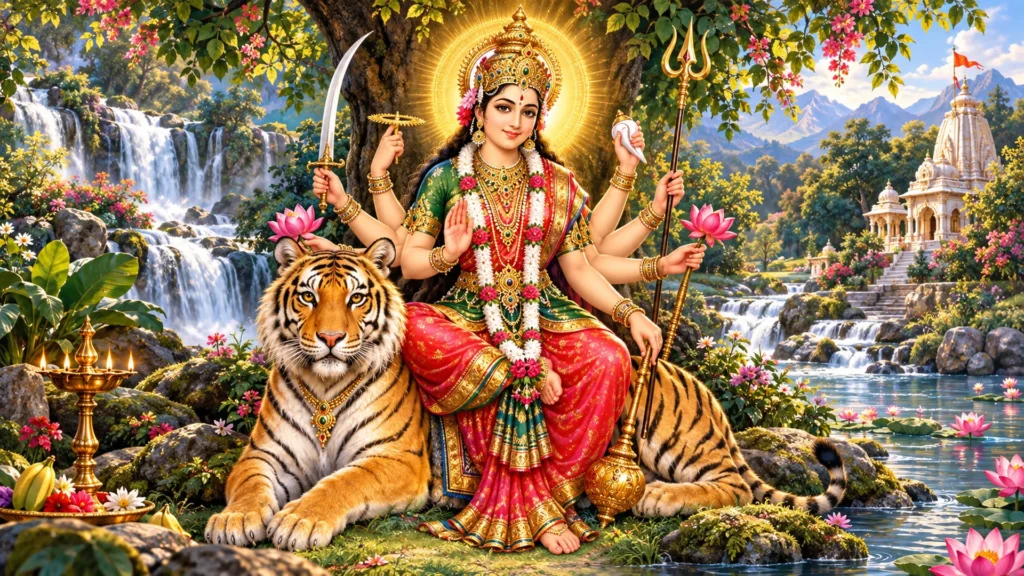
BANDI DEVI
Why is Bandi devi the predominating devi deity during Vasant Navaratri?
From the first vedic day (pratipat) of Shukla (bright) paksha (phase of the moon), of Vasant month, commences the week of Ramayan and ends with Rama-Navami. This period also signals the commencement of Vasant Navaratri and ends with Durga {Bandi} Navami. So both these periods run concurrently.
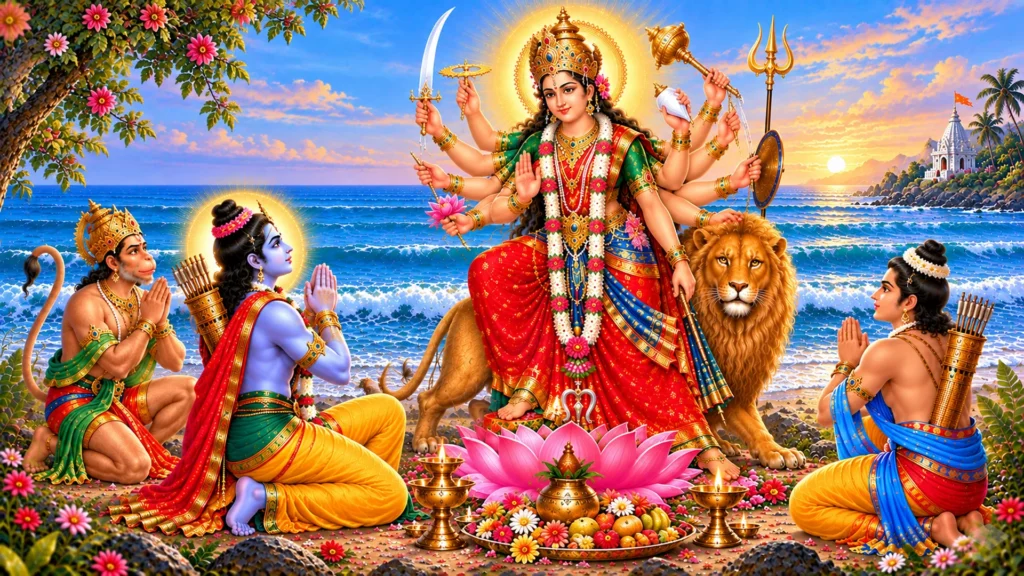
In the Bandi Paath, Lord Raam said, “O Mother Bandi you came to My aid in the time of hardship and because of that Hanuman devised so many tricks to kill these demons.”
Then Shree Raam and the devas sang Bandi devi’s eulogies. “Praiseworthy is the glory of Bandi devi and yet again praise be upon her.” The behaviour towards Bandi devi should be similar to that of Lord Raam. Thrilled and overwhelmed with affection, the Lord performed her worship in accordance with various rites. Lord Raam carried delicious dishes on golden trays, placed them in front of Devi, and with folded hands He entreated her. Mother Bandi was pleased and thrilled with the bestower of boons, and spoke these words. “O Gosain, I will grant whatever You ask of me, You have performed my worship with all Your mind and heart.” Then Lord Raam said, “Kindly listen, O Jagadamba (Bandi devi), where stands My worship, O support of Lord Shiva, grant Me a boon which would bring about great “Kalyana” (well being).” “You have served me in many ways. The desire of Your heart will be fulfilled O Lord Raam, whenever adversity falls upon You, there I will go and stand by You.” Having bowed, the Lord then departed. The glory of Mother Bandi had a fond place in the heart of Lord Raam.
Kindly view the photo provided below to view how Mother Bandi is blessing Lord Raam, Lord Lakshman and Shree Hanuman, before they could cross over to Shree Lanka to rescue Mother Sita. By Bandi devi’s blessings, Mother Sita was rescued. Hence this period is dedicated to Mother Bandi
(Vindhyeshvari devi).
How to observe Vasant Navaratri?
Every year www.dipika.org.za releases the article on how to observe and perform this Navaratri a month prior to the actual starting period of this Navaratri. However we are providing a simple Bandi devi prayer procedure below.
Bandi devi Prayer Procedure
At the prayer place, place a Lord Ganesh murti or photo and a picture/photo of Mother Bandi. Firstly offer an agarbatti, lamp (with either ghee or oil with a wick or a small piece of camphor) and a flower (or all three on a tray) to Shree Ganesh (turn seven times clockwise around the murti or photo), and pray to Shree Ganesh, praying to him to remove all obstacles in the path of your prayer to the Mother. Mother Bandi is now invoked and worshipped. Pray to Mother Bandi to please accept your prayers.
Now chant the following:
Hold your palms in the Namaste position and chant:
1. Om swagatam su swagatam – Om Bandi devee-yai namah (Swagatam means O Mother Bandi I welcome you.)
Then offer flower (Pushpam) or flower petals by turning it seven times clockwise around the photo.
2. Om idam pushpam – Om Bandi devee-yai namah
Then offer one or three incense sticks (Dhoopam) by turning it seven times clockwise around the photo.
3. Om tato dhoopam aghraa-payaami – Om Bandi devee-yai namah
Then offer a clay or brass lamp (deepam) with either ghee or oil with a wick or a small piece of camphor by turning it seven times clockwise around the photo.
4. Om prat-yaksha deepam darshayaami – Om Bandi devee-yai namah
Then offer cut fruit or sweet rice (Naivedyam). It should be in a small bowl with a teaspoon. Turn the bowl seven times clockwise around the photo and bring the bowl near the lips of the Mother suggesting she partakes the food offering. Then leave this in front of the photo. This is later consumed by the family as Devi Prashad.
5. Om naivedyam samar-payaami – Om Bandi devee-yai namah
6. In a cup (lota/chumbhu) which has only dhaar mixture turn the lota seven times clockwise around the photo and bring the lota near the lips of the Mother suggesting she drink the dhaar offering.
7. Offer prayers for forgiveness Om yaani kaani cha papani janmaantara kritaani cha taani sarvaani nashyanti pradakshina pade pade //
Then offer your personal prayers to Mother Bandi. Ask Devi for whatever you desire (within reason) and Devi being so merciful will grant what you desire. But be careful what you desire for.
Optional: You may sing or hear the Vindheshwari (Bandi) Chalisa kindly click ( HERE ).
Suggested Devi mantras you may chant 11, 21 or 108 times: Om Bandi devee-yai namah Om Vindhyeshvari yai namah Om Dum Durga yai Namah
After the worship is over offer the lota Dhaar in your Devi Thaan.
One may chant the following mantra from the “Shree Artha Argala Stotram” when offering Dhaar but if it’s rather difficult to pronounce then recite the English meaning. Om Jayanti Mangala Kaali Bhadra Kaali Kaapaalini Durga Shamma Shivaah Dhaatri Swaahaa Swaadhaa Namostute (Oh! Conqueror of all, Remover of darkness, Auspicious one, beyond time, the bearer of Skulls of Impure thoughts, Reliever of difficulties, loving forgiveness, supporter of the Universe. You are the one who truly receives the sacrificial offerings and the offerings to the Pitrs (Ancestors). To you I bow most merciful Devi.)
Who is VARAHI DEVI? (the predominating devi deity of Ashadha (Gupta) Navaratri)?
Ashadha Gupta Navaratri (June–July) is observed over eight to ten days. The main day for this Navaratri falls on Navami (the last day of this Navaratri). On this day, Mother Varahi devi is worshipped. This divine mother is one of its kind in this world. Varahi Navaratri (Ashadha Navaratri) is celebrated with great fervor and is considered very auspicious for divine Mother Varahi devi’s sadhana and getting her divine grace quickly.
Who is Varahi devi? A brief synopsis…
Varahi (Sanskrit: वाराही, Vaaraahee) is a member of one of the Sapta-Matrikas group (“seven mothers”), in Vedic scriptures. Since she’s the fifth of the matrikas, she is also known as ‘Panchami’. Bearing the head of a sow, Varahi is the shakti (feminine energy) and one of the consorts of Varaha, the boar avatar of Lord Vishnu (kindly view the photo provided below).
According to the Shumbha-Nishumbha katha (8th and 9th chapters) of the Devi Mahatmya from the Markandeya Purana, the Matrikas goddesses appear as shaktis (feminine powers) from the bodies of the Devas. She has a boar form, wields a chakra (discus) and fights with a sword. The Devi Bhagavata Purana states that Varahi devi, along with the other Matrikas, is created by the Supreme Mother Shakti. The Mother promises the devas that the Matrikas will fight demons if needed. Varahi devi is worshipped by Shaivas (devotees of Lord Shiva), Vaishnavas (devotees of Lord Vishnu) and Shaktas (devotees of the Universal Mother).
Varahi devi is the goddess of the Earth plane and observing this period fulfils one’s desires and wishes. She bestows strength, power, and victory. She also brings about happiness, prosperity, health, wealth and auspiciousness. She grants mental peace and harmony at home. She confers the power to attract and overpower enemies. She paralyses all forms of one’s enemies and removes wicked forces/evil spirits. She restores stability in one’s life. She removes obstacles in one’s marriage. She settles property and trade-related issues, fulfills one’s wishes, and bestows success in litigations. She also fulfills material wishes and grants abundance. So please pray to this amazing warrior goddess Devi and receive her miracles, wealth and boons.
Varahi devi is a ratri devi (night goddess) and according to Tantra, Varahi devi should be worshipped after sunset and before sunrise.
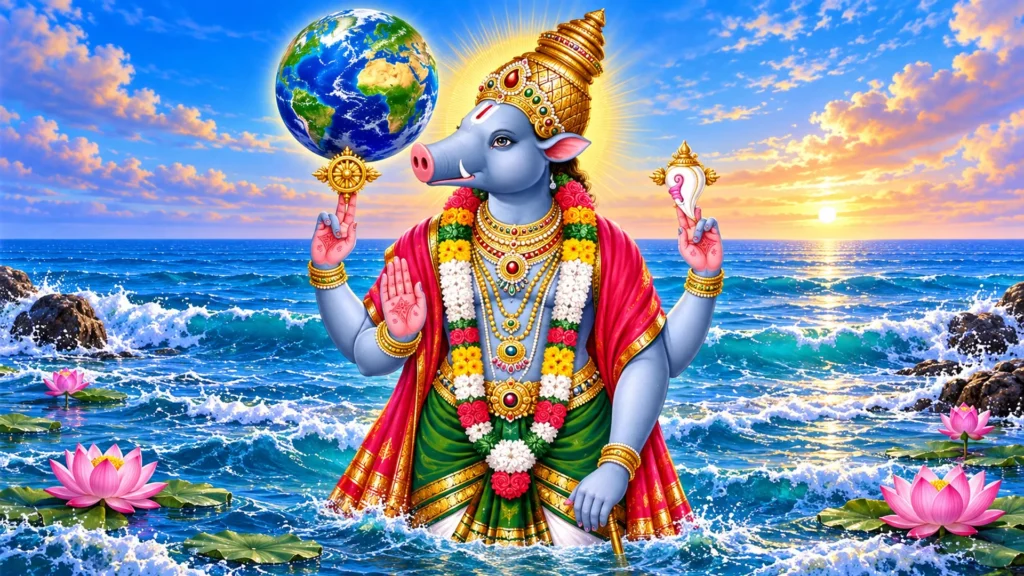
VARAHA DEVA
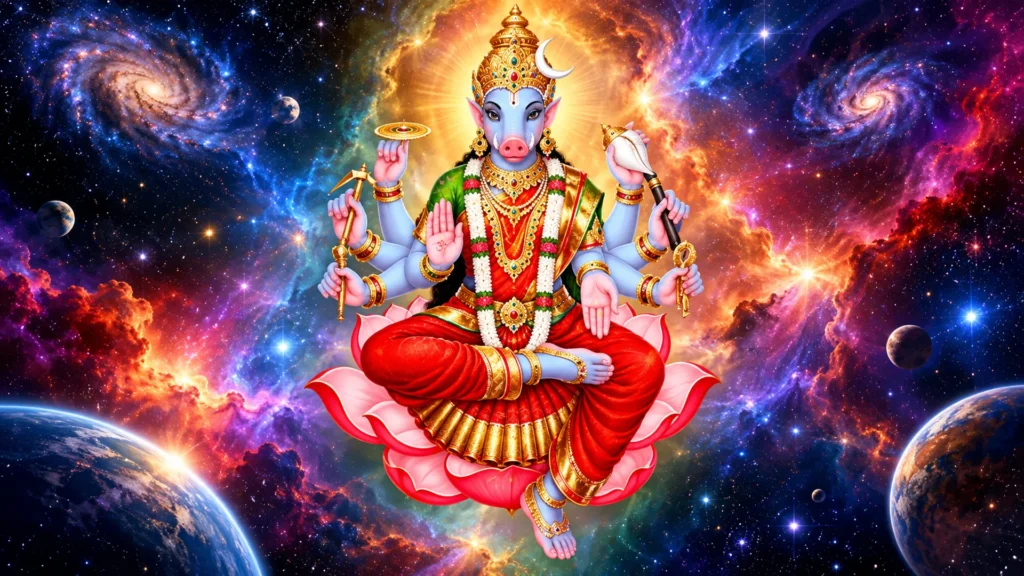
VARAHI DEVI
How to observe Ashadha Gupta (Varahi) Navaratri?
Every year www.dipika.org.za releases the article on how to observe and perform this Navaratri a month prior to the actual starting period of this Navaratri. However we are providing a simple Varahi devi prayer procedure below.
Varahi devi Prayer Procedure
At the prayer place, place a Lord Ganesh murti or photo and a picture/photo of Mother Varahi. Firstly offer an agarbatti, lamp (with either ghee or oil with a wick or a small piece of camphor) and a flower (or all three on a tray) to Shree Ganesh (turn seven times clockwise around the murti or photo), and pray to Shree Ganesh, praying to him to remove all obstacles in the path of your prayer to the Mother. Mother Varahi is now invoked and worshipped. Pray to Mother Varahi to please accept your prayers.
Now chant the following:
Hold your palms in the Namaste position and chant:
1. Om swagatam su swagatam – Om Vaaraahee devee-yai namah (Swagatam means O Mother Varahi I welcome you.)
Then offer flower (Pushpam) or flower petals by turning it seven times clockwise around the photo.
2. Om idam pushpam – Om Vaaraahee devee-yai namah
Then offer one or three incense sticks (Dhoopam) by turning it seven times clockwise around the photo.
3. Om tato dhoopam aghraa-payaami – Om Vaaraahee devee-yai namah
Then offer a clay or brass lamp (deepam) with either ghee or oil with a wick or a small piece of camphor by turning it seven times clockwise around the photo.
4. Om prat-yaksha deepam darshayaami – Om Vaaraahee devee-yai namah
Then offer cut fruit or sweet rice (Naivedyam). It should be in a small bowl with a teaspoon. Turn the bowl seven times clockwise around the photo and bring the bowl near the lips of the Mother suggesting she partakes the food offering. Then leave this in front of the photo. This is later consumed by the family as Devi Prashad.
5. Om naivedyam samar-payaami – Om Vaaraahee devee-yai namah
6. In a cup (lota/chumbhu) which has only dhaar mixture turn the lota seven times clockwise around the photo and bring the lota near the lips of the Mother suggesting she drink the dhaar offering.
7. Offer prayers for forgiveness Om yaani kaani cha papani janmaantara kritaani cha taani sarvaani nashyanti pradakshina pade pade //
Then offer your personal prayers to Mother Varahi. Ask Devi for whatever you desire (within reason) and Devi being so merciful will grant what you desire. But be careful what you desire for.
Optional: You may sing or hear the Varahi devi Chalisa kindly click ( HERE ).
Suggested Devi mantras you may chant 11, 21 or 108 times: Om Vaaraahee devee-yai namah Om Mahisha-dhwajayai Vidmahe, Danda-hastayai Dhimahi, Tanno Vaaraahee Prachodayat
After the worship is over offer the lota Dhaar in your Devi Thaan.
One may chant the following mantra from the “Shree Artha Argala Stotram” when offering Dhaar but if it’s rather difficult to pronounce then recite the English meaning. Om Jayanti Mangala Kaali Bhadra Kaali Kaapaalini Durga Shamma Shivaah Dhaatri Swaahaa Swaadhaa Namostute (Oh! Conqueror of all, Remover of darkness, Auspicious one, beyond time, the bearer of Skulls of Impure thoughts, Reliever of difficulties, loving forgiveness, supporter of the Universe. You are the one who truly receives the sacrificial offerings and the offerings to the Pitrs (Ancestors). To you I bow most merciful Devi.)
Who is DURGA/KALI DEVI? (the predominating devi Deities of Sharada Maha Navaratri)?
Sharad Maha Navaratri (September-October) is observed over eight to ten days in South Africa. The main day for this Navaratri falls on Navami (the last day of this Navaratri). Navaratri (the Great Navaratri) is celebrated in the Vedic month of Ashvina. It is celebrated during Sharad (beginning of winter in India, September– October) and is the festival of nine days dedicated to the nine forms of Mother Durga or the three main forms of the Mother namely Mothers Durga, Lakshmi and Saraswati.
Who is Durga devi? A brief synopsis…
Durga (Sanskrit: दर्गा ु Durga) is a major deity and supreme divinity in the Vedic scriptures.
Durga devi is worshipped as one of the principal aspects of the supreme divinity Mahadevi and is also one of the most popular and widely revered among Vedic divinities.
Durga devi is associated with protection, strength, motherhood, destruction and wars.
Durga devi’s fame centres around combating evils and demonic forces that threaten peace, prosperity and Dharma, the power of good over evil. Durga devi unleashes her divine wrath against the wicked for the liberation of the oppressed, and includes destruction to empower creation. Durga devi is seen as a motherly figure and is often depicted as a beautiful woman, riding a lion or tiger, with many arms each carrying a weapon, and often defeating demons. She is widely worshipped by the followers of the goddess centric sect, Shaktism, and has importance in other denominations like Shaivism (devotees of Lord Shiva) and Vaishnavism (devotees of Lord Vishnu).
The two most important scriptural texts of Shaktism, Devi Mahatmya and Devi-Bhagavat, reveres Devi or Shakti (goddess) as the primordial creator of the universe, and the Brahman (ultimate truth and reality). While all major texts of Hinduism (Sanatan Dharma) mention and revere the goddess, these two texts centre around her as the primary divinity.
The word Durga (दर्गा ु ) literally means “impassable”, “invincible, unassailable”. It is related to the word Durg (दर्गु ) which means “fortress, something difficult to defeat or pass”. According to the Monier-Williams Sanskrit dictionary, Durga is derived from the roots “dur” (difficult) and “gam” (pass, go through).
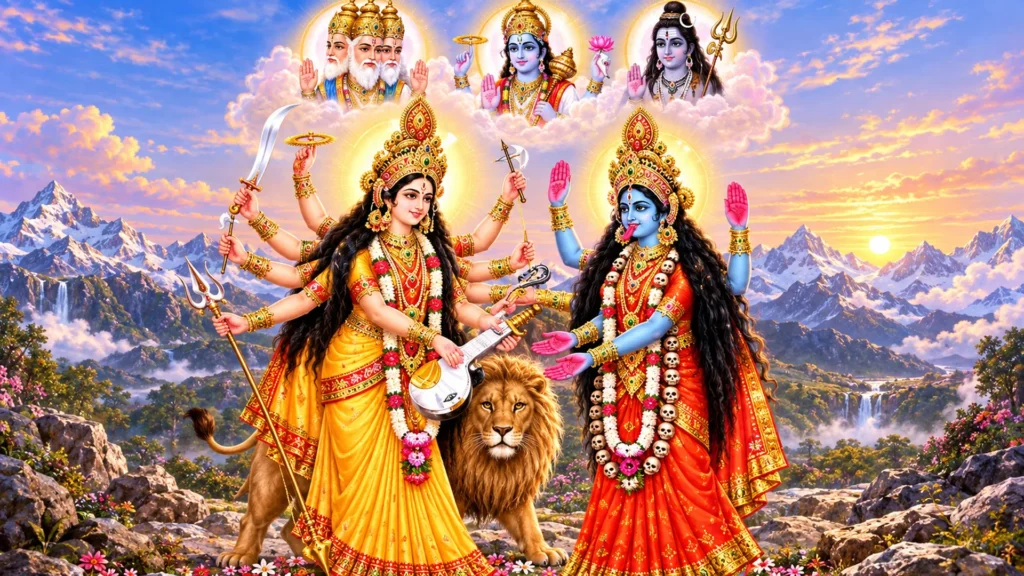
Mother DURGA and Mother KALI
In the Srimad Bhagavatam Maha Purana – 10th canto chapter 3 verse 47, Durga devi is depicted as the sister of Lord Krishna. In the Ramayan, Durga devi comes to the aid of Lord Raam.
Kindly view the photo provided below to see how Mother Durga is blessing Lord Raam, Lord Lakshman and Shree Hanuman before they could cross over to Shree Lanka to rescue Mother Sita.
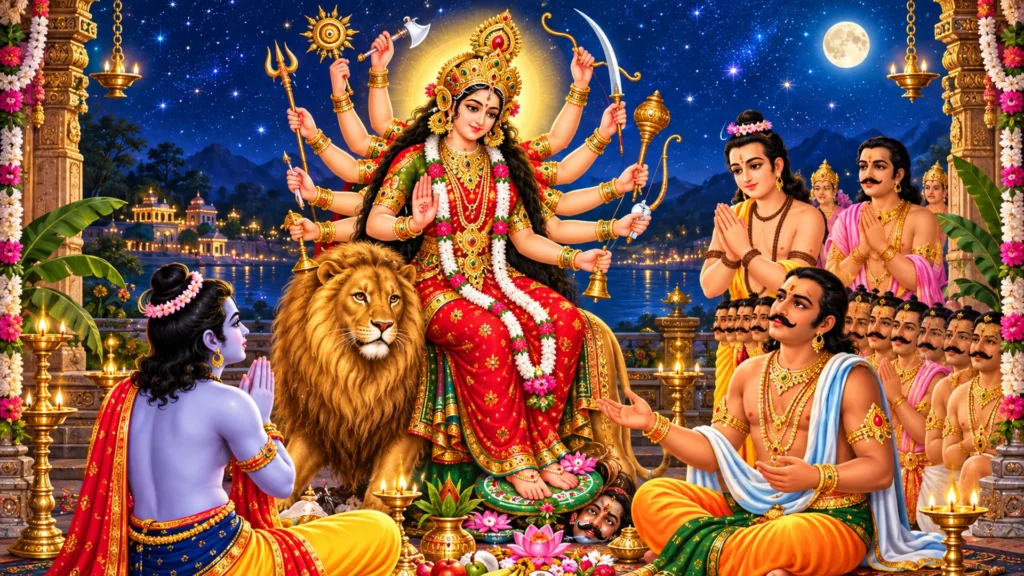
Mother Durga is blessing Lord Raam, Lord Lakshman and even Ravana
Who is Kali devi? A brief synopsis…
Kali (Sanskrit: काली, Kaalee), also known as Kaalikaa (Sanskrit: कालिका), is a Vedic goddess who is a devi of death, time, and change. According to Shaktism, she is a form of Mother Parvati, the supreme of all powers, or the ultimate reality. She is the ultimate manifestation of Shakti and the mother of all living beings. Mother Kali destroys evil in order to protect the innocent. Over time, Mother Kali has been worshipped by devotional movements and Tantric sects variously as the Divine Mother, Mother of the Universe, Adi Shakti, or Mother Parvati. She is also seen as the divine protector and the one who bestows moksha or liberation.
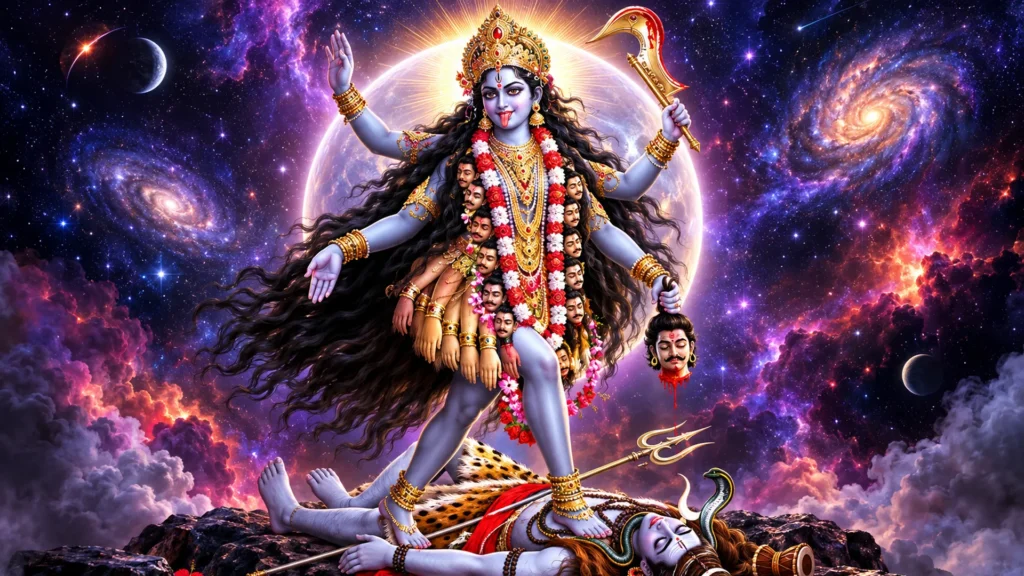
Mother KALI
Although the name Kaalee (Kali) appears as early as the Atharva Veda, the first use of it as a proper name is in the Kathaka Grhya Sutra (19.7). Mother Kali’s most well-known appearance is on the battlefield in the Markandeya Purana – Devi Mahatmyam (7th chapter). The deity of the first chapter of Devi Mahatmyam is Mahakali, who appears from the body of sleeping Lord Vishnu as goddess Yoga Nidra to wake Him up in order to protect Lord Brahma and the world from two powerful demons, Madhu and Kaitabha. After Lord Vishnu wakes up, He starts a war against the two demons. After a long battle with Lord Vishnu when the two demons were undefeated, Mahakali took the form of Mahamaya to enchant the two asuras. When Madhu and Kaitabha were enchanted by Mahakali, Lord Vishnu kills them.
In the 7th chapter, the katha of two demons who were destroyed by Kali devi are mentioned. Demons, Chanda and Munda attack Durga devi. Durga devi responds with such anger it causes her face to turn dark, resulting in Kali devi appearing out of her forehead. Mother Kali’s appearance is dark/black (sometimes Devi appears in a blue appearance), gaunt with sunken eyes, and wearing a tiger skin outfit and a garland of human heads. Mother Kali immediately defeats the two demons. Later in the same battle, the demon Raktabija is undefeated because of his ability to reproduce himself from every drop of his blood that reaches the ground. Countless Raktabija clones appear on the battlefield. Mother Kali eventually defeats him by sucking his blood before it can reach the ground, and thereafter eating the numerous clones. Mother Kali represents “Durga’s personified wrath, her embodied fury”.
Other kathas involve Parvati devi and Lord Shiva. Parvati devi is typically portrayed as a benign and friendly goddess. The Linga Purana describes Lord Shiva asking Mother Parvati to defeat the powerful demon Daruka, who received a boon that would only allow a female to kill him. Mother Parvati merges with Lord Shiva’s body, reappearing as Kali devi to defeat Daruka and his armies. Her bloodlust gets out of control, only calming when Lord Shiva intervenes. Mother Kali appears in the verse of the Mahabharata (10.8.64). She is called Kālarātri (literally, “dark blue night”) and appears to the Pandava soldiers in dreams, until finally, she appears amidst the fighting during an attack by Drona’s son Ashwatthama.
How to observe Sharad Maha Navaratri?
Every year www.dipika.org.za releases the article on how to observe and perform this Navaratri a month prior to the actual starting period of this Navaratri. However we are providing a simple Durga/Kali devi prayer procedure below.
Durga/Kali devi Prayer Procedure
At the prayer place, place a Lord Ganesh murti or photo and a picture/photo of Mother Durga or Mother Kali (of them Devi’s in one photo like the one provided below). Firstly offer an agarbatti, lamp (with either ghee or oil with a wick or a small piece of camphor) and a flower (or all three on a tray) to Shree Ganesh (turn seven times clockwise around the murti or photo), and pray to Shree Ganesh, praying to him to remove all obstacles in the path of your prayer to the Mother/s. The Mother/s are now invoked and worshipped. Pray to the Mother/s to please accept your prayers.
Now chant the following:
Hold your palms in the Namaste position and chant:
1. Om swagatam su swagatam – Om Durga devee-yai (or Kali devee-yai) namah (Swagatam means O Mother/s Durga/Kali I welcome you.)
Then offer flower (Pushpam) or flower petals by turning it seven times clockwise around the photo.
2. Om idam pushpam – Om Durga devee-yai (or Kali devee-yai) namah
Then offer one or three incense sticks (Dhoopam) by turning it seven times clockwise around the photo.
3. Om tato dhoopam aghraa-payaami – Om Durga devee-yai (or Kali devee-yai) namah
Then offer a clay or brass lamp (deepam) with either ghee or oil with a wick or a small piece of camphor by turning it seven times clockwise around the photo.
4. Om prat-yaksha deepam darshayaami – Om Durga devee-yai (or Kali devee-yai) namah
Then offer cut fruit or sweet rice (Naivedyam). It should be in a small bowl with a teaspoon. Turn the bowl seven times clockwise around the photo and bring the bowl near the lips of the Mother suggesting she partakes the food offering. Then leave this in front of the photo. This is later consumed by the family as Devi Prashad.
5. Om naivedyam samar-payaami – Om Durga devee-yai (or Kali devee-yai) namah
6. In a cup (lota/chumbhu) which has only dhaar mixture turn the lota seven times clockwise around the photo and bring the lota near the lips of the Mother suggesting she drink the dhaar offering.
7. Offer prayers for forgiveness Om yaani kaani cha papani janmaantara kritaani cha taani sarvaani nashyanti pradakshina pade pade //
Then offer your personal prayers to the Mother/s. Ask Devi/s for whatever you desire (within reason) and Devi/s being so merciful will grant what you desire. But be careful what you desire for.
Optional: You may sing or hear the Durga or Kali devi Chalisa Durga devi Chalisa kindly click ( HERE ). Kali devi Chalisa kindly click ( HERE ).
Suggested Devi mantras you may chant 11, 21 or 108 times: Durga Devi: Om Dum Durga-yai namah Kali devi: Om Aim Hreem Kleem Chaamundaayai Vicche Namah
After the worship is over offer the lota Dhaar in your Devi Thaan.
One may chant the following mantra from the “Shree Artha Argala Stotram” when offering Dhaar but if it’s rather difficult to pronounce then recite the English meaning. Om Jayanti Mangala Kaali Bhadra Kaali Kaapaalini Durga Shamma Shivaah Dhaatri Swaahaa Swaadhaa Namostute (Oh! Conqueror of all, Remover of darkness, Auspicious one, beyond time, the bearer of Skulls of Impure thoughts, Reliever of difficulties, loving forgiveness, supporter of the Universe. You are the one who truly receives the sacrificial offerings and the offerings to the Pitrs (Ancestors). To you I bow most merciful Devi.)