


Lord Vishvaksena
Lord Vishvaksena, depicted above as a dwarapalaka (gatekeeper) at Srirangam (Srirangam is a city of Tiruchirappalli and a part of Tiruchirappalli Metropolitan Area in the Indian state of Tamil Nadu.) Lord Vishvaksena is the Supreme High Commander-in-Chief of all the Ganas of Lord Vishnu. The whole universe runs at the point of his fingertips. Lord Vishnu never says ‘no’ to any of the programs arranged by Lord Vishvaksena. May Lord Vishvaksena bless us to be in the service of the Supreme Personality of Godhead.
CONTENTS IN THIS SHORT ARTICLE
- Who is Lord Vishvaksena?
- Lord Vishvaksena attributes, description, scriptural proof of his existence and so forth.
- Is Lord Vishvaksena and Lord Vinayaka (Lord Ganesh) the one and same?
- Why does Lord Ganesha go missing and not worshipped during the Pitar Paksha period?
- Srila Prabhupada on Lord Ganesh worship.
- How to worship Lord Vishvaksena?
- DISCLAIMER
Vishvaksena (Sanskrit: विष्वक्सेन) or Vishwaksena, also known as Senai Mudalvar (Sena Mudaliar) and Senadhipathi (all literally means “army-chief”), is the Supreme High commander-in-chief of the army of Lord Vishnu, additionally serving as the gate-keeper and chamberlain of his celestial abode of Vaikuntha (spiritual world). As the embodiment of the tantras *, Lord Vishvaksena is worshipped before any ritual or function in ISKCON temples, the Vaikhanasas and Vaishnavism sects. He occupies an important place in Vaikhanasa ** and Pancharatra temple traditions, where temple festivals often begin with His worship and procession.
* Tantra are the esoteric traditions of Sanatan Dharma (Hinduism) and Buddhism that developed in Bharat Bhumi (India) many thousands of years ago. The term tantra, in the Vedic/Indian traditions, also means any systematic broadly applicable “text, theory, system, method, instrument, technique or practice”
** Vaikhanasa: Vaikhanasam is one of the principal traditions of Sanatan Dharma and primarily worships Lord Vishnu as the Supreme Personality of Godhead.

Lord Vishvaksena appears almost like Lord Narayana Himself. His body colour is fair in complexion but not blue. Lord Vishvaksena has four hands. As the photo above depicts, the Lord has his two upper hands holding a shankha (conch) {left hand} and chakra (discus) {right hand}, the right lower in Avgana hastam (hand gesture providing his blessings and removing the fears of all evil powers), and the left lower hand on his hip i.e. Gada hastam – a spear. In the photo above are two elephant headed (gaja mukhas) ganadhipathis who are a part of Lord Vishvaksena’s invincible army. The murti of Vishvaksena and its worship are strictly in accordance with the Vaikhanasa Agama.
The Kurma Purana describes Vishvaksena to have been born out of a portion of Lord Vishnu, carrying a conch, Sudarshana chakra and gada (mace) and wearing yellow clothes like his master. The Kalika Purana describes him as an attendant of Lord Vishnu, who has four arms. The Pancharatra text Lakshmi Tantra mentions Vishvaksena as four-armed and holding a shankha and a lotus. Vishvaksena carries all attributes of Lord Vishnu, including the srivatsa mark and his weapons. In the Ramayana, Sugriva, the chief of the vanara (ape/monkey) army that helped Lord Raam in Treta Yuga was the avatar of Lord Vishvaksena.
Lord Vishvaksena and Lord Vinayaka (Lord Ganesh) are not the one and the same. Vishvaksena is worshipped by Vaishnavas and Lord Ganesh is worshipped mainly by non-Vaishnavas to remove obstacles in their path. Lord Vishvaksena is worshipped to remove spiritual obstacles to gain the grace of the Supreme couple Radha-Krishna (or Sita-Raam or Lakshmi Narayana) while Lord Ganesh is worshipped to remove material obstacles. Lord Vishvaksena is worshipped first in Lord Vishnu based temples while Lord Ganesh in every other temple. Vaishnava temples highly respect Lord Ganesh but their tradition is to worship Lord Vishvaksena first. Just like non-Vaishnavas worship Lord Ganesh first. So either traditions should be respected on who they should worship first.
Vinayaka (Ganesh) is the commander in chief of Lord Shiva’s army. One who worships him naturally go to his appointed chief who eliminates material obstructions. So they pray to him. He is ‘ekadantha’ (has one tusk), Gajanana (having an elephant’s face), Ganapati (leader of the forces), Vinayaka (head of the forces), Lambodara (a big stomach). Since an elephant is a ‘sakhahari’ eats the branches of trees, he is worshipped with different leaves and fruits (especially bananas).
While devotees of Lord Shiva pray to his commander in chief Lord Ganapati, the son of Devi Parvati – the daughter of Lord Parvata (Himalayas), the devotees of Lord Vishnu pray to Lord Vishvaksena, the Supreme High commander of Lord Sriman Narayana undefeatable invincible army forces. Vishvaksena’s undefeatable invincible army forces are all of elephant faces with two full tusks.
There are two types of elephant faced celestials.
- Lord Shiva’s parivaram (kul/house/family). Under the leadership of Lord Gajanana (Lord Ganesha) has a single full tusk who leads Lord Shiva’s army. Lord Ganesha has one full tusk with the other broken. When Lord Ganesha was writing the Mahabharata, the feather he was writing with broke. So, to stick to the condition of writing continuously, Lord Ganesha broke his left tusk and continued writing with it.
- Lord Vishnu’s parivaram (kul/house/family). Under the leadership of Lord Vishvaksena, his undefeatable invincible army consists mainly of two full tusked elephant warriors called Ganadhipathis.
In the Srimad Bhagavatam, Book I, Chapter II states Vishva is the “universe or entire creation” and Sena is “Army”. As Lord has his army in every nook and corner of the universe, he is Lord Vishvaksena.
Lord Vishvaksena is the attribute of Lord Vishnu and is mentioned in the 14th Verse of Vishnu Sahasranama as below:
सर्वगः सर्वविद्भानुर्विष्वक्सेनो जनार्दनः ।
वेदो वेदविदव्यङ्गो वेदाङ्गो वेदवित्कविः ॥ १४ ॥
sarvagah sarva vidbhaanur vishvakseno janaardanah |
vedo veda vidavyango vedaango vedavit kavih || 14 ||
Purport: Lord Vishnu pervades everything and reaches everyone. He is All Knowing and the One who continues to shine undiminished despite His acts of creation and maintenance. His army is ever present looking out in all directions to protect everyone (Vishvaksena). As Lord Janardana He destroys the wicked, bestows His grace on the devotees and protects them. He is the embodiment of scriptures and the true knower of the inner meaning of the Vedas as He created them. He is perfection personified with Vedas as his body as He perceives everything.
#127 Vishvak-Senah. ‘Vishvak-Senah’ means The One who has His army present in all directions for the protection of everyone. In the Vaishnava tradition Vishvaksena is the name of the supreme commander of Shree Maha Vishnu’s army. This nama refers to the aniruddha vyuha, who is the protector endowed with his two gunas of Tejas and Shakti.
The second preliminary sloka of the Vishnu Sahasranamam states:
‘Yasya Dvirada vaktraadyaah Paarishadyaah Parasshatam
Vighnam Nighnanti satatam Vishvaksenam Tamaashraye’
This verse pays homage to the commander-in-chief of Shree Vishnu’s army – “Lord Vishvaksena – who controls several two-tusked elephant warriors and other beings who serve in this army”. He is called upon to remove obstacles from one’s path. This nama indicates His Shakti or His capacity. Aniruddha means One who is not under anyone else’s control. This nama also indicates the guna of the Lord by which He is always there to protect His devotees. He comes to the rescue of his devotees’ call – for example Draupadi Pandava, Prahlada Maharaja, Gajendra the Elephant, Ambarish Maharaja and so forth. The great Sri Adi Shankaracharya (an ancient Vedic scholar and teacher) describes that Bhagavan is called Vishvaksena because He makes the opposing Asura (demon) army run helter-skelter and everywhere in battle. Vishvaksena is the chief of Lord Vishnu’s impregnable army and He protects the function or ritual from evil and negative vibrations.
garudo bhagavan stotra-stobhash chandomayah prabhuh
rakshatv ashesha-kricchrebhyo vishvaksenah sva-namabhih
Lord Garuda, the carrier of Lord Vishnu, is the most worshipable lord, for he is as powerful as the Supreme Lord Himself. He is the personified Vedas and is worshiped by selected verses. May he protect us from all dangerous conditions, and may Lord Vishvaksena, the Personality of Godhead, also protect us from all dangers by His holy names. (Srimad Bhagavatam 6.8.29)
Vishvaksena does not appear in Vedas or the Dharma Shastra texts, but his worship is mentioned in Pancharatra and other Agama texts. Vishvaksena is believed to symbolize the sacred Agama scriptures. The twelve Alvar saints of Sri Vaishnavism sect are considered as manifestations of Lord Vishnu in some form, and the Alvar saint Nammalvar is considered as an avatar of Vishvaksena. The poet Bhattar in his Srirangaraja Stava has taniyans or verses praising various acharyas (teachers). Vishvaksena also has a taniyan dedicated to him in the later part of the work, incorporating him in the list of the traditional Sri Vaishnava guru parampara (succession of teachers and disciples) starting from Lord Vishnu’s consort Devi Lakshmi (Sri) to Nammalvar. This indicates the influence of Pancharatra texts on Sri Vaishnavism. In Sri Vaishnavism, he is described as the “dispeller of difficulties” and the bearer of a moon-like shining complexion. The great Vaishnava Ramanuja Acharya remarks that the Vaishnavas worship Vishvaksena in the place of Lord Kartikeya (Muruga) and Lord Ganesha.
At Tirumala Venkateswara Temple (they follow the Vaikhanasa tradition), Vishvaksena is worshipped before any temple ritual. The temple for Vishvaksena is located at the northern side of the main temple, in the Mukkoti Pradakshinam (‘Pradakshinam’ means: clockwise circumambulation). Offerings of flowers and garlands (nirmalya) to the central icon of Venkateshwara (an aspect of Lord Vishnu) are removed from it and then offered to the Vishvaksena icon. The temple festival Brahmotsavam commences with the worship of Vishvaksena and his bronze icon is taken in procession around the temple precincts. Vishvaksena is believed to arrange for the festival and ensure that it goes on smoothly.
The Srirangam temple, dedicated to Lord Ranganatha (an aspect of Lord Vishnu), also celebrates similar festivals where Vishvaksena plays a role in the temple festivals. On the first day of the festival, images of Lord Vishvaksena and Shree Hanuman are paraded to the shrine of Ranganayaki, the presiding consort goddess of the temple. Soil from a holy bael tree and from the banks of the Kaveri river are brought by priests, as though collected by the deities and seeds are sown in this soil as part of the Ankurarpanam (sprouting the seeds) ritual. Then as part of the Nagarasodani, Vishvaksena is paraded again as though inspecting the streets before the commencement of the main procession of the central deity of the temple.
The temple festival Brahmotsavam of Varadharaja Perumal Temple, Kanchipuram also begins with worship and procession of Vishvaksena on the day before the main days of Brahmostavam, which is known as Sena Mudaliar.
In the Sri Nrisimha Sahasra-nama – The Thousand Names of Lord Narasimha one of the 1000 names of Lord Narasimha is Vishvaksena.
Text 28
vikirna-nakha-damshträya
nakha-damshträyudhäya cha
vishvaksenäya senäya
vihvaläya baläya cha
Obeisances to Lord Nrisimha, who has sharp claws and teeth (vikirna- nakha-damshtra), whose weapons are His claws and teeth (nakha- damshträyudha), whose armies are everywhere (vishvaksena), who has a great army (sena), who is ferocious (vihvala), who is powerful (bala).
Lord Vishvaksena occupies an important place in the Vaikhanasa sect of Vaishnavism, a sect dedicated to Lord Vishnu. Any Vaishnava ritual or Vaishnava function begins with the worship of Lord Vishvaksena. As the commander-in-chief of Lord Vishnu’s army, he protects the ritual or function from obstacles and evil vibrations/energies. This role is similar to that of Lord Ganesha, who generally is the first worshipped Deity in Sanatan Dharma (Hinduism), especially the Shaiva (dedicated to the Lord Shiva) and Shakti (dedicated to Devi) traditions. The katha regarding Lord Ganesha in Kailasa parvathas of Himalayan mountain range, are of Lord Ganesha after he was born to Parvati devi. It was here that he was blessed by the Lord Vishnu, Lord Rudra (Shiva), Lord Brahma, Lord Indra and other devas with the boon of being worshipped first.
Several elephant headed (gaja mukhas) ganadhipathis are in Lord Vishvaksena army, to obey his instructions in removing the hurdles of Lord Vishnu devotees. Vishvaksena looks after the administration of the entire Universe and also the Paramapadam. The following sloka states:
“vande vaikuntta senanyam, devam sutravathisakham |
yad vethra sikhara spande viswam ethath vyavasthitham ||”
Whatever draft he prepares with regard to running the vibhuties or Universes, will be accepted by Sriman Narayana, without any alteration or addition.
Alawandar Stotram reveals this in its verse:
”priyena senapathina nyavedi thath, thatthanujanantham udara vikshanaihi”.
This is the greatness of Shree Vishvaksena. As Gajamukhas are so many in the Parivara (family) of Vishvaksena, in some occasions if devotees worship a Gajamukha in the place of Vishvaksena, as a representative of him, will also be accepted. Because all the parivaras pass on the result to their leader always.
In Vaikuntha loka (the Eternal Spiritual World), Vishvaksena is one of the dwarapalakas (guardian deities or the gatekeepers of Vaikuntha loka entrances) of Sriman Narayana. The dwarapalakas are revered as Lord Narayana himself, so Lord Ganesha can also be revered as an avatar of Lord Vishnu.
The devatas are the avataras (expansion) of the Supreme Personality of Godhead Shree Krishna, the Supreme Parabrahman. Not just the devatas, the whole universe is just an expansion of the Supreme Parabrahman. Even humans and creatures expansion of the Supreme Parabrahman.
Why does Lord Ganesha go missing and not worshipped during the Pitar Paksha period?
The information provided below is in most probability never been heard of before by many.
During Ganesh Visarjan (immersion) which is 10 days after Ganesh Chaturthi every year, the clay or metal Murti of Lord Ganesh is immersed in water (the ocean or river). This ritual is performed to signify the birth cycle of Lord Ganesha; just as he was created from clay/Earth by his mother Gauri devi, his symbolic murti (deity) is as well. The murti will be immersed in water so that Lord Ganesha may return to his home after his ‘stay’ at his devotees’ home or temple where the Ganesha Chaturthi 10 days rituals are conducted.
So lets further delve into this subject matter. After the immersion when it is said that the Lord returns to his home is in actual fact the Lord withdraws himself into the deeper realms of this planet. Here in these approximately 15 days (one Paksha – a period of 15 Vedic days {Tithi}), Lord Ganesh meditates and rejuvenates the much depleted Earths energies. He esp. recharges the 7 main chakra points on this planet (viz. Mt. Shasta in California, Lake Titicaca Peru/Bolivia, Uluru, Ayers Rock in Australia, Mt. Kailash in the Himalayas, etc). During the past year (view the previous years Hindu calendar to find out the final day of Pitar Paksha), the energies of the Earth has been slowly but surely being depleted. Due to Kali Yuga (the Age of strife”, “discord”, “quarrel” or “contention”), every year it seems that the depletion of the Earth energies is occurring alarmingly more quickly than the previous year. This, of course, is cause for alarm.
So in this period of Pitar Paksha due to Lord Ganesh being unavailable and in meditation to accept worship, Weddings, Katha and Jhanda, Sacred thread ceremonies, Moving into a house, and so forth, are avoided as much as possible. All these prayers need Lord Ganesh to be worshipped first before one can commence with that particular prayer.
It is rather interesting to note that in the daily Tarpan (water of libation) offerings, Lord Brahma, Lord Vishnu, Lord Shiva’s and so forth Deity names are chanted but NO Ganesh water mantra offerings are chanted.
Once Pitar Paksha ends (in the current year), Lord Ganesh then returns to the surface of this planet to resume his duties as the chief remover of obstacles.
Now that the Earth planet is positively charged and rejuvenated by Lord Ganesh, when the sun rises in the morning of the first day of Navaratri of the current year, Mother Durga is welcomed into a positively charged planet, ready to accept Her devotees’ worship and prayers. Lord Ganesh cleared the stagnant energies in this planet for his mother whom he holds so dear to his heart. This is why so many devotees feel euphoria on the first morning and subsequent days during Navaratri – all thanks to Lord Ganesh, Mother Gauri’s son. Now maybe you may understand what an important and crucial role that Lord Ganesh plays in Sanatan Dharma.
Srila Prabhupada on Lord Ganesh worship.
So far worshipping Ganesha is concerned, that is not necessary. Not that it should be done on a regular basis. If you like you can pray to Ganapati for removing all impediments on the path of Krishna Consciousness. That you can do if you like. 71-08-25 Letter: Sivananda
“One should begin the worship of the deva Ganapati (Ganesha), who drives away all impediments in the execution of devotional service. In the Brahma-samhita it is stated that Ganapati worships the lotus feet of Lord Nrsimhadeva and in that way has become auspicious for the devotees in clearing out all impediments. Therefore, all devotees should worship Ganapati.” (A. C. Bhaktivedanta Swami Prabhupada. Nectar of Devotion, chapter 8. Offenses to be avoided.)
Devotee: Srila Prabhupada, if… Since Krishna is the power that gives the devas the ability to render everything, then why is it recommended in the Nectar of Devotion that a Vaishnava should worship Ganapati?
Prabhupada: Krishna worship, everyone. Just like we worship also ordinary man if it gives us facility to worship Krishna. We go to somebody and worship him, flatter him, because he will give some money, and it will be engaged in Krishna’s service. The man is not worshippable, but he will help us to worship Krishna. Thereby he will be helped and we will be also helped, and Krishna will be satisfied. Krishna will be satisfied that “My devotee has brought some money from this rascal. All right.” That is… (Laughter) So Ganapati is also devotee. So Ganapati, it is not required, but sometimes we do. Just like gopis, they worshipped Goddess Durga, Katyaayani. They did not require, but the social system is that. But they asked that Mother Katyaayani, give us the opportunity to have Krishna as our husband.” The aim is Krishna. Generally, they go to worship Devi Durga for asking material benefit. Dhanam dehi rupam dehi yasho dehi, the things that we want in material… But the gopis, they do not go for any material things. For Krishna. Similarly, we can go to any deva. Why Ganapati? Everyone. But our prayer should be, “Please give us Krishna.” Then it is correct. (A.C. Bhaktivedanta Swami Prabhupada. 10th January 1974. Morning Walk conversation. Los Angeles)
“I adore the primeval Lord Govinda, whose lotus feet are always held by Ganesha upon the pair of tumuli protruding from his elephant head in order to obtain power for his function of destroying all the obstacles on the path of progress of the three worlds.” (Brahma Samhita 5:50. PURPORT)
The power of destroying all obstacles to mundane prosperity has been delegated to Ganesha who is the object of worship to those who are eligible to worship him. He has obtained a rank among the five gods as Brahma possessing mundane quality. The self-same Ganesha is a god in possession of delegated power by infusion of the divine power. All his glory rests entirely on the grace of Govinda.” (Bhakti Siddhanta Saraswati. August 1932. Brahma Samhita 5:50 purport.)
“Just like in the Brahma-samhita, we are giving respect to all the devas. We are giving respect to Lord Shiva, we are giving respect to Durga, we are giving respect to Ganesha, and we are giving respect to the sun god. They are very big devas. Lord Shiva, or Durga, Ganesha, and Brahma, and… We don’t disrespect. We give respect even to the ant. Why not to Lord Shiva or Lord Brahma? They should have their due respect, but that does not mean, we consider them as the Supreme Lord.” (A.C. Bhaktivedanta Swami Prabhupada. 24th May 1969. Srimad Bhagavatam lecture SB 1:5:8-9.)
Indian man (2): If we become completely Krishna conscious…
Prabhupada: Hm?
Indian man (2): If we follow the Krishna conscious path… Now, take for example our wedding ceremonies. Now, the first thing that we take, the Ganapati, there is Ganasyainava, and there are various other deities that we have to respect. Now, what happens in his case?
Prabhupada: If you are actually Krishna conscious, then to worship Ganapati, there is no harm. But if you take Ganapati as independent God, then your Krishna consciousness is hampered.
Indian man (2): But in certain ceremonies these things are…
Prabhupada: Any ceremony. If you know the constable is constable and the president is president, then it is all right. But if you think constable is president, then you are misguided. (A.C. Bhaktivedanta Swami Prabhupada. 12th October 1975. Morning Walk. Durban, South Africa.)
How to worship Lord Vishvaksena?
Quick note: As a practicing Hindu (Sanatani) priest of over 30 years and coming from the Vaishnava background I always performed Lord Ganesh puja in conjunction with Lord Vishvaksena and the four Kumaras.
Vaishnavas observe Vishvaksena appearance day on Ganesh Chaturthi as Vighna Nivaraka Chaturthi – Obstacle Removing day.
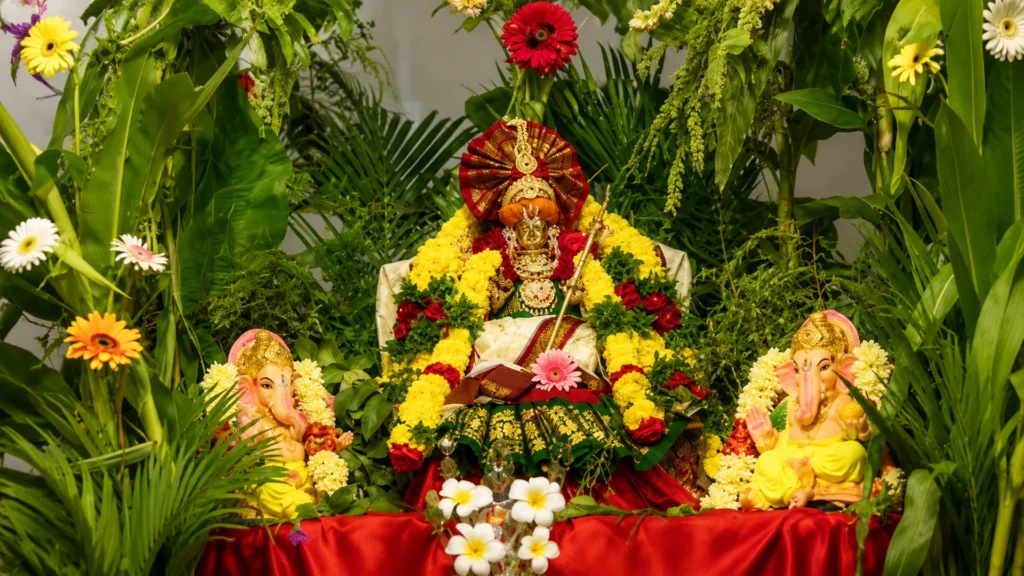
Vishvaksena (in the middle) flanked by two elephant headed (gaja mukhas) Ganadhipathis
26th August 2025 – Vighna Nivaraka Chaturthi – Obstacle Removing day.
On this day devotees pray to Lord Vishvaksena to give them the mental strength and strong will to solve and remove the hindrances on their path to spiritual enlightenment. Our actions which are responsible for the hurdles have to be wiped off. This Vighna Nivaraka Chaturthi is the special day we have to pray to the Deity who has the power to remove our spiritual hurdles and grant us with success in our endeavours.
Lord Vishvaksena Prashad: Lord Vishvaksena sustains on the remnants of His master’s (Lord Vishnu) food, which is a sign of approval of his master. So offer Kheer (sweet rice) or cut fruit/laddo/sweet meats to Lord Vishnu first and that offerings is thereafter offered to Vishvaksena in the prayers below.
In South Indian temples, Lord Vishvaksena is offered ‘appalu’ in his naivedyam (food) offering. Appalu is actually RHOT but with oil instead of Cows ghee. Yes, you may use Ghee instead of oil.
Appalu is optional and Kheer can be offered instead.
Lord Vishvaksena Prayer Procedure on Ganesh Chaturthi for the current year.
The devotee should meditate upon a Lord Vishvaksena photo facing the north direction at the prayer place. Now offer an agarbatti, lamp (with either ghee or oil with a wick or a small piece of camphor) and a flower (or all three on a tray) to Lord Vishvaksena (turn seven times clockwise around the photo), and pray to Lord Vishvaksena, praying to him to remove all obstacles in the path of your prayer. Pray to Lord Vishvaksena asking him to please accept your prayers.
Now chant the following:
Hold your palms in the Namaste position and chant:
- Om swagatam su swagatam – Om Vishvaksena-ye namah
(Swagatam means “O Lord Vishvaksena I welcome you”)
Then offer flower (pushpam) or flower petals by turning it seven times clockwise around Lord Vishvaksena’s photo.
2) Om idam pushpam – Om Vishvaksena-ye namah
Then offer one or three incense sticks (dhoopam) by turning it seven times clockwise around Lord Vishvaksena’s photo.
3) Om tato dhoopam aghraa-payaami – Om Vishvaksena-ye namah
Then offer a clay or brass lamp (deepam) with either ghee or oil with a wick or a small piece of camphor by turning it seven times clockwise around the photo.
4) Om prat-yaksha deepam darshayaami – Om Vishvaksena-ye namah
Then offer cut fruit/laddo/sweet meats or sweet rice (Naivedyam). It should be in a small bowl with a teaspoon. Turn the bowl seven times clockwise around the photo and bring the bowl near the lips of Lord Vishvaksena suggesting he partakes the food offering. Then leave this in front of the photo. This is later consumed by the family as the Lord’s Prashad.
5) Om naivedyam samar-payaami – Om Vishvaksena-ye namah
- Then in a cup (lota/chumbhu) which has only milk turn the lota seven times clockwise around the photo and bring the lota near the lips of the Lord suggesting he drink the milk offering.
- Offer prayers for forgiveness
Om yaani kaani cha papani janmaantara kritaani cha
taani sarvaani nashyanti pradakshina pade pade //
Then offer your personal prayers to Lord Vishvaksena. Ask Lord Vishvaksena for whatever you desire (within reason) and the Lord being so merciful will grant what you desire. But be careful what you desire for.
The Lakshmi Tantra prescribe the worship of Vishvaksena and mention his mantra “Om rhum vaum jnanadaya namah”
Vishvaksena Gayatri Mantra – Commander of Lord Vishnu’s Abode Vaikuntha – Listen to Remove Obstacles
https://www.youtube.com/watch?v=wqgv-fBZ7mY
“Vishvaksenaya vidmahe vethra hasthaya
dhimahee thanno santha prachodayath” chant 11, 21 or 108 times.