

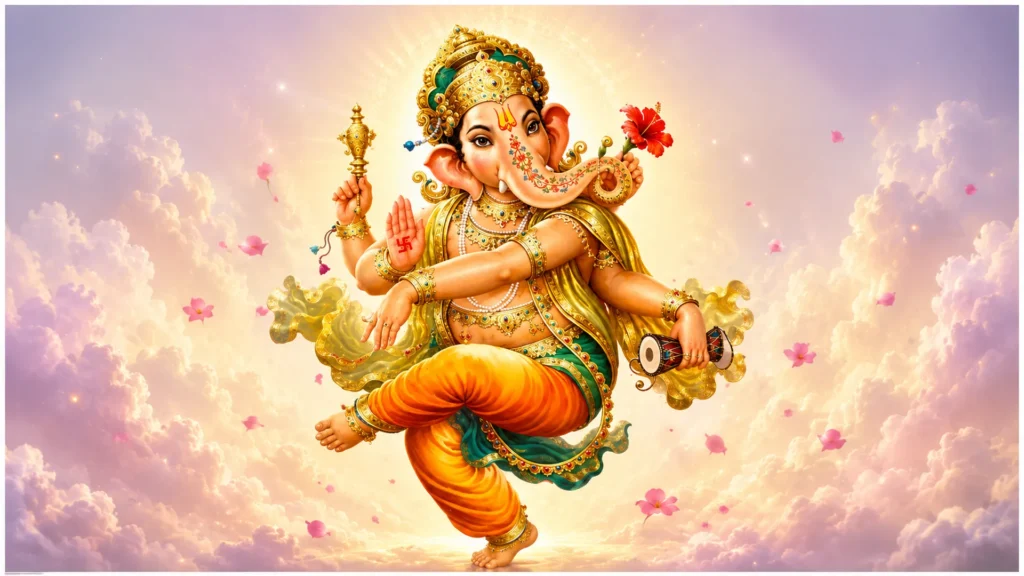
(The Appearance day Of Lord Ganesh) 14th of September 2026
SHREE GANESH VANDANA
Shuklam bharatharam vishnum
shashi varnam chaturbhujam
prasanna vadanam dhyayet
sarva vighnopa shantaye
agajanana padmargam gajanana
mahirsham aneka dantam bhaktanam
eka dant am upasmahe
We meditate on Lord Ganesha – who is clad in white (representing purity), who is all-pervading (present everywhere), whose complexion is grey like that of ash (glowing with spiritual splendour), who has four arms, which has bright countenance (depicting inner calm and happiness) and who can destroy all obstacles (in our spiritual and worldly path).
Shree Ganesh Chaturthi is one of the most popular Hindu festivals. This is the appearance day or birthday of Shree Ganesh-ji and is the most sacred day in honour of Lord Ganesh. It falls on the fourth day of the bright moon in the month of Bhadra (August-September) and this year this falls on the 14th of September 2026. Clay deities are made and after being worshipped for two to ten days are immersed into a river called Ganesh Visarjan (25th of September 2026). Lord Ganesh is the elephant-headed Deity. Hindus in any kind of prayer to remove any obstacles worship him first. His names are first repeated before any auspicious work and when any worship is begun. For example, I’m sure you heard of Dwaar Puja. This is a prayer that is performed by the bride’s side on the day of the wedding to the groom. Here prayers are performed to Shree Ganesh-ji and seeking his blessing and permission for the wedding. If this prayer is not performed then that marriage is doomed to go through problems because if Shree Ganesh is not pleased then he creates obstacles in one’s path.
The following narration is about the appearance of Shree Ganesh-ji and how did he come to have the head of an elephant. Millenniums ago, while bathing Parvati Devi, created Shree Ganesh as a pure white being out of mud of her body, and placed him at the entrance of her house. She told him not to allow anyone to enter while she was bathing. When Lord Shiva returned home quite thirsty, Lord Ganesh stopped him at the gate. Lord Shiva became enraged and threw his trident at Ganesha’s head and cut off his head, thinking that he was an outsider. When Parvati Devi came to know about this she became very aggrieved. To console her Lord Shiva ordered his servants to cut off and bring to him the head of any creature that was sleeping with its head facing north. The servants went on their mission and found only an elephant in that position. That sacrifice was made and the elephant’s head was brought before Lord Shiva. (Chill animal activists this animal was granted moksha {liberation} for its services rendered). Then Lord Shiva joined the elephant’s head onto the body of Ganesh. Thus he was revived.
Lord Shiva then made his son worthy of worship at the beginning of all undertakings, marriages, expeditions, studies and so forth. He also ordained that the annual worship of Lord Ganesh should take place on the fourth day of the bright half of the month of Bhadra (August-September).
Without the blessings and grace of Lord Ganesh, nothing whatsoever can be achieved. No action can be undertaken without his support and permission. In his/her lesson in the alphabet, a Maharashtrian child is initiated into the mantra of Shree Ganesh – “Om Sri Ganeshaya namah”. Only then is the alphabet taught to him. His holy mantra is “Om Gung Ganapataye namah”. Lord Ganesh is the Lord of the ganas or groups – for instance, groups of elements, groups of senses and so forth. “Gana” means groups and “esh” is ruler thus he is the ruler of groups. Shree Ganesh’s favourite food is Kheer, sugar candy and laddus. First of all any prayer or study that you do, you should chant Shree Ganesha-ji’s name: Om Ganeshaya namah (As many times as you like but 21 times is enough).
The Vighneswara mantra. “Om gang glaung ganapataye vighna-vinaasheene swaahaa”
This very famous sixteen-syllable mantra of Shree Ganesh was said to have been recited by Srimati Radharani to alleviate the suffering that followed the admiration of the Chaturthi moon by Lord Krsna. Even to this day, the moon is not seen on this day and people recite this mantra to come out of the sufferings of the planets like Ketu or for the removal of all obstacles. Once Chandradeva (the Moon god) offended Shree Ganesh and behaved very unbecomingly towards this great devotee. Thus if you do look at the moon immediately remember the story of the Syamantaka jewel in the Srimad Bhagavatam 10th canto, chapters 56 and 57. To read the katha of the Syamantaka jewel please go to these links.
http://www.srimadbhagavatam.org/canto10/chapter56.html
http://www.srimadbhagavatam.org/canto10/chapter57.html
Another famous pastime is intertwined with the katha of why one shouldn’t look at the moon on the night of Ganesh Chaturthi. It is well known that Lord Ganesha likes to eat. One evening, having stuffed himself to capacity, he decided to take a ride on his favoured mount, Mooshika, a rat. Along the moonlit road they chanced upon a large snake and the startled rat bolted. Lord Ganesh fell heavily; he hit the ground so hard that his stomach burst open. Gathering up the remains of his self-esteem, his ample guts and the snake, Lord Ganesh wittily used the reptile as a belt and tied himself up together again. Howls of derision shattered the peaceful scene; it was Chandradeva (the Moon-Deity) who had witnessed the whole incident with great relish. Lord Ganesh lost his temper and angrily looked about for something to throw at his tormentor. Finding nothing suitable, he ripped off one of his own tusks and hurled it at the moon. He added a vindictive curse that every so often the moon would lose its power of giving light thus we have the dark and light phases of the moon. A different pastime narrates that Lord Ganesh was asked to scribe down the epic of Mahabharata, dictated to him by its author, Vyasadev-ji since Lord Ganesha is the deva of education, knowledge, wisdom, literature and fine arts. Taking into note the enormity and significance of the task, Lord Ganesha realized the inadequacy of any ordinary ‘pen’ to undertake the task. He thus broke one of his own tusks and made a pen out of it. The lesson offered here is that no sacrifice is big enough in the pursuit of knowledge.
There are numerous pastimes associated with Lord Ganesh and all are told during the time of this festival. Once the devas decided to choose their leader and a race were to be held between the brothers Lord Kartikeya (Muruga) and Lord Ganesh. Whoever completed three rounds of the earth first would be made the leader. Lord Kartikeya seated on a peacock, his vehicle, started off for the test. Lord Ganesh was given a rat, which also moves swiftly. Lord Ganesh realized that the test was not easy, but he could not disobey his father. He reverently paid obeisance to his parents and circumambulated them three times and completed the test before Lord Kartikeya. According to Shree Ganesh, “My parents pervade the whole universe and going around them, is more than going round the earth.” Everybody was pleasantly surprised to hear Shree Ganesha’s logic and intelligence.
The huge belly of Ganesha signifies abundance and prosperity. It is said that Lord Kubera, the deva in charge of wealth for the Devas, once went to Lord Shiva and Ma Parvati and wanted to show off his wealth. He invited them to have a meal at his place. They refused his offer and said it would be sufficient if he could feed Lord Ganesh amply. Lord Kubera laughed at this. Lord Ganesh went with him. He coolly kept on eating the food offered to him but his hunger could not be satisfied even after the entire ration had been finished. So he started eating up the articles around. Lord Kubera was terror-struck. Lord Ganesh then said to him that he had promised to feed him to the full but he was still hungry so he would eat Kubera. The latter ran off to Lord Shiva and pleaded with him to save him. Lord Shiva asked Lord Kubera to feed Lord Ganesh a fistful of rice without pride. He did so and Lord Ganesh was full. Thus he does not desire us to offer our material possessions to him, he only blesses the humble and the devout.
Lord Ganesh has many other titles of respect or symbolic names and some of them are:
Aumkara: the Aum-shaped body.
Ganapati: Lord of the Ganas, a race of dwarf beings in the army of Lord Shiva.
Vakratunda: Curved Trunk.
Ekadanta: One-Tusked.
Shupakarna: Large/Auspicious Ears.
Gajanana: elephant face.
Anangapujita: The Formless, or Bodiless.
Lambodara: big-bellied.
Vinayaka: a distinguished Leader (Vi stands for vishesha Special and nayaka from root ni to lead, thus Leader.
Vighnesh, Vighneshwara: controller of obstacles (Vighna = obstacle, eeshwara=lord).
Vighnaharta: remover of obstacles.
Pillaiyar: meaning “whose child?”, Lord Shiva’s question in one story of how Lord Ganesh got his head and also Pillai an affectionate term in Tamil, aar for added respect.
Lord Ganesha has two wives-Riddhi (prosperity) and Siddhi (success). Thus anyone who has His blessings will automatically get prosperity and success.
Lord Ganesh Prayer Procedure.
At the prayer place, place a Lord Ganesh murti or photo. Firstly offer an agarbatti, lamp (with either ghee or oil with a wick or a small piece of camphor) and a flower (or all three on a tray) to Shree Ganesh (turn seven times clockwise around the murti or photo), and pray to Shree Ganesh, praying to him to remove all obstacles in the path of your prayer. Pray to Lord Ganesh asking him to please accept your prayers.
Now chant the following:
Hold your palms in the Namaste position and chant:
- Om swagatam su swagatam – Om Ganesha-ye namah
(Swagatam means O Lord Ganesh welcome you.)
Then offer flower (pushpam) or flower petals by turning it seven times clockwise around Lord Ganesha’s deity/photo.
2) Om idam pushpam – Om Ganesha-ye namah
Then offer one or three incense sticks (dhoopam) by turning it seven times clockwise around Lord Ganesha’s deity/photo.
3) Om tato dhoopam aghraa-payaami – Om Ganesha-ye namah
Then offer a clay or brass lamp (deepam) with either ghee or oil with a wick or a small piece of camphor by turning it seven times clockwise around the deity/photo.
4) Om prat-yaksha deepam darshayaami – Om Ganesha-ye namah
Then offer cut fruit/laddo/sweet meats or sweet rice (Naivedyam). It should be in a small bowl with a teaspoon. Turn the bowl seven times clockwise around the deity/photo and bring the bowl near the lips of Lord Ganesh suggesting he partakes the food offering. Then leave this in front of the deity/photo. This is later consumed by the family as the Lord’s Prashad.
5) Om naivedyam samar-payaami – Om Ganesha-ye namah
- Then in a cup (lota/chumbhu) which has only milk turn the lota seven times clockwise around the deity/photo and bring the lota near the lips of the Lord suggesting he drink the milk offering.
- Offer prayers for forgiveness
Om yaani kaani cha papani janmaantara kritaani cha
taani sarvaani nashyanti pradakshina pade pade //
Then offer your personal prayers to Lord Ganesh. Ask Lord Ganesh for whatever you desire (within reason) and the Lord being so merciful will grant what you desire. But be careful what you desire for.
Optional: You may sing or hear the Ganesh Chalisa.
Ganesh Chalisa click ( HERE ).
Suggested Lord Ganesh mantras you may chant 11, 21 or 108 times:
(1) Om Gam Ganapataye Namah
(2) Aum Gajaananaaya Namah
(3) Om Vighnanashaya Namah
(4) Vakratunda Maha-Kaaya Surya-Kotti Samaprabha
Nirvighnam Kuru Me Deva Sarva-Kaaryeshu Sarvadaa
(5) Aum Ekadantaya Viddhamahe, Vakratundaya Dhimahi,
Tanno Danti Prachodayat
Ganapati bappa morya Jai Shree Ganesha
Which position must Lord Ganesha’s trunk be? The position of Lord Ganesha’s trunk has a symbolic meaning. If the trunk turns to Lord Ganesha’s left, that is the direction for success in the world. It is a position associated with Grihastas or householders. To his right, the trunk represents moksha, good for renouncing the world. When one chooses a Lord Ganesha Deity that is proper for their own spiritual path the trunk position is one thing that is good to keep in mind. Lord Ganesha’s trunk mostly curls to reach the left hand. [90 per cent] The left hand symbolizes our feminine side, Lord Ganesha’s benevolent [feminine] aspect, which means one should get all the good things in life, money, good food, good progeny, name and fame and so on. The trunk curling towards the right hand indicates the predominance of the masculine aspect of Lord Ganesha. This indicates austerity, honesty, integrity, thrift, and living a life based on human moral values/principles.
Srila Prabhupada on Shree Ganesh
“One should begin the worship of the deva Ganapati (Ganesha), who drives away all impediments in the execution of devotional service. In the Brahma-samhita it is stated that Ganapati worships the lotus feet of Lord Nrsimhadeva and in that way has become auspicious for the devotees in clearing out all impediments. Therefore, all devotees should worship Ganapati.” (A. C. Bhaktivedanta Swami Prabhupada. Nectar of Devotion, chapter 8. Offenses to be avoided.)
Devotee: Srila Prabhupada, if… Since Krishna is the power that gives the devas the ability to render everything, then why is it recommended in the Nectar of Devotion that a Vaishnava should worship Ganapati?
Prabhupada: Krishna worship, everyone. Just like we worship also ordinary man if it gives us facility to worship Krishna. We go to somebody and worship him, flatter him, because he will give some money, and it will be engaged in Krishna’s service. The man is not worshippable, but he will help us to worship Krishna. Thereby he will be helped and we will be also helped, and Krishna will be satisfied. Krishna will be satisfied that “My devotee has brought some money from this rascal. All right.” That is… (Laughter) So Ganapati is also devotee. So Ganapati, it is not required, but sometimes we do. Just like gopis, they worshipped Goddess Durga, Katyayani. They did not require, but the social system is that. But they asked that Mother Katyayani, give us the opportunity to have Krishna as our husband.” The aim is Krishna. Generally, they go to worship Devi Durga for asking material benefit. Dhanam dehi rupam dehi yasho dehi, the things that we want in material… But the gopis, they do not go for any material things. For Krishna. Similarly, we can go to any deva. Why Ganapati? Everyone. But our prayer should be, “Please give us Krishna.” Then it is correct. (A.C. Bhaktivedanta Swami Prabhupada. 10th January 1974. Morning Walk conversation. Los Angeles)
“I adore the primeval Lord Govinda, whose lotus feet are always held by Ganesha upon the pair of tumuli protruding from his elephant head in order to obtain power for his function of destroying all the obstacles on the path of progress of the three worlds.” (Brahma Samhita 5:50. PURPORT)
The power of destroying all obstacles to mundane prosperity has been delegated to Ganesha who is the object of worship to those who are eligible to worship him. He has obtained a rank among the five gods as Brahma possessing mundane quality. The self-same Ganesha is a god in possession of delegated power by infusion of the divine power. All his glory rests entirely on the grace of Govinda.” (Bhakti Siddhanta Saraswati. August 1932. Brahma Samhita 5:50 purport.)
“Just like in the Brahma-samhita, we are giving respect to all the devas. We are giving respect to Lord Shiva, we are giving respect to Durga, we are giving respect to Ganesha, and we are giving respect to the sun god. They are very big devas. Lord Shiva, or Durga, Ganesha, and Brahma, and… We don’t disrespect. We give respect even to the ant. Why not to Lord Shiva or Lord Brahma? They should have their due respect, but that does not mean, we consider them as the Supreme Lord.” (A.C. Bhaktivedanta Swami Prabhupada. 24th May 1969. Srimad Bhagavatam lecture SB 1:5:8-9.)
Indian man (2): If we become completely Krishna conscious…
Prabhupada: Hm?
Indian man (2): If we follow the Krishna conscious path… Now, take for example our wedding ceremonies. Now, the first thing that we take, the Ganapati, there is Ganasyainava, and there are various other deities that we have to respect. Now, what happens in his case?
Prabhupada: If you are actually Krishna conscious, then to worship Ganapati, there is no harm. But if you take Ganapati as independent God, then your Krishna consciousness is hampered.
Indian man (2): But in certain ceremonies these things are…
Prabhupada: Any ceremony. If you know the constable is constable and the president is president, then it is all right. But if you think constable is president, then you are misguided. (A.C. Bhaktivedanta Swami Prabhupada. 12th October 1975. Morning Walk. Durban, South Africa.)
Jai Srila Prabhupada