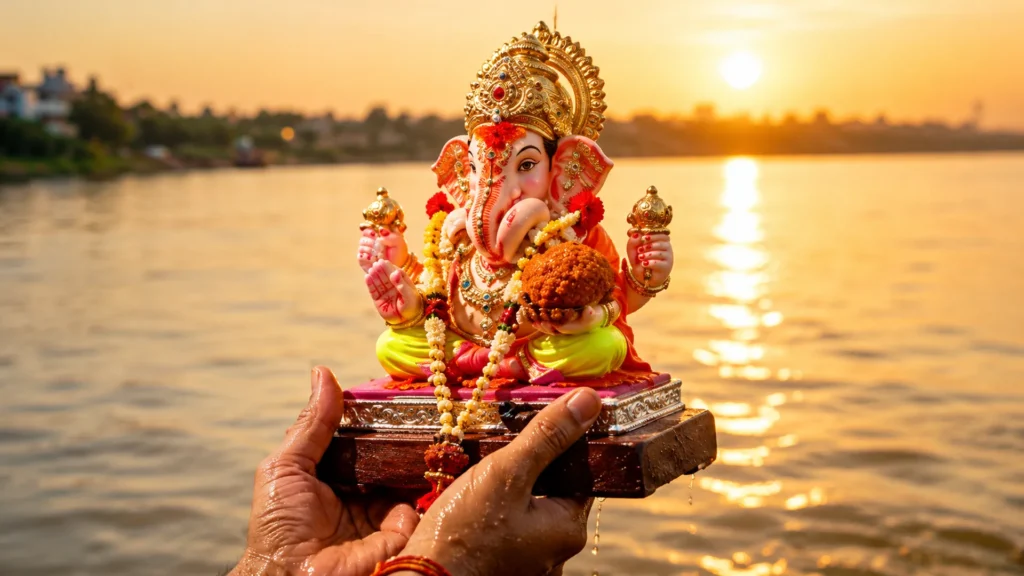

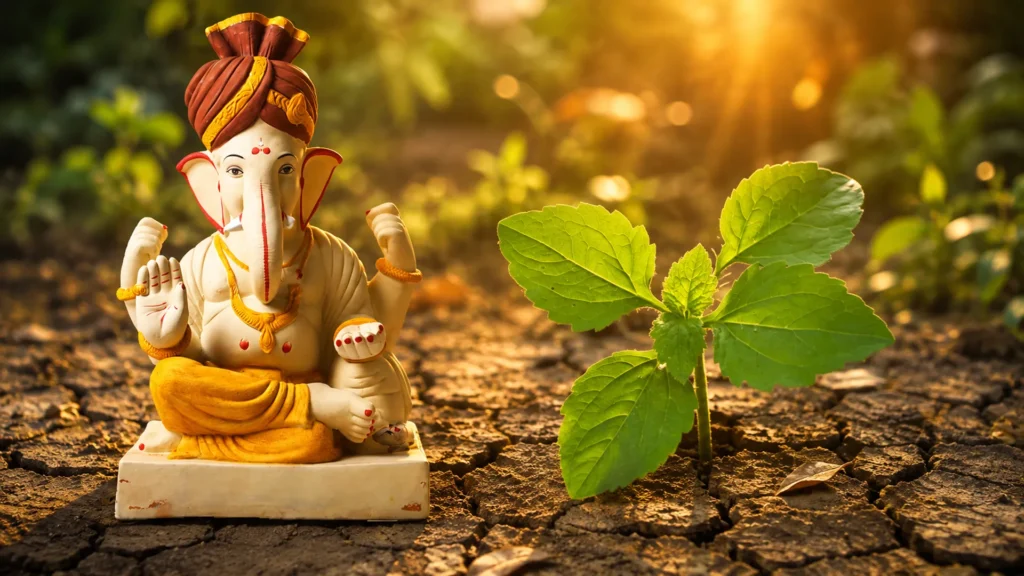
Lord Ganesh made of clay.
Why do we celebrate Ganesh visarjan?
This celebration denotes the significance of the cycle of birth, life, and death and also lays emphasis on the fact that everything in life is momentary. Visarjan ends with a ritual called ‘Uttar puja’ (final prayers to Lord Ganesh). After this is completed, Lord Ganesha’s murti is immersed in water and blessings are sought.
Can we observe Ganesh Visarjan at home especially if one resides in Gauteng or Free State?
Of course! If you choose to go the eco-friendly Ganapati route this Ganesh Chaturthi and brought home a clay set for the same, you may perform the visarjan at your home in a bucket or large dish.
Process: After the Uttar puja, which is performed just before the immersion of the murti, take the murti to your balcony.
What is the process of Ganesh visarjan?
On the day of the visarjan, devotees perform aarti and distribute the bhog or prashad amongst the devotees. The immersion process starts with Uttrang pooja. This involves an offering of oil lamps, flowers, incense sticks, fragrance and food offerings to Lord Ganesha. The shubh mahurat (auspicious time) for Ganapati visarjan differs daily.
How many days can we keep Ganpati at home?
You may keep the Ganesh murti for one and a half days, three days, five days, seven days, ten days or even 21 days before visarjan.
Why Ganapati Visarjan is performed in water?
The ritual is done to signify the birth cycle of Lord Ganesha; just as he was created from clay/Earth, his symbolic murti is as well. The murti is immersed in water so that Lord Ganesh may return to his home after his ‘stay’ at the devotees’ home or temple where the Ganesha Chaturthi rituals are observed.
What is an eco friendly Ganesh murti?
Eco-Friendly Ganesh Chaturthi: Ganapati murtis that grow into plants after immersion. Since the murtis are made from Plaster of Paris, these are non-biodegradable naturally and so these continue to float on the water for a long time, thereby choking the water bodies and adversely impacting the aquatic ecosystem. So please use a clay murti.
What is the time of Ganesh visarjan in Kwa-Zulu Natal, South Africa?
Ganesha Visarjan on Anant Chaturdashi (25th of September 2026)
Anant Chaturdashi is the most significant day for Ganesha Visarjan. Apart from Ganesha Visarjan, Anant Chaturdashi is a very significant day to worship Lord Vishnu in Anant form.
Ganeshotsav or Ganesh-Utsav, which begins on Ganesha Chaturthi, culminates on Anant Chaturdashi. Hence Ganeshotsav is celebrated for 10 days in the month of Bhadrapada. The last day of festivity is known as Ganesha Visarjan.
The murti of Lord Ganesha is immersed into a water body, preferably in a river, lake or the sea. After the final offering of coconuts, flowers and sweets, the murtis of Lord Ganesh are taken to the water body through the street procession with much fanfare. Thousands of devotees join the procession and fill the whole atmosphere with chanting of Lord Ganesha. “Ganapati Bappa Morya” and “Ganesh Maharaj Ki, Jai” are a few of the famous slogans which are chanted throughout the procession.
Ganesha Visarjan on Anant Chaturdashi on, 25th of September 2026 (South Africa)
Auspicious Choghadiya Muhurat (auspicious time) for Ganesha Visarjan
Time to avoid Moon sighting – 07h34 to 21h10
Morning Muhurat – 05h42 to 10h16
Afternoon Muhurat – 11h48 to 13h19
Afternoon Muhurat – 16h22 to 17h54