

ॐ Pranaams friends प्रणाम दोस्त aur Jai Pitar जय पितृ Devata’s. 卐
Below are pertinent questions that are generally asked every year by Hindus regarding Pitar Paksha. Dipika is compiling this article for all to learn more about this important period.
CONTENTS
- Why is Lord Ganesh absent during the Pitar Paksha period every year?
- The difference between Lord Vishvaksena and Lord Ganesh
- Can a son perform his own Pitar Paksha puja at his residence instead of going to his parent’s residence?
- Can I partake in meals at my friends or families home if I didn’t perform my Pitar Paksha prayers?
- Can one purchase a vehicle, house or sign important documents during Pitar Paksha?
- What Seedha do I donate and to whom during Pitar Paksha?
- My dad/mother/family member passed a few months ago. Can I still perform my Pitar puja as normal this year?
- Can you eat the food that you offer your Pitars?
- Links on DIPIKA about Pitar Paksha.
Why is Lord Ganesh absent during the Pitar Paksha period every year?
The information provided below is in most probability has never been heard of before by many. On Ganesh Visarjan (immersion) is observed, whereby the clay or metal Murti of Lord Ganesh is immersed in the ocean. This ritual is performed to signify the birth cycle of Lord Ganesh; just as he was created from clay/Earth by his mother Gauri Devi, his symbolic murti (deity) is as well. The murti is immersed in water so that Lord Ganesh may return to his home after his 10 days ‘stay’ at his devotees’ home or temple where the Ganesh Chaturthi rituals were being conducted.
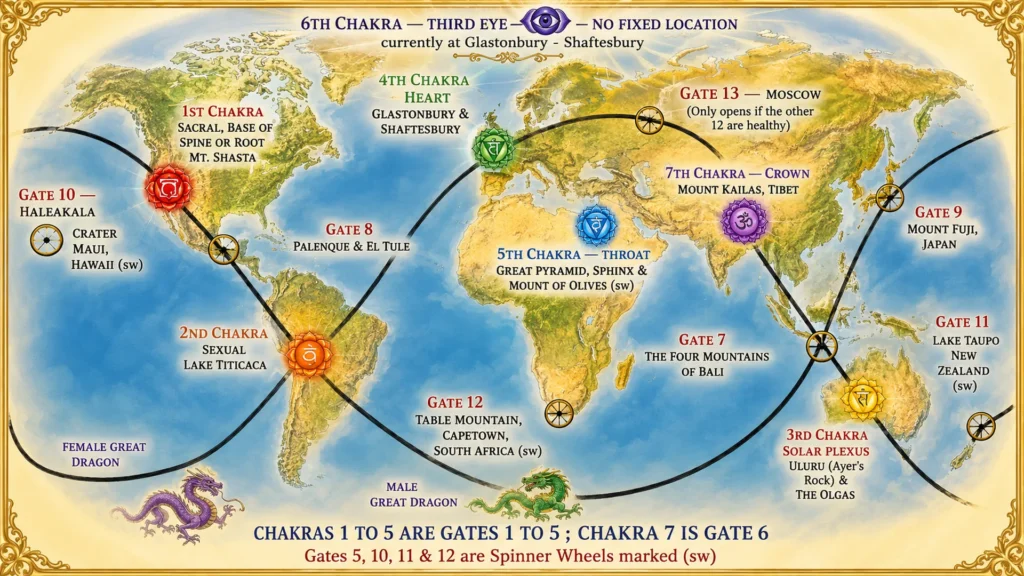
Let’s delve further into this subject matter. After the immersion when it is said that the Lord returns to his “spiritual home” is in actual fact the Lord withdraws himself into the deeper realms and enter the central root survival chakra of this planet. In these approximately 15 days, Lord Ganesh meditates and rejuvenates the much depleted Earth’s energies. His presence there creates healing and regenerating vortex forces that keep the planet stable. He especially recharges the 7 main chakra points on this planet {namely Mt. Shasta in California, Lake Titicaca Peru/Bolivia, Uluru, Ayers Rock in Australia, Mt. Kailash in the Himalayas, etc – view the attached picture below). During the previous year, after the final day of Pitar Paksha, the energies of the Earth has been slowly but surely being depleted especially due to Covid and other factors. Due to Kali Yuga (the Age of strife”, “discord”, “quarrel” or “contention”), every year it seems that the depletion of the Earth energies is occurring alarmingly more quickly than the previous year. This, of course, is cause for alarm.
In this period due to Lord Ganesh being in meditation and unavailable to accept worship, prayers like weddings, katha and jhanda, sacred thread (Janeo) ceremonies, moving into a house, and so forth, are avoided as much as possible. All these prayers require Lord Ganesh to be worshipped first before one can commence with that particular prayer. It is rather interesting to note that during Pitar Paksha, the daily Tarpan (water of libation) offerings, Lord Brahma, Lord Vishnu, Lord Shiva’s and other Deities names are chanted but NO Ganesh water mantra offering is chanted.
Once Pitar Paksha ends, Lord Ganesh then returns to the surface of this planet to resume his duties as the chief remover of obstacles. Now that the Earth planet is positively charged by Lord Ganesh, when the sun rises on the morning of the first day of Navaratri, Mother Durga is welcomed into a positively charged planet, ready to accept Her devotees’ worship and prayers. Her son, Lord Ganesh cleared the stagnant energies in this planet for his mother whom he holds so dear to his heart. This is the reason why so many devotees feel euphoria on the first morning and subsequent days during Navaratri – all thanks to Lord Ganesh, Mother Gauri’s son. Now maybe you can understand what an important and crucial role that Lord Ganesh plays in Sanatan Dharma.
All glories to our dearest Lord Ganesh.
Hope you enjoyed this little piece of priceless information.
The difference between Lord Vishvaksena and Lord Ganesh
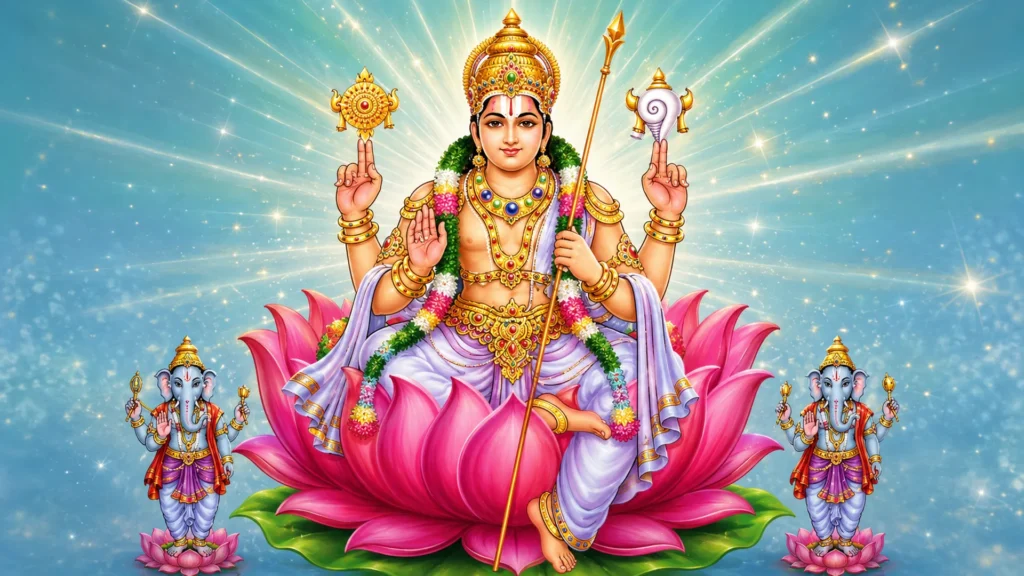
Lord Vishvaksena with Lord Ganapati below on either side.
No religious-minded person, belonging to the Hindu faith, fails to pay his obeisance to Lord Ganapati in some form, manner or other. His Grace is invoked at the commencement of any auspicious ceremony or enterprise. However, for Sri Vaishnavites (devotees of Lord Vishnu/Narayana), Lord Ganapati is the counterpart of Sri Vishvaksena, the commander of Lord Narayana’s celestial forces. The term ‘Ganapati’ also means the same – commander of the Shiva Ganas, the forces of Lord Shiva. Vishvaksena is the alter-ego of Lord Narayana. He is the commander in chief of Lord Vishnu’s army. Of moon-like complexion, he is four-armed and is the destroyer of all difficulties (or obstacles). The Sri Vaishnavas worship Vishvaksena in place of Lord Ganesha.
According to the Sri Vaishnavite philosophy, Lord Vishvaksena is the first and foremost Acharya (great spiritual leader) – since he was taught directly by the Divine Couple (Radha-Krishna). Lord Vishvaksena subsequently passed on the knowledge to other Sri Vaishnavite Acharyas.
There are many elephant-headed and horse-headed soldiers with ‘Lord Vishvaksena’, who is the supreme controller of Paramapadam, the divine abode of Lord Vishnu. All these elephant-headed soldiers have two tusks according to Pancharathra Agama scriptures. It is also mentioned that there are several hundreds of such Gajananas in the battalions of Sri Vishvaksena.
In both Vaikanasa Agama and Pancharatra Agama, Sri Vishvaksena is accorded the first place in worship as the one who drives the negative forces and obstacles away before the commencement of an auspicious event.
It is also interesting to note that the Vaikanasa Sutras do mention a “Dwara {door} Ganapati” that is to be installed along with Nagaraja (the form of a 5 hooded serpent with the image of nardhana krishna superimposed on it) at the entrance of the Rajagopuram. This Ganapati is having the same form as Parvati Putra (the son of Mother Parvati) – however, the representation of Dwara Ganapati serves a role similar to that of a kaval devathai (similar to a security guard at the lobby of government building) and this Ganapati’s position does not supersede that of Sri Vishvaksena – who will still have his shrine in the place where we would expect to find one of Lord Ganesh in a Shiva temple.
Therefore in place of Lord Ganesh, Sri Vaishnavas will worship Sri Vishvaksena only. Sri Vishvaksena is also one of the acharyas in Vaishnava Acharya Parampara (linage) – the third acharya starting from Lord Narayana. This also makes Sri Vishvaksena special to all Sri Vaishnavas. He not only removes obstacles in our material path but also in spiritual life paving the way for divine knowledge.
However, there is nothing inappropriate in acknowledging the presence of Lord Ganesh, as prapannas (a fully surrendered devotee of Lord Narayana) we can only respect Lord Ganesh as an exalted soul and devotee of Bhagavan Sri Vishnu but not equal to Him.

Can a son perform his own Pitar Paksha puja at his residence instead of going to his parent’s residence?
Question: “With the covid pandemic lurking over our shoulders, my wife and I strongly believe in practising social distancing, if we are to prevent the spread hence we thought it would be best for my elder parents safety if we did not attend their Pitar Paksha at their residence this year. This is one of our favourite prayers, so it’s sad to think that we’d miss out on it entirely. We thought judging the situation, we should do this on our own however my parents find it very disrespectful to perform the prayer on our own accord since both my parents and spouses parents are still alive. With that said, how do we as the kids perform such an auspicious prayer on our own without offending our parents.”
Answer: We shall refer to Vedic Shastras before we shall expound further on this query.
ध्रियमाणे तु पितरि पूर्वेषामेव निर्वपेत् ।
विप्रवद् वाऽपि तं श्राद्धे स्वकं पितरमाशयेत् ॥ २२० ॥ मनुस्मृति
dhriyamāṇe tu pitari pūrveṣāmeva nirvapet |
vipravad vā’pi taṃ śrāddhe svakaṃ pitaramāśayet || 220 || Manu smriti
“While his father holds, one should make the offering to the previous ancestors; or, he may feed his own father at the Shraaddha as a Brahmana.—(220).” Manu smriti
Medhātithi’s commentary (manubhāṣya): ‘While his father holds,’—(is alive)—‘one should make the offering to the previous ancestors,’— (i.e., to the three, the grandfather, the great-grandfather and the father of the latter); that these three are meant is indicated by the plural number. The Gṛhyasūtra states—‘The son should offer to those to whom the father offers, if both father and son are persons who have set up the fire.’
Vishnu (75.1).—‘If one performs the Shraddha while his father is alive, he shall offer it to those whom his father offers it.’
From the above shastric shlokas (verses), one can deduce that the son can perform the shraaddha puja even though his father is alive? Yes. But only for the previous three generations.
Other sources refer to it as “jivapitruk”. Jivapitruk is a son whose father is alive. However, he does not have the right to perform Pitru shraadh; but has the right to perform shraadh of the grandfather, great grandfather and great great grandfather.
Essentially if one’s father is alive one cannot perform pinda daan and tarpan for him (of course) but one should for one’s grandfather and great grandfather and great great grandfather.
Now, this is where many complications arise. If we, as Sanatanists (Hindus) don’t evolve we shall perish which is currently happening at an alarming rate.
My father is very old school and do I blame him – NO. He strongly and stubbornly believes 3-5 days observance of Pitar Paksha and he then “breaks” fasts with non-veg. I would never criticize him as that’s his way and I respect that. I am not judgemental. My concern is always my son. By my father not performing the full 15 days it will certainly affect my child negatively. So daily my son and I offer water and food (via Whatsapp Video call) for the 15 days and perform Pinda Puja and havan on the last day. If I don’t offer the Pindas and food daily my Pitars will starve and thus become angry. So I am doing what my father is supposing to be doing.
Most families in South Africa observe Pitar Paksha for just a few days rather than the entire fortnight which is indeed extremely sad. For example, if I came to your home daily for 15 days and you know me well, won’t you prepare meals etc for me. If a family just offer food offerings on for example the 3rd day during Pitar Paksha then what about the other 12 days. Are you going to let your beloved Ancestors, who did so much for you – STARVE????? and this is NOT emotional blackmail.
If the couple goes to his parent’s residence and performs the puja and tarpan, likely, his wife’s ancestors would NOT be acknowledged in the food and water offerings. Hence I suggest that the couple perform their prayers at their residence (so her ancestors are honoured and respected) but do attend their parent’s prayers (from either side) out of respect.
Due to many younger couples now being educated on the importance of Pitar Paksha, they now desire to observe the 15 days but their parents don’t want to as they prefer holding onto family traditions, instead of following our scriptures.
Can I partake in meals at my friend’s or family’s home if I don’t perform my Pitar Paksha prayers?
This would NOT be an issue if food and water were offered daily at one’s home. If one offers food and tarpana on the first day then the same day they may attend others’ homes and partake in meals.
Can one purchase a vehicle, house or sign important documents during Pitar Paksha?
We humbly yet strongly advise that during this period of Pitar Paksha and out of respect to our Ancestors that purchasing of a vehicle, a house or signing of documents and the like should suggestively be delayed or avoided.
It is not that our Ancestors will be upset, but do remember that this is their period to be in the “limelight” and they want our total love and attention. They come “officially” once a year (when Pitruloka {the planet of the Manes} is closest to the Earth) so they have limited time on this earthly plane. Living in 2021 is just not the same as living in the 1800s. Times and circumstances have changed drastically. As Sanatanists (Hindus) if we don’t evolve we shall perish which is currently happening at an alarming rate.
Our greatest inspiration for compiling articles and being so bold is SRILA PRABHUPAD. All of DIPIKA’S articles are based on Srila Prabhupad’s method of writing. Srila Prabhupad was a master writer and everything he wrote he backed up by Vedic Shastras. So I am going to use the three words that Srila Prabhupad used often namely “deśa-kāla-pātra”.
Srila Prabhupad often used this verse from Vedic shastras like the Bhagavad Gita and Srimad Bhagavatam Maha Purana. Deśa means “situation”, kāla, “time”, and pātra means the “subject, the individual, circumstance”.
Deśa-kāla-pātra: according to time, according to circumstances, according to the subject, everything is scrutinizingly judged, not whimsically. We must understand everything by taking these three elements into consideration. (Lectures: Bhagavad-gita 7.1 Fiji, 24/5/75)
EXPLANATION: These three elements have to be taken into consideration determining what is right and what is the wrong action. What is true at one time may not necessarily be true at another time. Similarly, what is true in a place or situation may turn out to be wrong at another place or another state.
For example: Singing for entertainment is true, but when singing next to those who are sick then it becomes transformed into a wrong action or bad behavior.
Serving ice-cold drink at night in a cold place might be received by a person with a reluctant heart, but when the ice was served during the hot hours of a sunny day it would be gladly welcomed.
From the examples above it is obvious that what is called the wrong action, when people do not know how to adjust to the place, time and circumstances of their behavior. So, the appropriate way is to adjust our actions according to Deśa-kāla-pātra.
But we are keeping our principles as it is, but making an arrangement according to the circumstances. That is required.” (Srila Prabhupad Lecture Srimad Bhagavatam Class Delhi 16/11/1973)
According to time, atmosphere, and the performer, there may be little difference. But the real purpose of dharma is to surrender to God and try to love Him. That is true religion or way of life (Sanatan Dharma).
Can one purchase a vehicle, a house or sign important documents in this period?
Well NO, but using the above reasoning then YES but only if there is no other option and within reason.
What do I mean by this? I get loads of calls, messages etc, “Panditji my car was stolen and I urgently need to purchase a vehicle as without one I can’t travel to work or I can’t run my business etc”. Or “I have an offer for a house or my lease expired and if I don’t sign the papers by tomorrow I will lose that amazing deal I am getting”, etc. So you get my point.
In these circumstances purchasing a vehicle or signing of a house, a document cannot be avoided and thus the “Deśa-kāla-pātra – situation, time and circumstance” rule comes into play.
*** But I humbly advise performing the car or house prayers after Pitar Paksha ends.
During Pitar Paksha, Lord Ganesh’s energies are withdrawn from the planetary surface and enter the central root survival chakra of the earth. His presence there creates healing and regenerating vortex forces that keep the planet stable.
Immersing murti’s/deities of Lord Ganesh in water at the end of the Ganesh Chaturthi festival is an acknowledgement of this fact. The disappearance of Lord Ganesh’s energies from the earth when he descends to the inner of the planet allows the pitars to approach their descendants. Thus Lord Ganesh remains largely dormant in this period, while he heals Mother Earth.
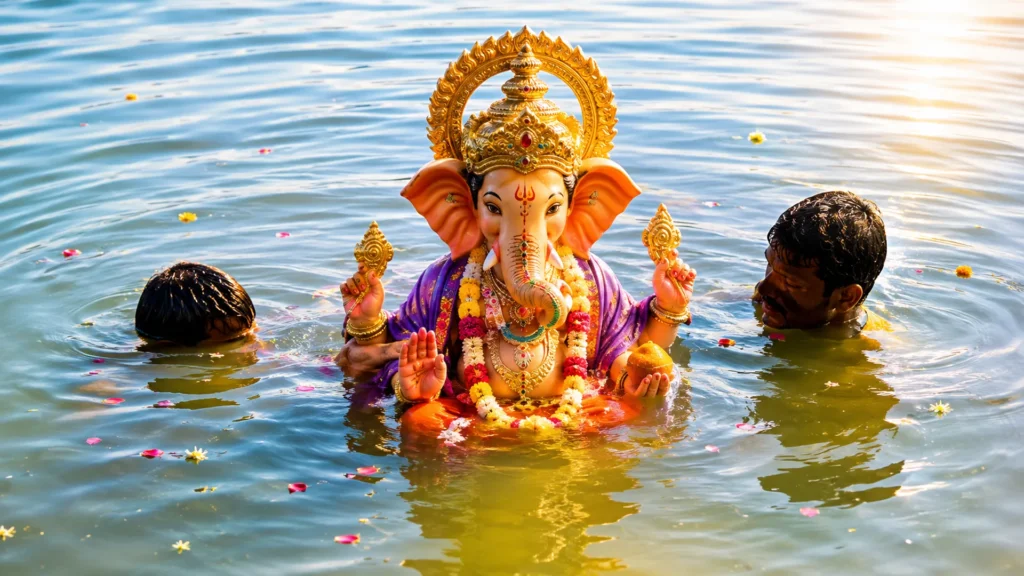
Hence prayers that require the blessings of the remover of obstacles, Lord Ganesh is largely avoided namely weddings, buying a vehicle, moving into a new or another house and sign important papers, starting a new job, starting a new business venture and so forth.
Have you ever noticed when chanting the Tarpan (water) mantras that Lord Ganesh’s name isn’t mentioned? Well, now you know why.
*** Moving into a house? Then don’t use your metal Lakshmi, rather use a clay lamp until Pitar Paksha ends and then start using the metal lamp.
What Seedha do I donate and to whom during Pitar Paksha?
On any day during Pitar Paksha Seedha/Daan (charity) should be donated to your family (KUL) Pandit or another priest or Guru or a poor deserving person/family. However, the 6th of October is the most auspicious day to donate the Seedha between sunrise and sunset.
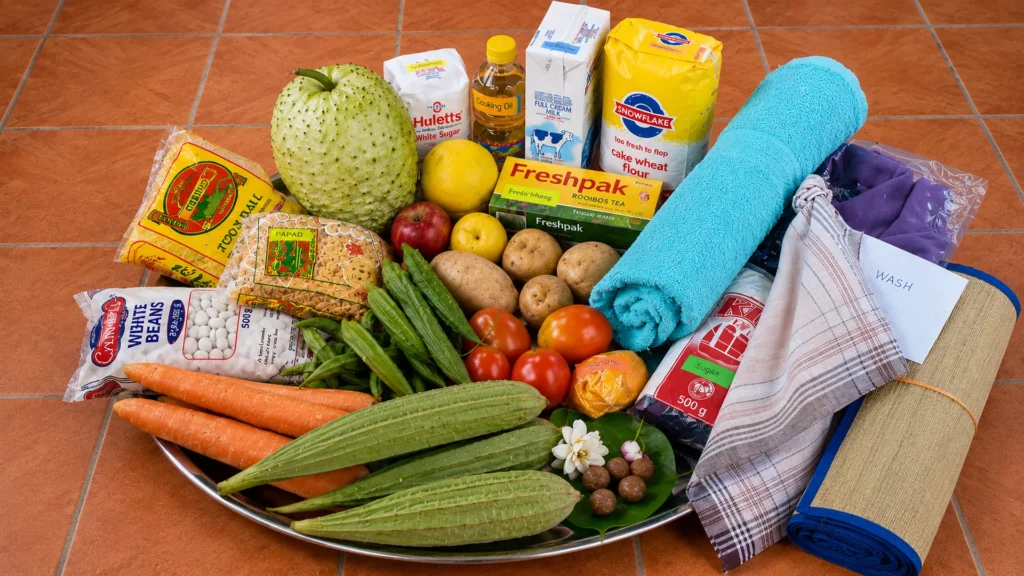
Seedha Guideline during Pitar Paksha: On a tray place 3 or 5 kinds of grains (like rice, beans, dal), 3 types of fruits, 3 types of vegetables, 500g rough or fine salt, sugar, flour, 250ml oil or ghee, few tea bags, little hurdi (turmeric) in a small packet, 1 towel or shirt, CASH (according to your financial situation but kindly be liberal) and SALT. Salt and rice are the most important of these daans. Also, include one betel leaf + one flat brown betel nut + one coin + one flower.
Optional: 3 new handkerchiefs. At one corner end of the handkerchief put a ¼ tsp white rice grains, and a coin and tie the corner.
My dad/mother/family member passed a few months ago. Can I still perform my Pitar puja as normal this year?
Garuda Purana, Preta Kanda Chapter 29 verse 12 Lord Vishnu said, “In death O Garuda, impurity lasts only for 10 days.” In the Garuda Purana, Lord Vishnu states quite clearly that the “ashucha” (contamination period) starts from the day of the funeral (more specifically when the body enters the furnace) and lasts for 10 days, but all other prayers only resume when the 12th/13th days (Sapindi) puja is completed and thus the family is then re-integrated into society. Do note the 12th day is observed by Brahmins and the 13th day by non-Brahmins.
Lord Vishnu said to Shree Garuda (His eagle bird carrier), “Offering of Ashirbaad (blessings), Deity worship, direct contact with the public, giving of Daan (charity/gifts), Hawan (Homa), Tarpana (offering of water), Fasts (like Krsna astami, Raam Navami etc), and Brahmin bhojan (feeding Brahmins) are forbidden in the 10 days period”. (Garuda Purana Preta Khanda chapter 13 verses 20-21).
CONCLUSION: The period of 12 or 13 days applies to the family of the deceased individual only. Other prayers like PITAR PAKSHA PRAYERS and so forth resume as normal once the 12th / 13th days puja is completed.
Can you eat the food that you offer your Pitars?
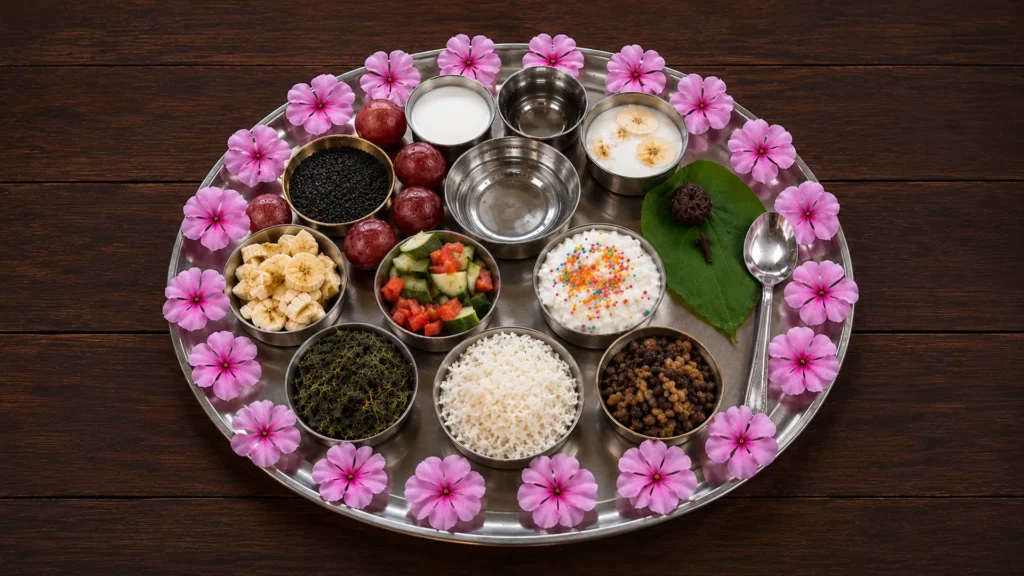
Both Hindus and Parsis offer food to their departed loved ones. The Ancestors consume the food ethereally by smelling rather than tasting it. The external form of the food does not change. I humbly caution everyone never to eat food offered to the dead. Such food has been polluted by the spirit’s intense desire to return to physical life, which has ruinous effect on the human mind. A practical example of this is to find a yogi in full meditation and place some food in his mouth; he will directly come down from his meditation. The pull of the physical is so strong. Hence one should NEVER partake in the “direct” food offerings (generally offered in the yard of one’s home) to ones Ancestors.
Do spirits eat food like us? “Absolutely not, but everything is energy, and this is what binds them to us here in this material world, energy and matter. Therefore, it is the energy the food emits that the spirits absorb. Spirits do not have corporeal bodies as do living beings and therefore do not require food for sustenance, yet so many spiritual traditions require the feeding of the dead. Love isn’t the only thing that is believed to be eternal. Food is, too. The connection between food and the dead seems to be as strong and vital as the connection between food and the living.
The first meal of the day is always theirs, and the first share from a plate is always theirs. In India and many other countries as well, it is a widespread daily practice to keep aside the first food item that is cooked for departed souls. Before starting the first meal of the day, each family member also keeps aside a portion for them from his or her plate or share. In fact, several ancient texts recommend offering the first ‘roti’ or whatever is cooked for the day to a cow, a crow, or a dog. The belief being that whatever is fed to them will ‘reach’ one’s ancestors and other spirits. Some people leave the first food cooked daily under a ‘peepal’ or a banyan or a banana tree as an offering for the spirits.
Even a quick glance at offerings for departed souls in different regions of the world makes it evident that food as an offering forms a central part of almost all ceremonies or observances connected with spirits. In a feature titled “Honoring the Dead By Feeding Them” in “Good”, Javier Cabral revealed that food is a vital component to spirits. He wrote, “I remember as a teenager slowly walking around the ornate altars and getting a kick out of seeing the type of foods that were offered to the spirits since you can tell a lot about a person by what they ate. Not to mention that the food looked amazing and I kind of wanted to taste it, too. But what would happen if I actually took a bite? Would I be cursed with bad food for seven years?” It is believed that if you take a bite of any of the foods that are on the altar after Day of the Dead, the food has no flavour anymore because the spirits have already eaten it ethereally.
Essentially, such food offering are an expression of love, caring and respect, a source of spiritual energy for spirits.
Ancestors are not a matter of belief, you have them whether you like it or not, they are you & you are them, without their first existence you wouldn’t be here, this is not a matter of debate, these are teachings that you should tie them in your heart for daily dose remembrance.